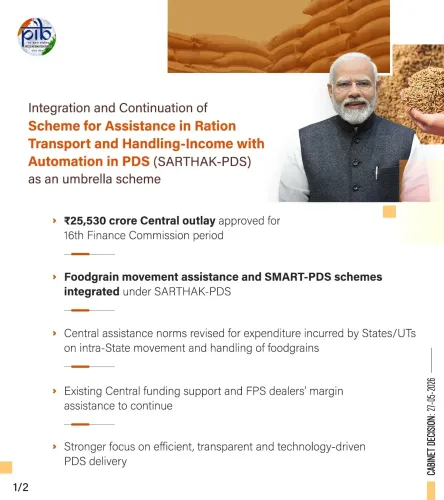
SARTHAK PDS scheme gets ₹25,530 crore Cabinet nod for next 5 years
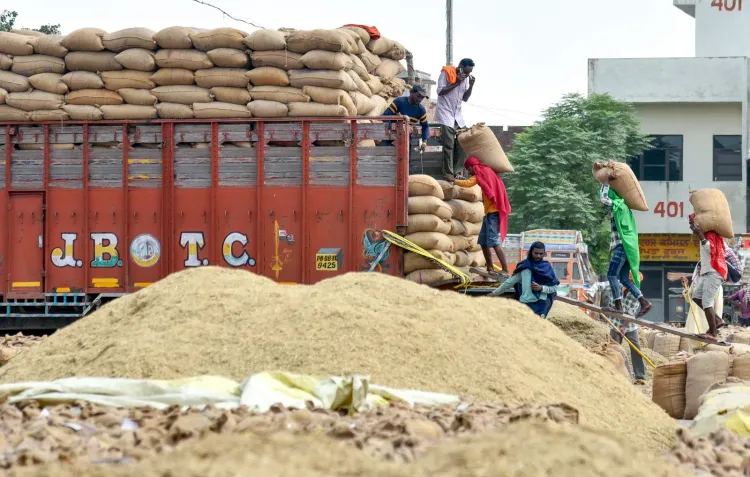
Synopsis
The Centre has committed ₹25,530 crore to overhaul India's public food distribution system through 2031, merging two existing schemes into SARTHAK PDS — a unified, AI- and blockchain-powered architecture aimed at plugging leakages and delivering rations to 81.35 crore people. The scale of the technology ambition is new; the execution track record will determine whether it stays that way.
Key Takeaways
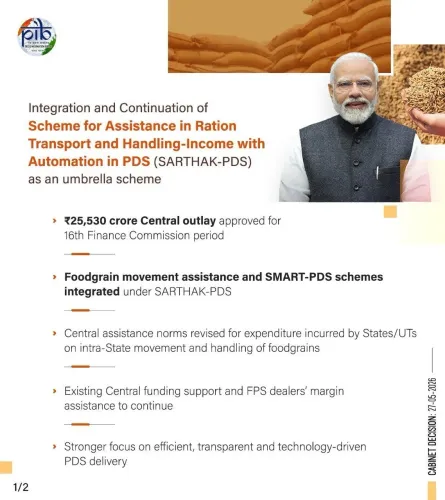
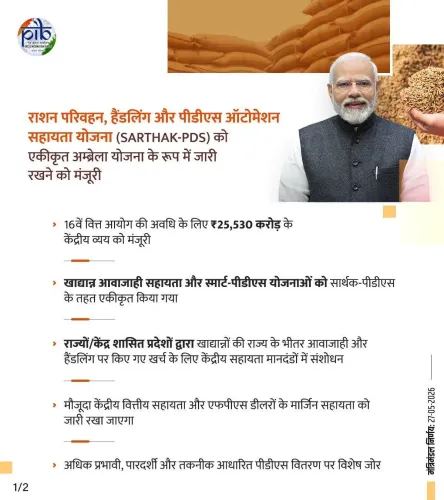
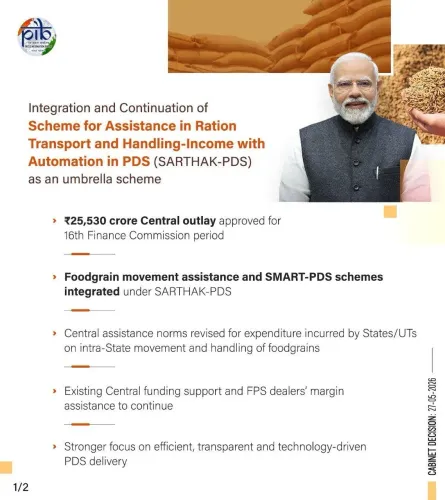
The CCEA , chaired by PM Modi , approved SARTHAK PDS on 27 May with a Centre's outlay of ₹25,530 crore .
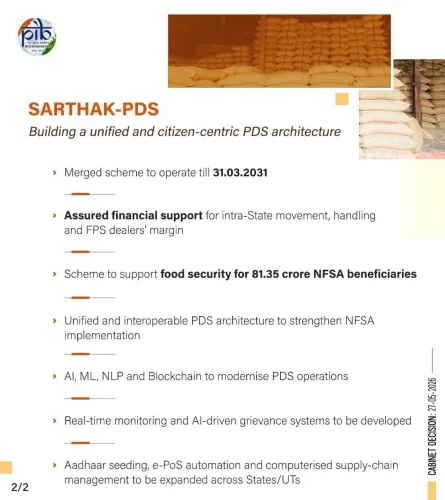
The scheme runs through 31 March 2031 , covering the 16th Finance Commission cycle award period.
It merges two existing schemes — intra-state foodgrain movement assistance and SMART PDS — into a single umbrella programme.
Technology backbone includes AI, ML, NLP, and Blockchain , with State Command Control Centres for real-time oversight.
The scheme covers 81.35 crore persons under the National Food Security Act, 2013 .
All 36 states and UTs are already onboarded under the predecessor SMART PDS since 1 April 2023 .
The Cabinet Committee on Economic Affairs (CCEA), chaired by Prime Minister Narendra Modi, on Wednesday, 27 May approved the SARTHAK PDS scheme — formally, the Scheme for Assistance in Ration Transport and Handling-Income with Automation in PDS — as an umbrella programme for the next five years, with a Centre's share outlay of ₹25,530 crore. The scheme will run through 31 March 2031 and is designed to comprehensively strengthen implementation of the National Food Security Act, 2013 (NFSA).
What SARTHAK PDS Covers
The scheme consolidates two existing programmes: 'Assistance to State Agencies for intra-State movement of foodgrains and FPS dealers' margin under NFSA' and the 'Scheme for Modernisation and Reforms through Technology in Public Distribution System (SMART PDS)'. By merging these under a single umbrella during the 16th Finance Commission cycle award period, the Centre aims to eliminate duplication and sharpen delivery at the last mile.
The CCEA also revised the norms of Central assistance for expenditure incurred by states and Union Territories on intra-state movement, handling of foodgrains, and Fair Price Shop (FPS) dealers' margin, while continuing the existing funding pattern, according to an official statement.
Technology at the Core
SARTHAK PDS is built around advanced technologies including Artificial Intelligence (AI), Machine Learning (ML), Natural Language Processing (NLP), and Blockchain. The architecture envisages standardised unified databases for real-time monitoring, AI-driven grievance redressal and analytics systems, and State Command Control Centres for data-driven oversight. ISO-certified process frameworks are also planned to ensure transparency, security, and sustainability in PDS operations.
Notably, this is not a fresh start — it builds on over a decade of digitisation work. Since 1 April 2023, the SMART PDS scheme has enabled complete digitisation of ration cards, Aadhaar seeding, FPS automation through e-PoS devices, online allocation, and computerised supply-chain management across all 36 states and Union Territories. Citizen-facing tools such as Mera Ration, Anna Mitra, the Rightful Targeting Dashboard, and Anna Sahayata have also been deployed under earlier iterations.
Who It Affects
The scheme directly serves 81.35 crore persons covered under the NFSA — roughly two-thirds of India's population. For this group, SARTHAK PDS promises assured financial support for intra-state movement and handling of foodgrains, a unified citizen-centric PDS architecture, and a sharper focus on minimising leakages that have historically undermined food security outcomes.
What Happens Next
With Cabinet approval secured, the scheme is expected to move into implementation mode across states and UTs. The revised Central assistance norms will govern disbursements to state agencies, with the merged programme operational until 31 March 2031. The integration of AI and blockchain-based oversight systems is likely to be rolled out in phases, with State Command Control Centres serving as the nodal monitoring infrastructure. Whether the technology ambitions translate into measurable reductions in leakage will be the key performance test for this scheme.
Point of View
At its core, a consolidation play — merging two overlapping schemes and adding a technology veneer. The ₹25,530 crore outlay is substantial, but the harder question is whether AI and blockchain integration will actually reduce leakages in a system where the problem has historically been political economy, not data architecture. India has digitised ration cards, seeded Aadhaar, and deployed e-PoS across 36 states — yet leakages persist. The scheme's real test is not the launch announcement but the audit outcomes by 2028. Without independent leakage measurement tied to disbursement conditions, this risks being a technology upgrade that leaves the structural problem untouched.
NationPress
13 Oct 2026
Frequently Asked Questions
What is the SARTHAK PDS scheme approved by the Cabinet?
SARTHAK PDS — Scheme for Assistance in Ration Transport and Handling-Income with Automation in PDS — is an umbrella scheme approved by the CCEA on 27 May with a ₹25,530 crore Centre's share outlay for five years through 31 March 2031. It merges two earlier schemes to strengthen delivery of food security under the National Food Security Act, 2013.
How many people will benefit from SARTHAK PDS?
The scheme covers 81.35 crore persons enrolled under the National Food Security Act, 2013 — roughly two-thirds of India's population who are entitled to subsidised foodgrains through the Public Distribution System.
What technologies will SARTHAK PDS use?
The scheme will deploy Artificial Intelligence, Machine Learning, Natural Language Processing, and Blockchain to create unified databases, AI-driven grievance systems, and State Command Control Centres for real-time monitoring. ISO-certified process frameworks are also planned for transparency and sustainability.
How does SARTHAK PDS differ from SMART PDS?
SMART PDS, operational since 1 April 2023, focused on digitisation of ration cards, Aadhaar seeding, and e-PoS automation. SARTHAK PDS absorbs SMART PDS and the intra-state movement assistance scheme into a single umbrella, adding AI and blockchain layers and revised Central assistance norms for states and UTs.
When will the SARTHAK PDS scheme be operational until?
The scheme is approved for the 16th Finance Commission cycle award period and will operate through 31 March 2031, covering all 36 states and Union Territories.