Cabinet Approves SARTHAK-PDS With ₹25,530 Cr Outlay
Synopsis
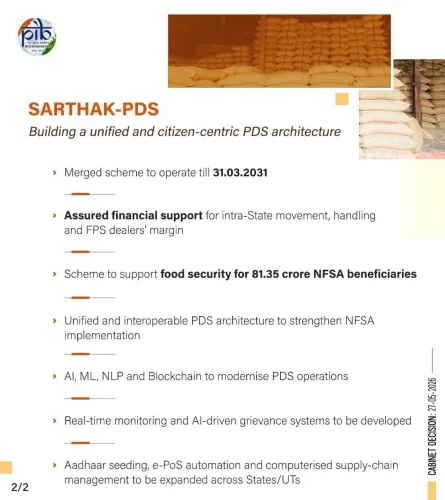
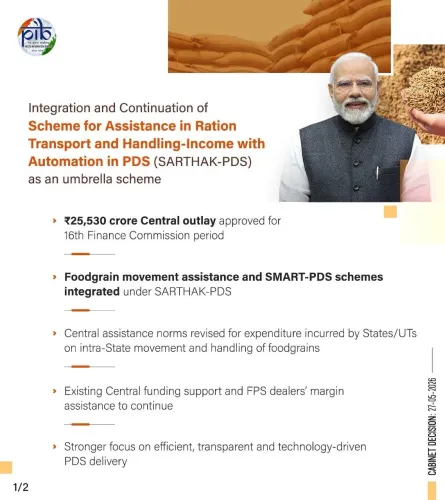
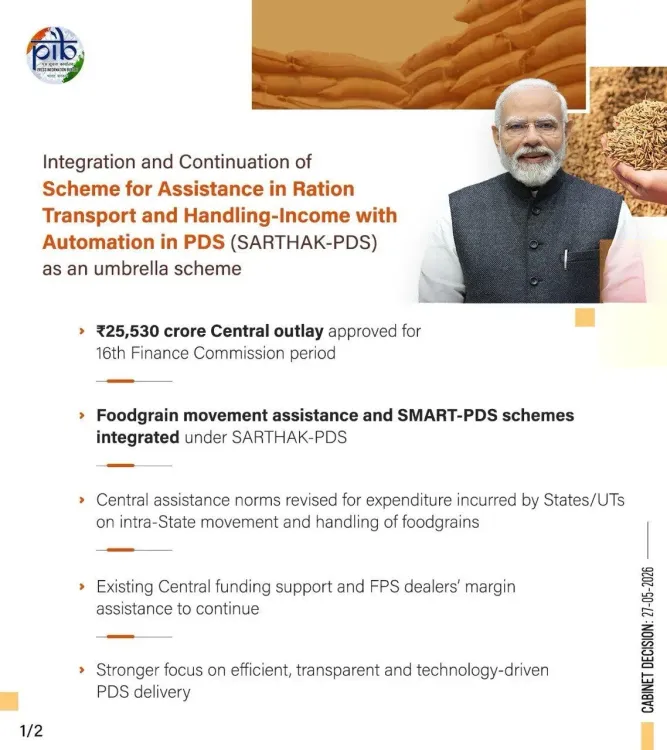
The Union Cabinet has approved SARTHAK-PDS, an umbrella scheme for ration transport, handling, and PDS automation, with a ₹25,530 crore central outlay running through 31 March 2031. The scheme integrates AI, ML, NLP, and blockchain to cut leakages and strengthen last-mile food delivery under the National Food Security Act.
Key Takeaways
The Union Cabinet , chaired by PM Narendra Modi , approved the continuation of SARTHAK-PDS on 27 May 2026 .
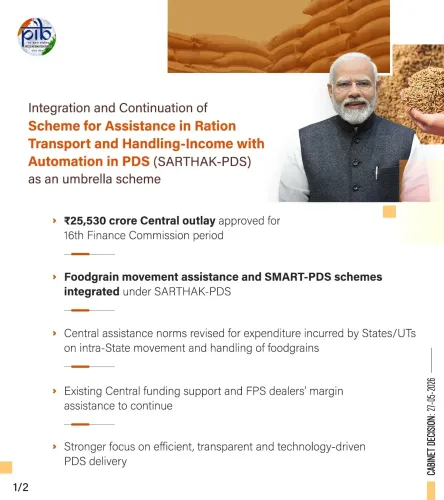
Total central outlay is ₹25,530 crore for the award period of the 16th Finance Commission .
The scheme will be operational through 31 March 2031 .
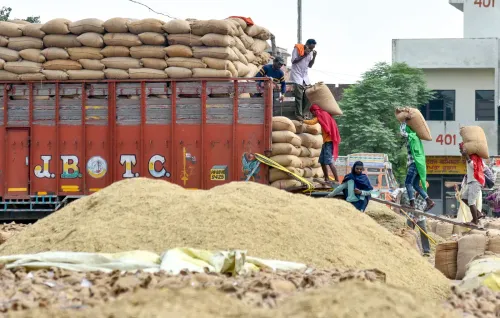
It covers assured financial support for intra-state ration transport, handling costs, and FPS dealer margins .
Technology integration includes AI, ML, NLP, and Blockchain for real-time monitoring, grievance redressal, and analytics.
State-level Command and Control Centres and ISO-certified process frameworks are envisaged to standardise PDS governance nationwide.
Union Road Transport and Highways Minister Nitin Gadkari announced on Wednesday, 27 May 2026 that the Union Cabinet, chaired by Prime Minister Narendra Modi, has approved the continuation of the SARTHAK-PDS scheme — formally titled 'Scheme for Assistance in Ration Transport and Handling – Integrated with Automation in PDS' — as an umbrella scheme for the award period of the 16th Finance Commission, carrying a total central outlay of ₹25,530 crore.
Context
The Cabinet decision extends and consolidates central government support for the Public Distribution System (PDS), the nationwide network of Fair Price Shops (FPS) that delivers subsidised food grains to eligible households under the National Food Security Act, 2013. The scheme will remain operational through 31 March 2031, aligning its lifecycle with the forthcoming Finance Commission award cycle.
As Gadkari's post states, SARTHAK-PDS is designed to 'ensure assured financial support for intra-State movement, handling, and FPS dealer margins' while establishing 'a unified, citizen-centric, intelligent, and interoperable PDS architecture that strengthens last-mile delivery, minimizes leakages, and reinforces the nation's commitment to food security.'
Policy Backdrop
The approval is the latest step in a decade-long effort to digitise and de-leak India's food subsidy chain. The journey began with Aadhaar-seeding of beneficiary databases from 2014 onward and accelerated with the One Nation One Ration Card initiative in 2019, which enabled inter-state portability of ration entitlements. The Integrated Management of Public Distribution System (IM-PDS) scheme, approved in 2018, laid the groundwork for end-to-end computerisation that SARTHAK-PDS now seeks to advance.
What distinguishes the new approval is the explicit integration of frontier technologies. The scheme envisions deploying Artificial Intelligence (AI), Machine Learning (ML), Natural Language Processing (NLP), and Blockchain across PDS operations — a significant escalation from the earlier emphasis on biometric authentication and point-of-sale terminals alone.
Stakeholders and Impact
The primary beneficiaries are the hundreds of millions of households covered under the National Food Security Act, for whom reliable last-mile delivery is a direct livelihood concern. FPS dealers stand to gain from the assured margin support embedded in the scheme's financial design, addressing a long-standing grievance about delayed and inadequate reimbursements from state governments.
State food departments will be central to implementation: the scheme envisages State-level Command and Control Centres for data-driven governance, along with ISO-certified process frameworks to standardise operations across the country. AI-enabled grievance redressal and real-time analytics are positioned as tools to reduce the diversion and leakage that successive audit reports have flagged in the PDS.
The ₹25,530 crore central outlay will underwrite intra-state transport and handling costs — expenses that states have historically struggled to absorb without central support, particularly in geographically challenging regions.
What's Next
Attention will now shift to the Department of Food and Public Distribution, which is expected to issue operational guidelines covering interoperability standards, procurement norms for AI and ML tools, and timelines for establishing state command centres. States will need to float requests for proposals for the technology components, a process that will test both administrative capacity and political will.
With the scheme running to 2031 and anchored to the 16th Finance Commission cycle, SARTHAK-PDS sets the structural terms for food-subsidy delivery through the end of the decade — making its implementation fidelity a key indicator of whether India's welfare technology ambitions translate into measurable gains for its most food-insecure citizens.
Point of View
The Cabinet is signalling that technology-enabled welfare delivery is now a permanent architectural feature rather than a pilot. The emphasis on state command centres mirrors a broader governance pattern — centralising data visibility while leaving operational responsibility with states — which has produced mixed results in health and scholarship programmes. The real test will be whether the interoperability standards and ISO frameworks translate into measurable reductions in diversion, or remain aspirational benchmarks in official documents.
NationPress
11 Oct 2026
Frequently Asked Questions
What is the SARTHAK-PDS scheme?
SARTHAK-PDS stands for 'Scheme for Assistance in Ration Transport and Handling – Integrated with Automation in PDS.' It is an umbrella central government scheme that provides financial support for intra-state ration transport, handling costs, and Fair Price Shop dealer margins, while also funding the technological modernisation of the Public Distribution System through AI, ML, NLP, and blockchain.
How much money has been approved for SARTHAK-PDS?
The Union Cabinet approved a total central outlay of ₹25,530 crore for SARTHAK-PDS for the award period of the 16th Finance Commission.
How long will the SARTHAK-PDS scheme run?
The scheme will be operational through 31 March 2031 , covering the full award period of the 16th Finance Commission.
What technologies will be used under SARTHAK-PDS?
The scheme envisions integrating Artificial Intelligence (AI), Machine Learning (ML), Natural Language Processing (NLP), and Blockchain into PDS operations, along with State-level Command and Control Centres, unified databases, and ISO-certified process frameworks for real-time monitoring and governance.
Who benefits from the SARTHAK-PDS scheme?
The primary beneficiaries are households entitled to subsidised food grains under the National Food Security Act, 2013 . Fair Price Shop dealers also benefit from assured margin support, while state food departments gain technology infrastructure for data-driven governance.