Khattar: Cabinet Clears ₹25,530 Cr SARTHAK PDS Scheme
Synopsis
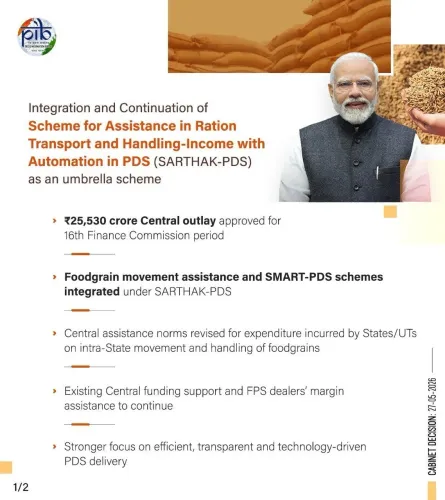
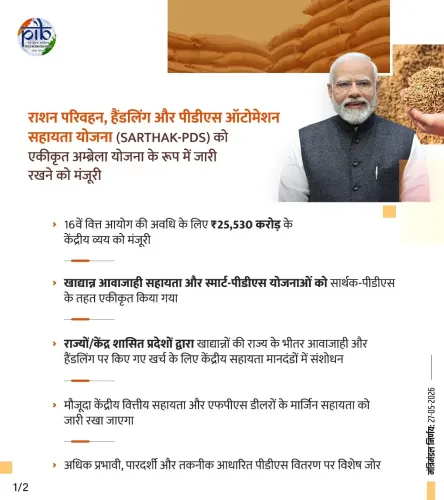
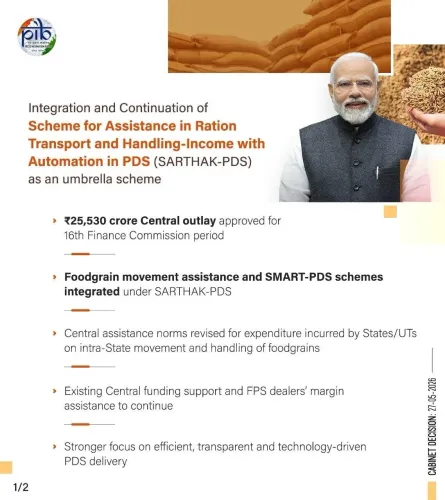
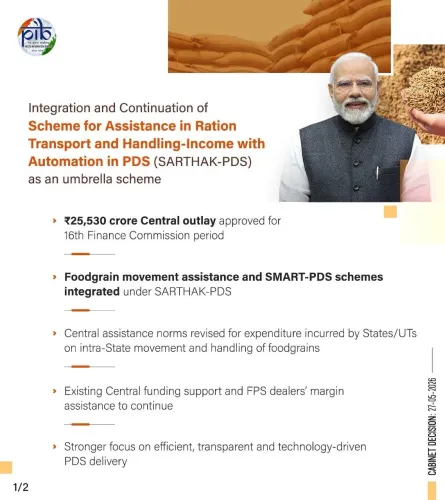
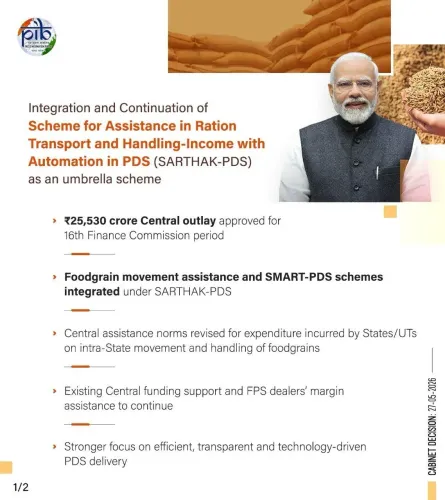
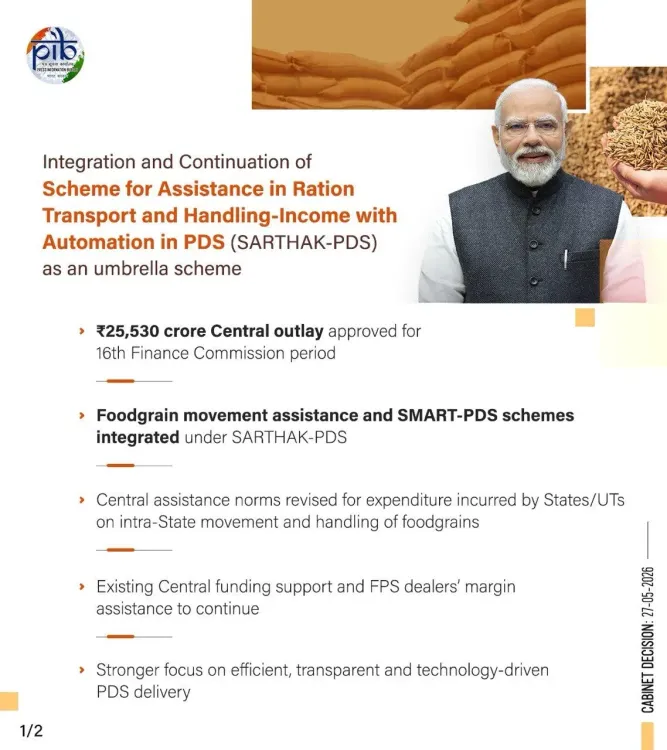
The Union Cabinet has approved continuation of the SARTHAK PDS umbrella scheme with a ₹25,530 crore central outlay for the 16th Finance Commission period, revising norms for foodgrain transport, handling costs, and Fair Price Shop dealer margins across States and UTs.
Key Takeaways
The Union Cabinet, chaired by PM Narendra Modi , approved continuation of the SARTHAK PDS umbrella scheme on 27 May 2026 .
The central financial outlay approved is ₹25,530 crore for the 16th Finance Commission period (2026–27 onwards) .
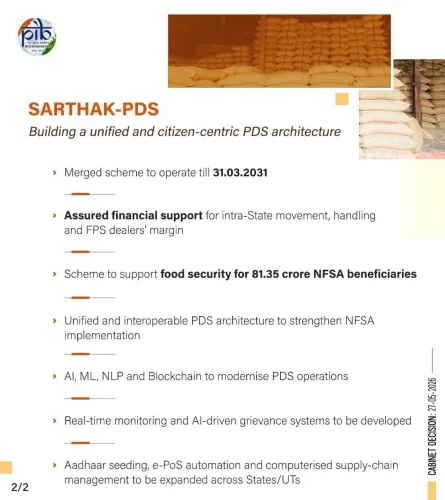
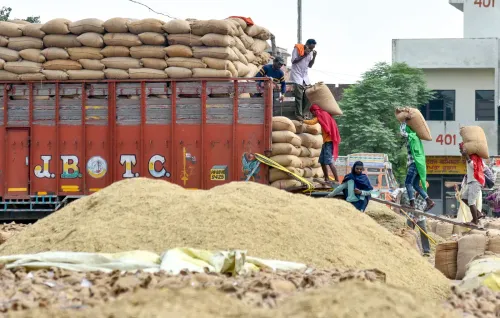
The scheme covers central assistance for intra-state movement and handling of foodgrains and FPS dealer margins .
Revised norms for central assistance have been approved alongside continuation of the existing funding pattern for States and Union Territories .
The scheme integrates automation in PDS as a core objective, aimed at reducing leakages and improving last-mile delivery.
The decision ensures continuity from the 15th Finance Commission period (2021–26) without a funding gap for state food departments.
Union Power Minister Manohar Lal Khattar announced on Wednesday, 27 May 2026 that the Union Cabinet, chaired by Prime Minister Narendra Modi, has approved the continuation of the SARTHAK PDS umbrella scheme with a central outlay of ₹25,530 crore for the 16th Finance Commission period. The scheme — formally titled 'Scheme for Assistance in Ration Transport and Handling - Income with Automation in PDS' — supports the logistics, handling, and automation of India's Public Distribution System.
Context
Khattar posted the cabinet decision on X, noting that the approval covers revised norms for central assistance towards intra-state movement and handling of foodgrains, margins for Fair Price Shop (FPS) dealers, and continuation of the existing funding pattern for States and Union Territories. The post linked to an official Press Information Bureau release confirming the decision. The scheme's full name embeds its dual mandate: improving transport and handling economics for ration distribution while driving automation in the PDS network.
Policy Backdrop
The National Food Security Act, 2013, established the legal architecture for subsidised foodgrain distribution across India, creating obligations for the Centre and states to maintain an efficient supply chain from procurement to doorstep delivery. Central assistance for intra-state movement and handling was operational during the 15th Finance Commission period (2021–26), and the cabinet's action ensures seamless continuation into the next five-year cycle beginning 2026–27, avoiding any funding gap for state food departments. The revision of norms — particularly on FPS dealer margins — reflects an acknowledgment that logistics costs and dealer compensation must keep pace with inflation and operational realities.
The SARTHAK umbrella design consolidates multiple support streams — transport subsidies, handling charges, dealer margins, and automation investments — under a single administrative framework. This mirrors the Centre's broader move across welfare ministries to rationalise scheme architecture and improve fund-flow accountability to states.
Stakeholders and Impact
The most direct beneficiaries are the estimated 80 crore-plus individuals covered under the National Food Security Act who depend on the PDS for subsidised rice, wheat, and other commodities. Fair Price Shop dealers — the last-mile agents of the system — stand to gain from the revised margin norms, addressing long-standing complaints that their compensation had not kept up with operating costs. State food and civil supplies departments benefit from predictable multi-year central funding, allowing them to plan procurement logistics without annual uncertainty. The automation component, embedded in the scheme's title and design, is aimed at reducing leakages and diversion through digitised beneficiary verification and electronic point-of-sale systems at FPS outlets.
What's Next
Attention will now turn to the issuance of detailed operational guidelines to states, which will specify the revised cost-sharing ratios, eligible expenditure heads, and automation benchmarks for the 16th Finance Commission cycle. Any mid-term review of PDS automation targets — particularly the pace of e-PoS device deployment and Aadhaar-based biometric authentication at fair price shops — will be a key indicator of whether the scheme's efficiency goals are being met. States with historically lower PDS automation rates will face pressure to accelerate compliance to unlock the full central assistance on offer.
Point of View
And whose grievances have periodically surfaced in state-level politics. Embedding automation as a named component of the scheme signals that the Centre intends to use funding leverage to push states toward digitised beneficiary verification, a reform that has faced uneven adoption. Taken together, the approval fits a pattern of the Modi government using Finance Commission cycles as anchors for welfare-scheme architecture, ensuring predictable central transfers while building in performance conditions around technology adoption.
NationPress
10 Oct 2026
Frequently Asked Questions
What is the SARTHAK PDS scheme?
SARTHAK PDS stands for 'Scheme for Assistance in Ration Transport and Handling - Income with Automation in PDS.' It is an umbrella scheme under which the Central government provides financial assistance to States and UTs for the intra-state movement and handling of foodgrains, Fair Price Shop dealer margins, and automation of the Public Distribution System.
How much money has been approved for SARTHAK PDS?
The Union Cabinet approved a central outlay of ₹25,530 crore for the continuation of the SARTHAK PDS scheme during the 16th Finance Commission period, which begins from 2026–27.
What is the 16th Finance Commission period?
The 16th Finance Commission period refers to the five-year fiscal cycle beginning 2026–27 , for which the Finance Commission recommends the devolution of taxes and grants from the Centre to states. The SARTHAK PDS scheme has been approved for continuation through this entire period.
Who are Fair Price Shop dealers and why does their margin matter?
Fair Price Shop (FPS) dealers are the licensed retailers — often called 'ration shop owners' — who distribute subsidised foodgrains to beneficiaries under the National Food Security Act. Their dealer margin is the commission paid by the government for this service, and revising it upward helps ensure their continued participation and financial viability in the PDS supply chain.
How does PDS automation help reduce leakages?
PDS automation, primarily through electronic Point-of-Sale (e-PoS) devices and Aadhaar-based biometric authentication at fair price shops, ensures that only genuine, verified beneficiaries receive their entitled quota. This reduces ghost beneficiaries, duplicate entries, and diversion of subsidised foodgrains to the open market.