Cabinet Approves SARTHAK-PDS Scheme Continuation
Synopsis
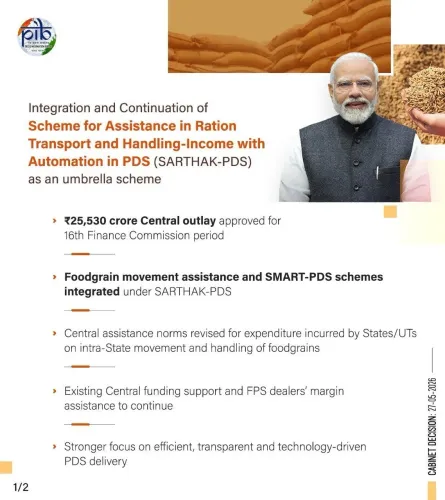
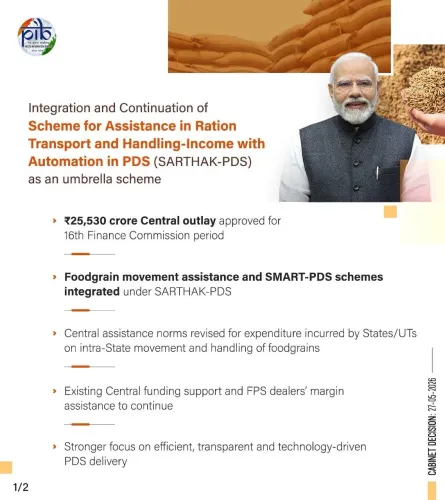
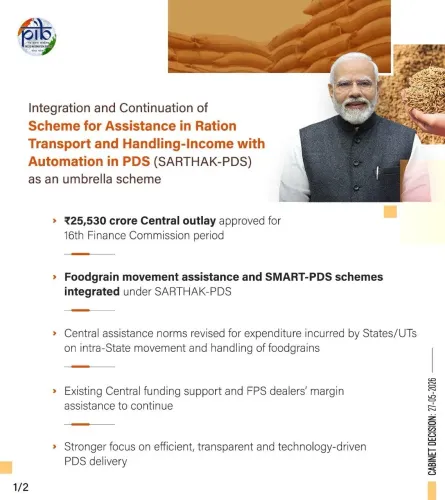
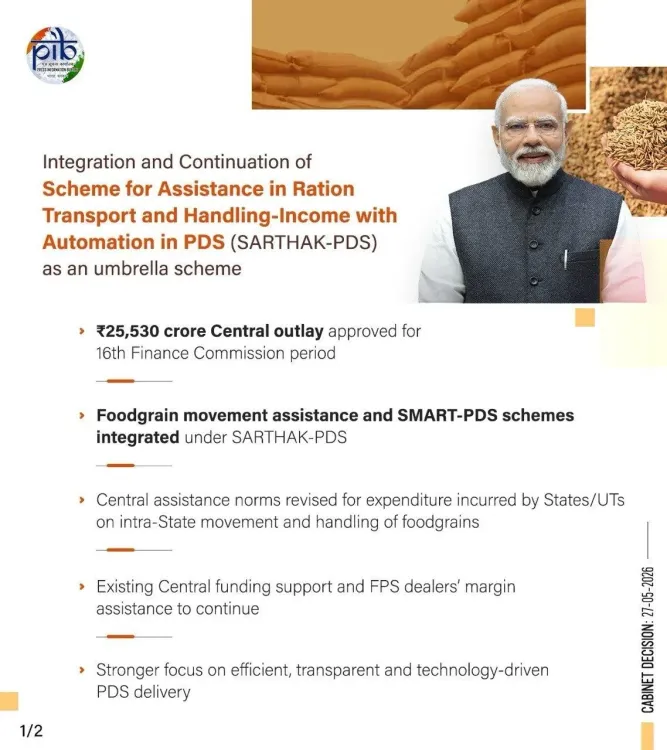
The Union Cabinet led by PM Narendra Modi has approved continuation of the SARTHAK-PDS Scheme, which provides financial support for intra-state foodgrain transport, FPS dealer margins, and establishes an interoperable PDS architecture to curb leakages and strengthen food security under the National Food Security Act.
Key Takeaways
The Union Cabinet approved continuation of the SARTHAK-PDS Scheme on 27 May 2026 .
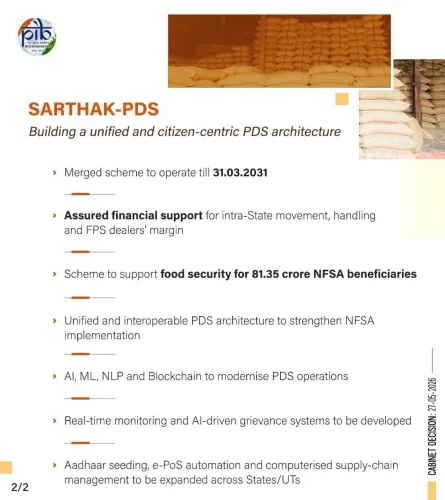
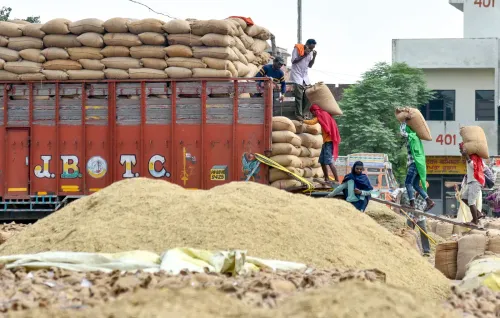
The scheme provides assured financial support for intra-state foodgrain movement, handling, and FPS dealer margins .
It mandates a unified, interoperable PDS architecture to minimise leakages and ensure last-mile delivery.
The scheme is anchored in the National Food Security Act (NFSA), 2013 , which entitles a large share of India's population to subsidised foodgrains.
FPS dealers and NFSA beneficiaries are the primary stakeholders to benefit from the continuation.
State-level rollout and integration with the One Nation One Ration Card platform will be key implementation milestones to watch.
Union Finance Minister Nirmala Sitharaman announced on Wednesday, 27 May 2026 that the Union Cabinet, led by Prime Minister Narendra Modi, has approved the continuation of the SARTHAK-PDS Scheme — formally titled the 'Scheme for Assistance in Ration Transport and Handling-Income with Automation in PDS' — aimed at strengthening food security infrastructure across India.
Context
The cabinet decision green-lights the continuation of SARTHAK-PDS, a centrally driven initiative designed to provide assured financial support for intra-state movement, handling of foodgrains, and margins for Fair Price Shop (FPS) dealers. The scheme also mandates the creation of a unified, citizen-centric, intelligent, and interoperable Public Distribution System (PDS) architecture to ensure last-mile delivery of subsidised foodgrains.
Sitharaman posted on X, stating the scheme 'aims to provide assured financial support for intra-State movement, handling, and FPS dealers' margins' and 'establishes a unified, citizen-centric, intelligent and interoperable PDS architecture to ensure last-mile service delivery, minimize leakages and strengthen food security under the NFSA.'
Policy Backdrop
The National Food Security Act (NFSA), enacted in 2013, legally entitles a large share of India's population to subsidised foodgrains through the PDS — making it the statutory backbone of the country's food welfare architecture. SARTHAK-PDS is positioned as a direct instrument to operationalise the NFSA's last-mile delivery mandate.
The approval reflects a broader pattern of the central government extending time-bound schemes that combine financial assistance to last-mile functionaries — such as FPS dealers — with technology upgrades aimed at interoperability and transparency. This continues a digitisation drive in the PDS that has included Aadhaar seeding, computerisation of ration shops, and the One Nation One Ration Card initiative, all aimed at curbing leakages in the welfare delivery chain.
Stakeholders and Impact
FPS dealers, who serve as the final link in the foodgrain distribution chain, stand to benefit directly through the assured margin support built into the scheme. NFSA beneficiaries — hundreds of millions of Indians dependent on subsidised rations — are the intended end-beneficiaries of the improved delivery architecture.
By targeting leakages and mandating an interoperable system, the scheme seeks to reduce diversions of subsidised grain and ensure that entitlements reach intended households. The emphasis on automation and a 'citizen-centric' design signals an intent to reduce manual intervention points where pilferage has historically occurred.
What's Next
Attention will now turn to state-level rollout timelines, given that intra-state transport and handling fall within the administrative domain of individual state governments. Integration milestones with existing e-PDS infrastructure and the One Nation One Ration Card platform will be closely watched as indicators of on-ground implementation progress.
The cabinet's endorsement signals continued federal commitment to food security spending, and the interoperability mandate could pave the way for deeper convergence between central and state-level welfare delivery systems in the months ahead.
Point of View
The scheme addresses both the political economy of ration shop operators and the administrative goal of a traceable supply chain. The explicit reference to a 'citizen-centric' architecture signals alignment with the government's broader digital public infrastructure narrative. The real test, however, will be whether states — which control intra-state logistics — move in step with the centre's automation timeline.
NationPress
11 Oct 2026
Frequently Asked Questions
What is the SARTHAK-PDS Scheme?
SARTHAK-PDS stands for 'Scheme for Assistance in Ration Transport and Handling-Income with Automation in PDS.' It provides assured financial support for intra-state foodgrain movement, handling costs, and margins for Fair Price Shop dealers, while also building an interoperable digital architecture for the Public Distribution System.
Why did the Cabinet approve the continuation of SARTHAK-PDS?
The Union Cabinet approved the continuation to sustain financial support for last-mile foodgrain delivery infrastructure and to advance the automation and interoperability of the PDS under the National Food Security Act, with the goal of minimising leakages and ensuring subsidised rations reach intended beneficiaries.
Who are the main beneficiaries of the SARTHAK-PDS Scheme?
The primary beneficiaries are Fair Price Shop (FPS) dealers, who receive assured margin support, and NFSA beneficiaries — the hundreds of millions of Indians entitled to subsidised foodgrains under the National Food Security Act, 2013.
What is the connection between SARTHAK-PDS and One Nation One Ration Card?
Both initiatives are part of the central government's broader effort to digitise and interoperate the PDS. SARTHAK-PDS's mandate for a unified, interoperable architecture is expected to complement the One Nation One Ration Card platform, which allows beneficiaries to access rations from any FPS in the country.
What does 'minimising leakages' in PDS mean?
Leakages in the PDS refer to the diversion or pilferage of subsidised foodgrains before they reach entitled beneficiaries. Automation, Aadhaar seeding, and interoperable systems are used to create traceable supply chains that reduce opportunities for such diversions.