Cabinet Extends SARTHAK-PDS for 5 Years at ₹25,530 Cr
Synopsis
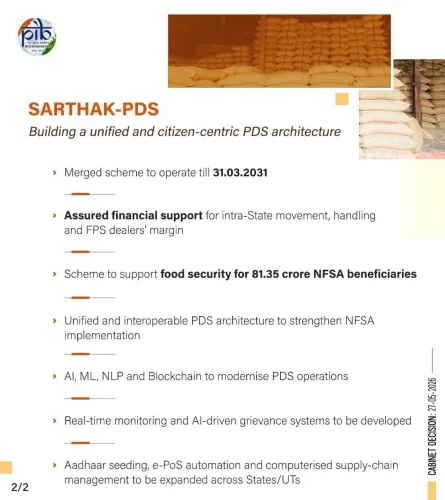
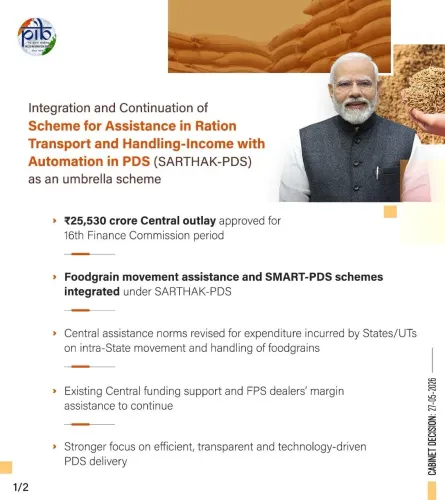
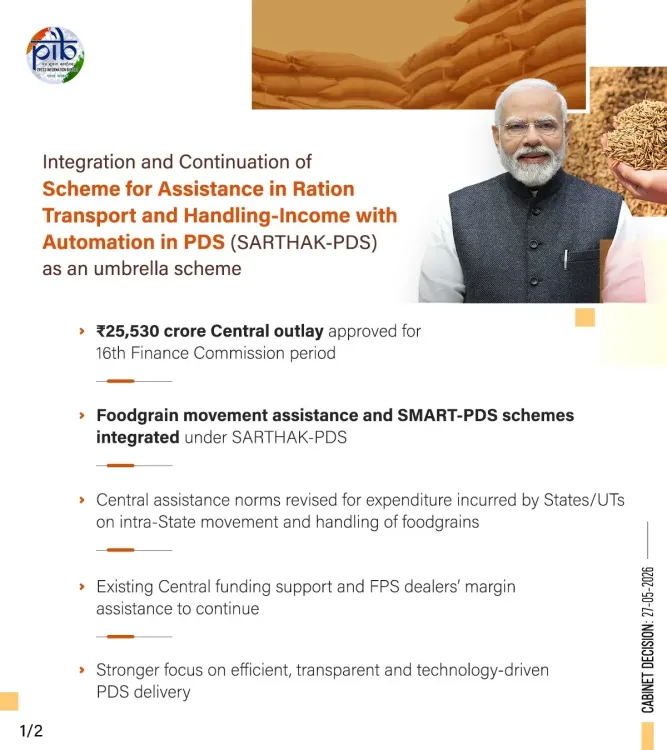
The Union Cabinet chaired by PM Modi has approved ₹25,530 crore to extend and modernise SARTHAK-PDS for five years, introducing AI-based beneficiary registration and greater state support — covering over 80 crore Indians under the world's largest food security programme.
Key Takeaways
The Union Cabinet , chaired by PM Narendra Modi , approved the extension of SARTHAK-PDS on 27 May 2026 .
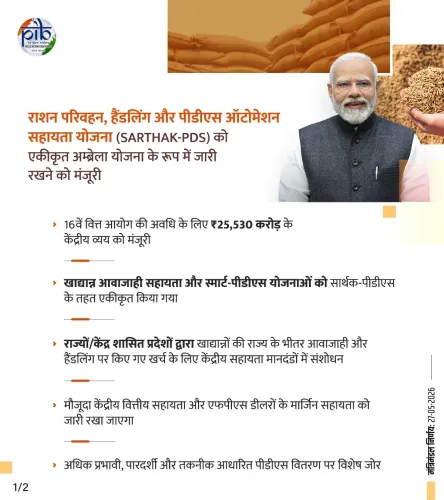
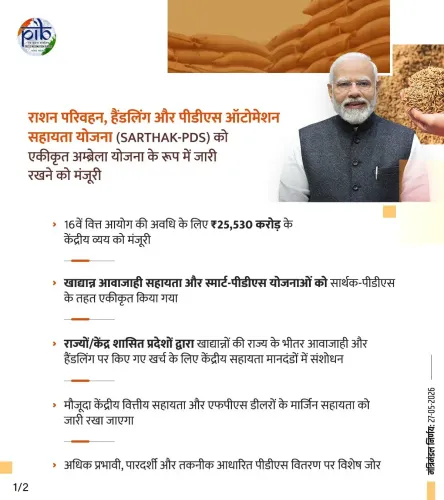
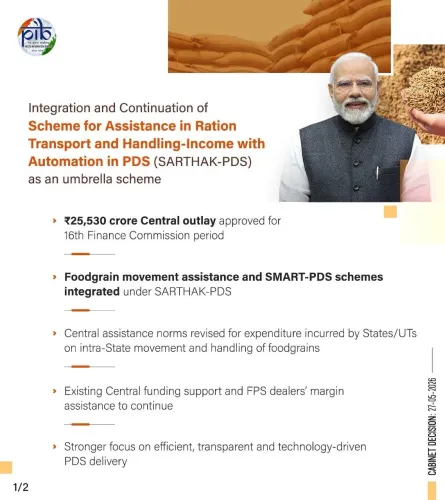
The scheme will be extended for five years at a total cost of ₹25,530 crore .
The PDS serves over 80 crore people , making it the world's largest food security programme.
Three major reforms include support to state governments , technology integration, and AI-based beneficiary registration .
The decision builds on prior reforms including Aadhaar integration and ePoS deployment at fair-price shops since 2014.
State-level rollout timelines and Budget allocations will be key markers to watch in the coming months.
The Chief Minister's Office of Gujarat announced on Wednesday, 27 May 2026 that the Union Cabinet, chaired by Prime Minister Narendra Modi, has approved a landmark decision to modernise and extend India's Public Distribution System (PDS) — the world's largest food security programme — for the next five years under a revamped scheme called SARTHAK-PDS, at a total outlay of ₹25,530 crore.
Context
The post, shared by the CMO Gujarat account, states that the Cabinet decision will make the ration distribution system 'વધુ આધુનિક અને પારદર્શક' ('more modern and transparent') and will extend the scheme for the next five years. The PDS currently serves over 80 crore people across India, making it the single largest food-security programme in the world. The decision was taken at a Cabinet meeting presided over by PM Modi.
The announcement specifies three major reforms under SARTHAK-PDS: enhanced support to state governments, greater use of technology within the distribution chain, and — most notably — the use of Artificial Intelligence (AI) for registering PDS beneficiaries.
Policy Backdrop
India's PDS draws its legal foundation from the National Food Security Act (NFSA), 2013, which entitles up to 75 per cent of rural households and 50 per cent of urban households to subsidised food grains. The Act brought roughly 80 crore citizens under a statutory food-entitlement framework for the first time.
Since 2014, successive Cabinet decisions have progressively integrated Aadhaar authentication and electronic Point-of-Sale (ePoS) devices into fair-price shops to curb diversion and ghost beneficiaries. The Pradhan Mantri Garib Kalyan Anna Yojana (PMGKAY), launched in 2020 during the pandemic, layered additional free-ration support on top of NFSA entitlements and was extended through 2023-24. The current SARTHAK-PDS decision continues this multi-year, technology-augmented funding pattern.
Stakeholders and Impact
State governments are direct beneficiaries of the new framework, which promises dedicated financial and administrative support for rolling out the upgraded system. For the 80 crore-plus PDS beneficiaries — predominantly from low-income rural and urban households — the reforms are aimed at reducing exclusion errors and making entitlement access more seamless.
The introduction of AI-based beneficiary registration marks a significant shift from the current Aadhaar-seeding model, potentially enabling real-time deduplication and faster onboarding of newly eligible households. Technology-sector partners and state food-and-civil-supplies departments will be key implementation actors in the five-year roadmap.
What's Next
Attention will now turn to the state-level rollout timelines for AI-driven registration and the phased release of the ₹25,530 crore outlay. Observers will also watch whether supplementary allocations appear in the next Union Budget to front-load the modernisation drive. The success of the reform will ultimately hinge on how quickly states can integrate AI tools into existing fair-price-shop infrastructure and whether the technology reduces the chronic problem of beneficiary exclusion that has dogged the PDS for decades.
Point of View
Moving from Aadhaar-seeding to AI-driven registration. The five-year, ₹25,530 crore commitment signals that the Centre views PDS modernisation as a durable governance priority rather than a crisis-response measure. Anchoring the reform in AI-based enrolment is politically significant — it frames the welfare state as technologically forward-looking ahead of state elections in several large beneficiary-heavy states. The real test, however, will be whether state governments can absorb and operationalise the new tools at the last-mile fair-price-shop level.
NationPress
14 Sept 2026
Frequently Asked Questions
What is SARTHAK-PDS?
SARTHAK-PDS is the revamped Public Distribution System scheme approved by the Union Cabinet in May 2026, aimed at making ration distribution more modern and transparent over a five-year period at a cost of ₹25,530 crore.
How much money has the government approved for SARTHAK-PDS?
The Union Cabinet has approved an outlay of ₹25,530 crore for the five-year extension and modernisation of SARTHAK-PDS.
How many people benefit from India's PDS ration scheme?
Over 80 crore people across India receive subsidised food grains through the Public Distribution System, making it the world's largest food security programme.
What are the three major reforms under SARTHAK-PDS?
The three reforms are: enhanced financial and administrative support to state governments, greater use of technology in the distribution chain, and AI-based registration of PDS beneficiaries.
What is the legal basis for India's food security programme?
India's PDS is anchored in the National Food Security Act, 2013, which entitles up to 75 per cent of rural and 50 per cent of urban households to subsidised food grains.