CM Bhupendra Patel Hails Cabinet Nod for SARTHAK-PDS Modernisation
Synopsis
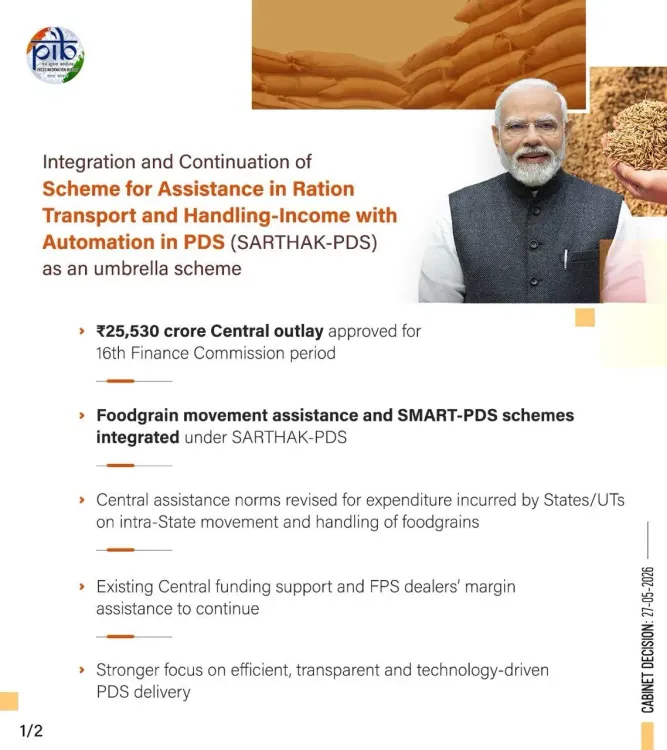
The Union Cabinet has approved the SARTHAK-PDS scheme with a ₹25,530 crore central outlay to modernise India's Public Distribution System using AI, GPS, and QR-based tools, benefiting nearly 80 crore people. Gujarat CM Bhupendra Patel welcomed the decision as a transformative step for food security.
Key Takeaways
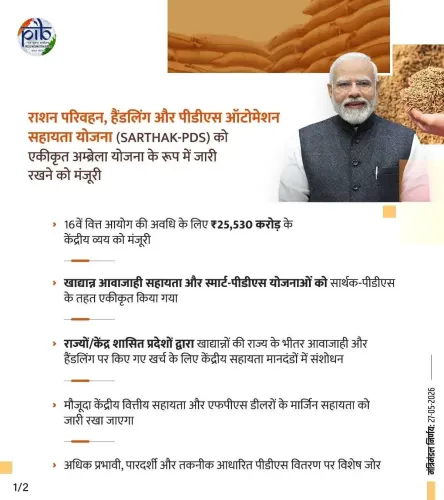
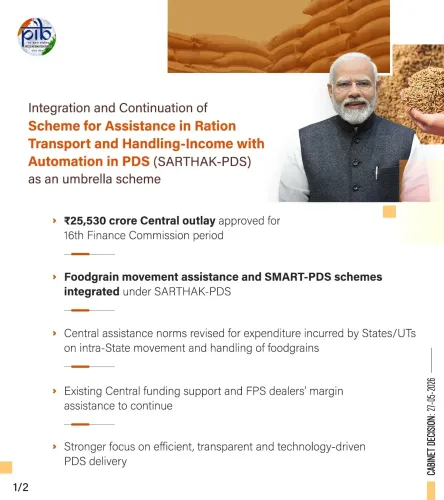
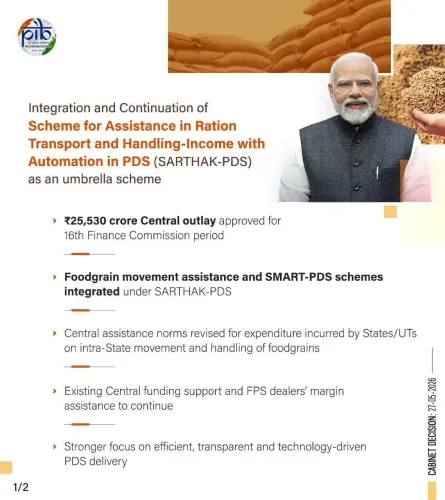
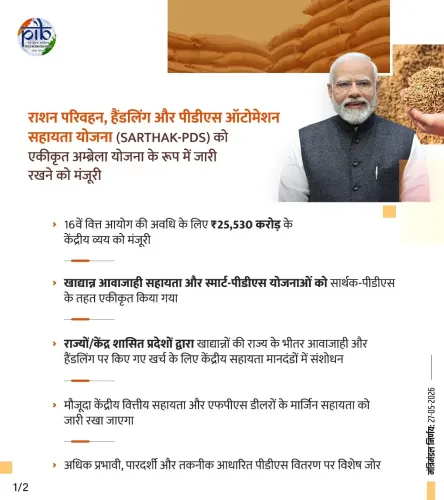
The Union Cabinet approved the continuation and modernisation of the SARTHAK-PDS scheme with a central outlay of ₹25,530 crore .
The scheme will deploy AI-enabled monitoring, GPS tracking, and QR-based supply-chain management across the Public Distribution System.
Nearly 80 crore beneficiaries covered under the National Food Security Act are expected to benefit.
Fair Price Shop dealers will receive improved financial and logistical assistance under the integrated scheme.
State governments will get strengthened central support for foodgrain transportation costs.
Gujarat CM Bhupendra Patel credited the decision to Prime Minister Narendra Modi 's leadership on 27 May 2026 .
Gujarat Chief Minister Bhupendra Patel on Wednesday, 27 May 2026 welcomed the Union Cabinet's approval for the continuation and modernisation of the SARTHAK-PDS scheme, calling it a major step towards strengthening India's food security system. The decision, backed by a central outlay of ₹25,530 crore, is aimed at deploying AI-enabled monitoring, GPS tracking, QR-based supply-chain management, and technology-driven grievance redressal across the Public Distribution System.
Context
Posting on X, CM Patel credited the decision to the 'visionary leadership' of Prime Minister Narendra Modi, stating that the integrated scheme will 'enhance transparency and efficiency in ration delivery' and benefit 'nearly 80 crore beneficiaries.' He also expressed gratitude to the Prime Minister for what he described as a 'transformative and citizen-centric' cabinet decision. The post came hours after the Union Cabinet meeting concluded in New Delhi.
Policy Backdrop
India's Public Distribution System has its legal foundation in the National Food Security Act, 2013, which entitles a large section of the population to subsidised foodgrains. End-to-end computerisation of the PDS was initiated from 2012 onwards, progressively adding Aadhaar seeding, electronic point-of-sale devices, and real-time monitoring to curb leakages and improve last-mile delivery. The SARTHAK-PDS scheme represents the latest phase in this long-running modernisation trajectory, layering artificial intelligence and GPS-based logistics tools onto an infrastructure that has been incrementally upgraded over more than a decade.
The announcement also addresses the operational economics of the distribution network. According to CM Patel's post, the scheme will 'improve assistance for Fair Price Shop dealers,' a constituency that has long sought better commission structures and logistical support from the central government.
Stakeholders and Impact
The most direct beneficiaries of the modernised scheme are the estimated 80 crore individuals covered under the National Food Security Act, for whom improved supply-chain visibility could mean fewer instances of short-weighing, ghost beneficiaries, or stock diversion. Fair Price Shop dealers — the frontline distributors who number in the lakhs across the country — stand to gain from enhanced logistical and financial support. State governments, which manage day-to-day PDS operations, are set to receive strengthened central assistance for foodgrain transportation, potentially easing a long-standing fiscal pressure point. Technology vendors and logistics firms capable of deploying AI and GPS solutions at scale are also likely to engage with the rollout process.
What's Next
Attention will now shift to state-level rollout timelines, as the effectiveness of any centrally approved scheme depends heavily on implementation capacity across diverse state administrations. Observers will also track how the ₹25,530 crore outlay is phased and whether utilisation certificates reflect on-ground progress. Any revision in Fair Price Shop dealer commission structures — a perennially contested issue — will be closely watched by dealer associations. The integration of AI-enabled monitoring and QR-based supply chains will serve as a test of whether technology can meaningfully close the gap between entitlement and delivery for India's most vulnerable food-security beneficiaries.
Point of View
The Centre is attempting to shift the PDS narrative from entitlement politics to efficiency governance. CM Patel's public endorsement signals that state BJP leaders are being mobilised to amplify the political dividend of central welfare decisions ahead of any electoral cycle. The real test, however, will be whether the ₹25,530 crore outlay translates into measurable reductions in leakage and improved dealer viability at the grassroots.
NationPress
11 Oct 2026
Frequently Asked Questions
What is the SARTHAK-PDS scheme?
SARTHAK-PDS is an integrated scheme approved by the Union Cabinet for the continuation and modernisation of India's Public Distribution System, incorporating AI-enabled monitoring, GPS tracking, and QR-based supply-chain tools to improve transparency and efficiency in ration delivery.
What is the budget outlay for the SARTHAK-PDS scheme?
The Union Cabinet has approved a central outlay of ₹25,530 crore for the SARTHAK-PDS scheme.
How many people will benefit from the SARTHAK-PDS scheme?
The scheme is expected to benefit nearly 80 crore beneficiaries covered under the National Food Security Act, 2013.
What did Gujarat CM Bhupendra Patel say about the cabinet decision?
Gujarat CM Bhupendra Patel welcomed the decision on 27 May 2026, calling it a 'transformative and citizen-centric' cabinet decision and crediting it to Prime Minister Narendra Modi's leadership.
How does SARTHAK-PDS help Fair Price Shop dealers?
The scheme includes improved financial and logistical assistance for Fair Price Shop dealers, who are the frontline distributors of subsidised foodgrains across India.