Karnataka CMO flags ₹1.34L cr investment push, new guarantees
Synopsis
On Independence Day 2026, Karnataka's CMO announced 945 investment proposals worth over ₹1.34 lakh crore approved in three years, ₹1.12 lakh crore in FDI attracted in one year, a new Industrial Policy 2025–30, e-Khata digitisation of land records, and a sixth Bhu-Guarantee for property ownership clarity.
Key Takeaways
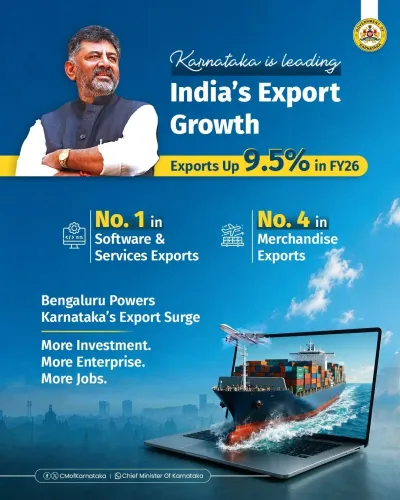
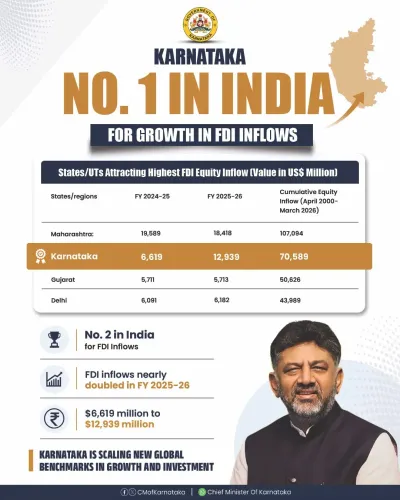
945 investment proposals worth more than ₹1.34 lakh crore approved by Karnataka over the past three years. ₹1.12 lakh crore in foreign direct investment attracted in a single year, according to the CMO.
The Industrial Policy 2025–30 has been formally implemented to guide the state's investment strategy for the next five years.
The e-Khata system is digitising property records to reduce ownership disputes and administrative friction.
A Bhu-Guarantee has been launched as Karnataka's sixth welfare guarantee , addressing property ownership confusion for citizens.
The government's stated goals span six groups: youth employment, farmer prosperity, women's self-reliance, children's education, worker dignity, and senior citizen security.
On Independence Day, 15 August 2026, the Chief Minister's Office of Karnataka laid out a sweeping account of the state's economic momentum — investment approvals, foreign capital inflows, a new industrial policy, and a sixth welfare guarantee — framing it all around a single, unambiguous promise: that the gains of growth must reach the young, the farmer, the woman, the worker, and the elderly.
₹1.34 lakh crore in approvals, ₹1.12 lakh crore in FDI
The CMO's post, part of a series (numbered 15/20), states that over the past three years, Karnataka approved 945 investment proposals worth more than ₹1.34 lakh crore. In the single year just past, the state claims to have attracted ₹1.12 lakh crore in foreign direct investment — a figure that, if borne out, would represent one of the largest single-year FDI hauls any Indian state has recorded.
Karnataka has held a leading share of national FDI for over a decade, driven by its dominance in IT services, biotech, and electronics manufacturing centred on Bengaluru. The current government's pitch is that it is not merely sustaining that lead but accelerating it through a structured policy framework.
Industrial Policy 2025–30 and the e-Khata shift
Central to that framework is the Industrial Policy 2025–30, which the CMO says has now been brought into force. The policy sets the state's investment and employment targets for the coming five years and is intended to provide predictability for both domestic and foreign investors.
Running alongside it is the e-Khata system — a digital platform that converts property records into electronic form. The move targets a chronic pain point in Karnataka's land administration: disputed ownership titles that have historically delayed both household transactions and industrial land acquisition. By digitising records, the government aims to reduce the friction that has long shadowed property dealings across the state.
The sixth guarantee: Bhu-Guarantee for property ownership
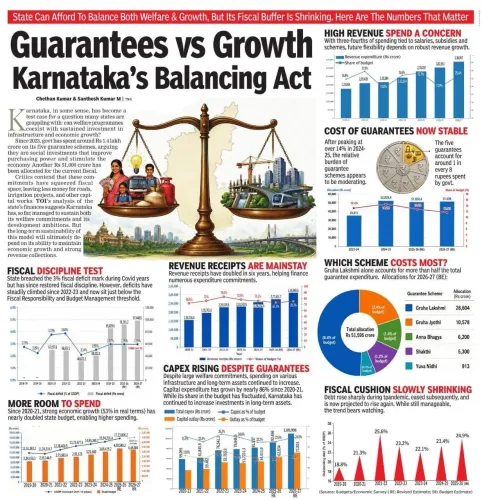
The post also announces a Bhu-Guarantee (ಭೂ-ಗ್ಯಾರಂಟಿ) — described as the sixth guarantee to the people of Karnataka — aimed at freeing citizens from confusion over property ownership. The Karnataka Congress government rolled out five major welfare guarantees in 2023 covering women, youth, and farmers. The addition of a sixth, focused on land-title clarity, extends that welfare architecture into the domain of property rights.
The post closes with six explicit commitments: youth must find employment; farmers must prosper; women must become self-reliant; children must be educated; workers must live with dignity; and senior citizens must have secure lives. It is, in effect, the government's own scorecard — the metrics against which it is inviting the public to judge the investment push.
A development model on public trial
What makes this Independence Day statement notable is the deliberate threading together of two narratives that state governments often keep separate — the investor-facing story of FDI and approvals, and the citizen-facing story of guarantees and welfare. By presenting them as a single programme with a single purpose, the CMO is making an explicit political argument: that industrial growth and social equity are not in tension in Karnataka, but are two faces of the same project.
The proof, as the government itself implies, will come in the rollout milestones of the Industrial Policy 2025–30, the pace of e-Khata coverage, and — most critically — the job numbers that eventually emerge from those 945 approved proposals.
Point of View
Focused on land titles, signals that the government sees property-rights clarity as both a governance imperative and an electoral asset. If the job-creation numbers from the 945 approved proposals materialise, the model becomes a replicable template other states will study; if they don't, the gap between the investment headline and the employment reality will become the central political liability heading into the next electoral cycle.
NationPress
15 Aug 2026
Frequently Asked Questions
How much FDI did Karnataka attract in 2025–26?
According to the Chief Minister's Office of Karnataka, the state attracted ₹1.12 lakh crore in foreign direct investment in the past one year, as stated in a post on 15 August 2026 .
What is Karnataka's Bhu-Guarantee?
The Bhu-Guarantee is Karnataka's sixth welfare guarantee , launched to free citizens from confusion and disputes over property ownership. It works alongside the e-Khata system, which digitises property records.
What is the Karnataka Industrial Policy 2025–30?
The Industrial Policy 2025–30 is a state policy framework implemented by the Karnataka government to set investment targets, attract industry, and guide economic growth in the state over five years from 2025 to 2030.
What is the e-Khata system in Karnataka?
e-Khata is a digital platform introduced by the Karnataka government to convert physical property records into electronic form, reducing disputes over land ownership and simplifying property transactions.
How many investment proposals has Karnataka approved in three years?
The Chief Minister's Office of Karnataka stated that 945 investment proposals worth more than ₹1.34 lakh crore were approved over the past three years.