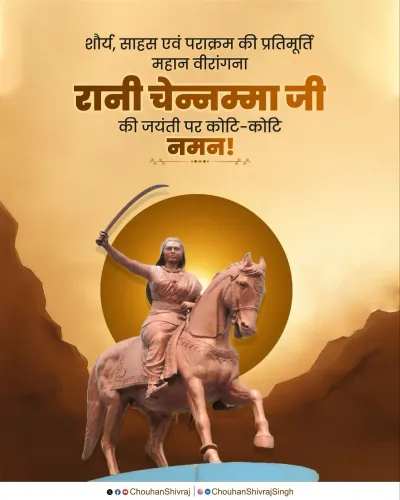
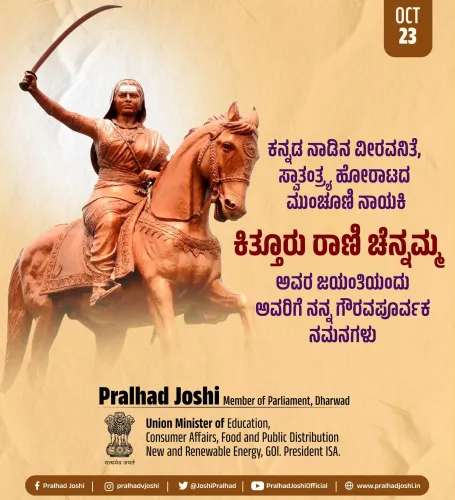
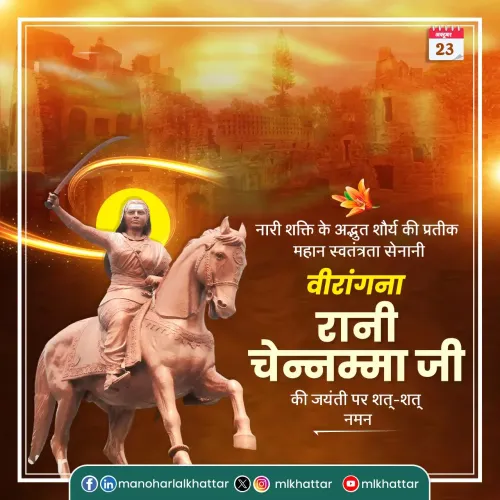
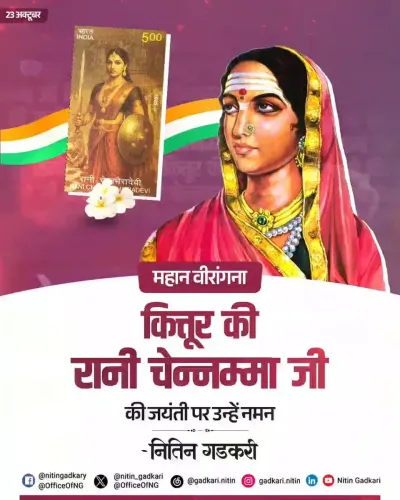
Karnataka CMO pays tribute to Kittur Rani Chennamma
Synopsis
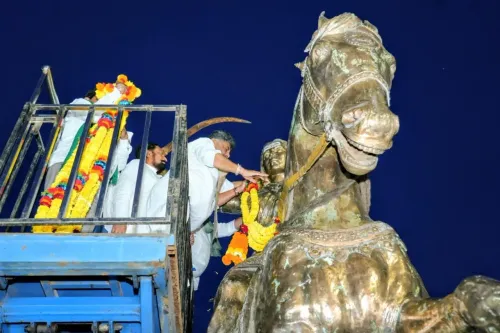
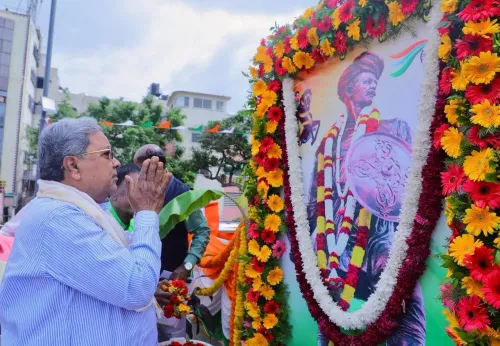
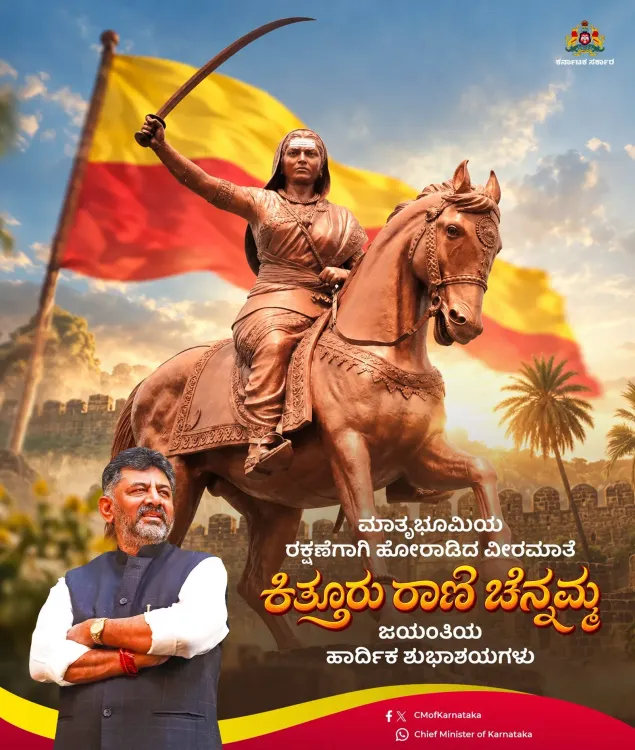
The Chief Minister's Office of Karnataka paid tribute to Kittur Rani Chennamma on 23 October 2026, honouring her 1824 armed revolt against the British East India Company as the symbol of Kannada sovereignty, self-respect, and women's power, alongside freedom fighter Sangolli Rayanna.
Key Takeaways
The Chief Minister's Office of Karnataka posted a Kannada-language tribute to Kittur Rani Chennamma on 23 October 2026 .
Chennamma led one of India's earliest armed revolts against the British East India Company in 1824 , from the princely state of Kittur in present-day Belagavi district .
The post specifically names Sangolli Rayanna as a 'selfless patriot' who fought alongside Chennamma to defend Kittur's independence.
Chennamma is described as the 'living embodiment of women's power' and her life is presented as a message never to tolerate injustice.
The tribute calls on all Kannadigas to embody her ideals and carry Karnataka's glory to the global stage.
Nearly two centuries after she forced a British army to retreat, Kittur Rani Chennamma remains the beating heart of Karnataka's identity — and the Chief Minister's Office of Karnataka invoked her legacy on Friday, 23 October 2026, with a tribute that called her struggle the very emblem of Kannada sovereignty and self-respect.
The post, written in Kannada, salutes Chennamma as 'ಸ್ತ್ರೀಶಕ್ತಿಯ ಸಾಕಾರ ಮೂರ್ತಿ' — 'the living embodiment of women's power' — and calls on all Kannadigas to imbibe her ideals of sacrifice and patriotism and carry the glory of the land to the world stage.
The queen who turned back the Company's guns
Kittur, a princely state in what is today the Belagavi district of Karnataka, became the site of one of India's earliest armed challenges to colonial rule in 1824 — more than three decades before the 1857 uprising. When the British East India Company attempted to annex Kittur after the death of its king, Chennamma refused to submit. She led her forces against the Company's army, repulsed the British in battle, and for a brief, electrifying moment proved that the colonial war machine was not invincible.
Fighting alongside her was Sangolli Rayanna, a chieftain and commander whose guerrilla resistance against British forces after Chennamma's eventual capture became its own chapter in Karnataka's freedom story. The CMO's tribute specifically names Rayanna as an 'ನಿಸ್ವಾರ್ಥ ದೇಶಭಕ್ತ' — 'selfless patriot' — whose courage helped hold aloft Kittur's flag of independence.
A tribute woven into Karnataka's political calendar
The Karnataka state government regularly marks anniversaries tied to regional heroes of the independence era, situating them within a broader narrative of local sovereignty. Commemorations of Chennamma are a fixture in this calendar — her image appears on Karnataka's official seals, her statue stands in Bengaluru's Vidhana Soudha precinct, and schools across the state teach her revolt as a foundational moment in Kannada history.
The CMO's message closes with a collective pledge: to carry the greatness of the land to the world, inspired by Chennamma's example that injustice must never be tolerated and self-respect must always be defended — a sentiment that resonates well beyond the history classroom.
Two centuries on, a queen who never surrendered her sovereignty is still being asked to show the way.
Point of View
The CMO's office connects a 19th-century queen's defiance to contemporary Kannada pride, reinforcing a political culture in which regional identity and patriotism are presented as complementary rather than competing loyalties. Such tributes also serve a quieter policy purpose: keeping pressure on curriculum authorities to expand the space these figures occupy in school syllabi and public memory. The emphasis on Chennamma as a symbol of women's power adds a gender-equity dimension that broadens the tribute's resonance beyond purely historical commemoration.
NationPress
23 Oct 2026
Frequently Asked Questions
Who was Kittur Rani Chennamma?
Kittur Rani Chennamma was the queen of the princely state of Kittur in present-day Belagavi district, Karnataka. In 1824, she led an armed revolt against the British East India Company, making it one of the earliest instances of armed resistance to colonial rule in Indian history.
Why is Kittur Rani Chennamma important to Karnataka?
Chennamma is regarded as a symbol of Kannada sovereignty and women's empowerment. Her successful repulsion of a British army in 1824 — decades before the 1857 uprising — is a source of regional pride, and her legacy is honoured in Karnataka's official seals, statues, and school curricula.
Who was Sangolli Rayanna and what was his role?
Sangolli Rayanna was a chieftain and military commander who fought alongside Kittur Rani Chennamma against the British East India Company. After Chennamma was captured, he continued guerrilla resistance and is celebrated as one of Karnataka's foremost freedom fighters.
What was the Kittur revolt of 1824?
The Kittur revolt of 1824 was an armed uprising led by Rani Chennamma against the British East India Company's attempt to annex the princely state of Kittur following the death of its king. The rebellion briefly succeeded in defeating British forces before being suppressed.
Why did the Karnataka CMO post a tribute to Rani Chennamma in October 2026?
The Chief Minister's Office of Karnataka regularly commemorates regional historical figures associated with India's independence movement. October marks anniversary observances linked to Kittur and Rani Chennamma, and such tributes are a fixture in the state government's public-communication calendar.