CM Shivakumar Grants One-Time OC Exemption for Home Power Links
Synopsis
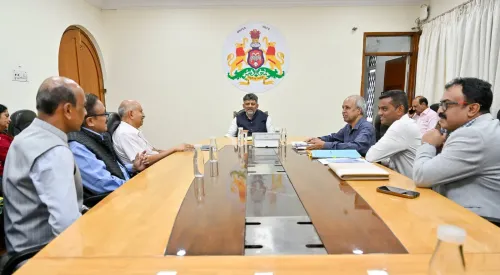
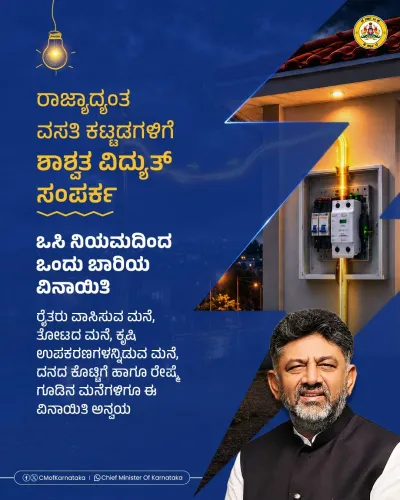
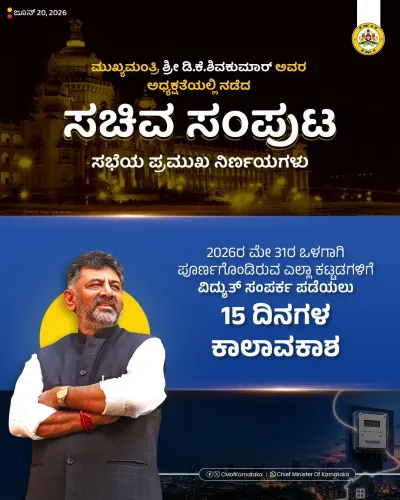
The Karnataka Cabinet, chaired by CM D.K. Shivakumar, has approved a one-time exemption from Occupancy Certificate rules to allow permanent electricity connections for residential buildings statewide. Citizens have 15 days from June 22, 2026, to apply. The relief covers urban, rural, and agricultural structures across all local body jurisdictions.
Key Takeaways
The Karnataka Cabinet approved a one-time OC exemption for permanent electricity connections on June 20, 2026 , with the Government Order effective from June 22, 2026 .
Citizens have only 15 days from June 22 to apply for a new permanent electricity connection under this scheme.
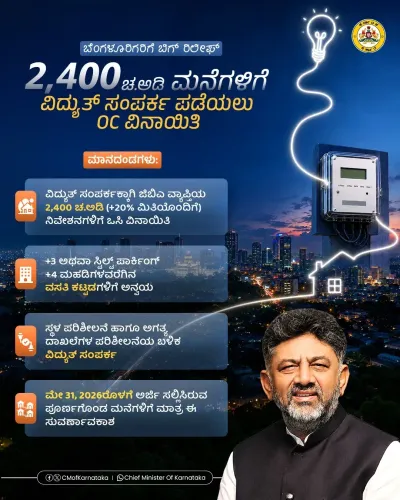
The exemption covers residential buildings on sites up to 2,400 sq. ft. with a 20% relaxation, including G+3 and Stilt Parking + 4-floor buildings.
The relief applies across Greater Bengaluru Authority (GBA) limits, municipal corporations, urban local bodies, and Gram Panchayat areas statewide.
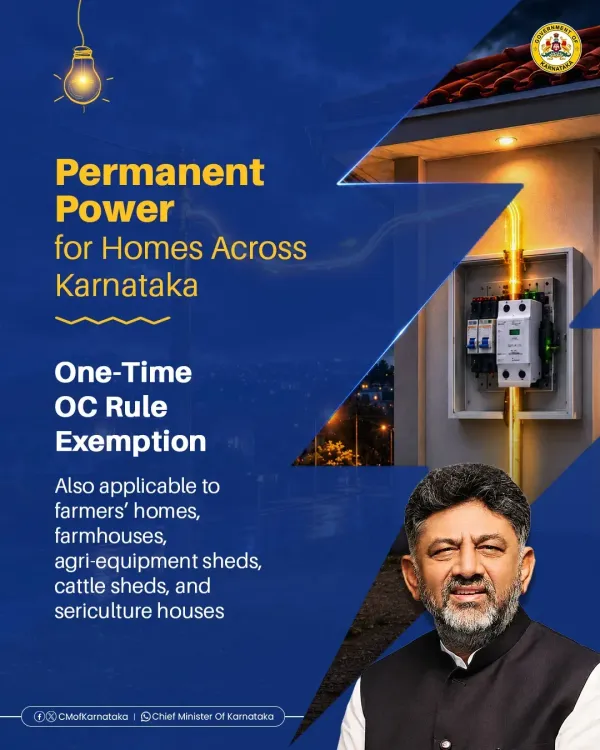
Agricultural and rural structures — including farmers' houses, farmhouses, cattle sheds, agri-equipment sheds, and sericulture houses — are also covered.
The decision follows Karnataka's earlier precedent of cabinet-level regularisation interventions, such as the Akrama Sakrama scheme of 2014–15.
The Chief Minister's Office of Karnataka announced on June 23, 2026, that the state cabinet has approved a one-time exemption from Occupancy Certificate (OC) rules to allow permanent electricity connections for residential buildings across Karnataka — a move aimed at resolving a long-pending regulatory bottleneck affecting thousands of homeowners.
What Was Decided
The exemption was cleared at a Karnataka Cabinet meeting chaired by Chief Minister D.K. Shivakumar on June 20, 2026, and the Government Order takes effect from June 22, 2026. Eligible citizens have a narrow window of just 15 days from that date to apply for a new permanent electricity connection under this scheme. The decision covers residential buildings across the entire state — from Greater Bengaluru Authority (GBA) limits and municipal corporations to urban local bodies and Gram Panchayat areas.Context
For years, residents of buildings that were constructed without obtaining an Occupancy Certificate — a document issued by local authorities confirming a structure meets approved building plans and safety norms — have been denied permanent electricity connections. This has left many households dependent on temporary or illegal connections, creating both a service gap and a compliance grey zone. Rapid urbanisation across Karnataka, particularly in and around Bengaluru, has meant that a significant share of the residential housing stock exists in this regulatory limbo. State governments across India have periodically issued time-bound exemptions to bridge such gaps between unplanned construction and formal utility access.Policy Backdrop
Karnataka has a precedent for such interventions. The Akrama Sakrama scheme, launched in 2014–15, sought to regularise unauthorised constructions and ease access to civic services in urban local bodies. The current OC exemption follows a similar philosophy — using cabinet-level action to provide citizen relief while sidestepping the slower process of full regularisation. The exemption applies specifically to residential buildings on sites up to 2,400 sq. ft. with a 20% relaxation, including G+3 buildings and Stilt Parking + 4-floor buildings. It also extends to a broader category of rural structures: farmers' residential houses, farmhouses, agri-equipment sheds, cattle sheds, and sericulture houses — signalling that the relief is not limited to urban centres.Stakeholders and Impact
The beneficiaries span a wide cross-section of Karnataka's population. Urban homeowners in Bengaluru and other municipal areas who built homes without completing the OC process stand to gain immediate access to permanent power connections. In rural areas, farmers and agricultural households whose ancillary structures — from cattle sheds to sericulture units — were ineligible for formal connections will also be covered. The inclusion of Gram Panchayat areas is particularly significant, as rural construction has historically operated with less formal documentation than urban projects. Electricity distribution companies in Karnataka will be responsible for processing applications within the stipulated window.What's Next
The critical variable is implementation. With a 15-day application window starting June 22, 2026, the pressure falls on both citizens to act quickly and on electricity distribution companies to process applications efficiently. Any follow-up government orders or operational guidelines from the power utilities will determine whether the relief reaches its intended beneficiaries in practice. If the scheme sees high uptake, it could prompt the state to consider a more permanent policy framework for addressing OC-compliance gaps in the future.Point of View
The cabinet is signalling that the compliance gap is not merely a Bengaluru problem but a statewide structural issue. The 15-day application window is deliberately tight, which could maximise uptake but also risks excluding residents who are unaware of the scheme. The move fits a broader pattern of Indian state governments using time-bound exemptions as pressure valves for urbanisation-driven regulatory strain, rather than reforming the underlying OC framework itself.
NationPress
22 Sept 2026
Frequently Asked Questions
What is the Karnataka OC exemption for electricity connections in 2026?
The Karnataka Cabinet approved a one-time exemption from Occupancy Certificate (OC) rules on June 20, 2026, allowing residents of buildings without an OC to apply for permanent electricity connections within a 15-day window starting June 22, 2026.
Who is eligible for the Karnataka electricity connection OC exemption?
Residents of buildings on sites up to 2,400 sq. ft. with a 20% relaxation — including G+3 and Stilt Parking + 4-floor buildings — are eligible, as are farmers with residential houses, farmhouses, cattle sheds, agri-equipment sheds, and sericulture houses across Karnataka.
What is the last date to apply for a permanent electricity connection under this scheme?
The 15-day application window begins June 22, 2026, making the last date to apply approximately July 7, 2026. Citizens should check with their local electricity distribution company for the exact deadline.
Does the Karnataka OC exemption apply in Bengaluru?
Yes, the exemption applies within Greater Bengaluru Authority (GBA) limits, as well as all municipal corporations, urban local bodies, and Gram Panchayat areas across the state.
What is an Occupancy Certificate and why does it matter for electricity connections?
An Occupancy Certificate is a document issued by local authorities confirming that a building meets approved plans and safety norms. Without it, residents are typically denied permanent electricity connections, leaving them reliant on temporary arrangements.