Karnataka CM hikes milk procurement price by ₹7 per litre
Synopsis
The Karnataka government, under CM DK Shivakumar, has hiked milk procurement prices by ₹7 per litre and consumer MRP by ₹8 — a record single-step revision that KMF officials call historic, set to benefit 11 lakh dairy-farming families statewide.
Key Takeaways
Karnataka has raised the milk procurement price for farmers by ₹7 per litre — described by KMF officials as the largest single-step increase in the federation's history.
The consumer MRP for Nandini-brand milk has simultaneously risen by ₹8 per litre .
An estimated 11 lakh dairy-farming households across Karnataka stand to benefit from the revised procurement rate.
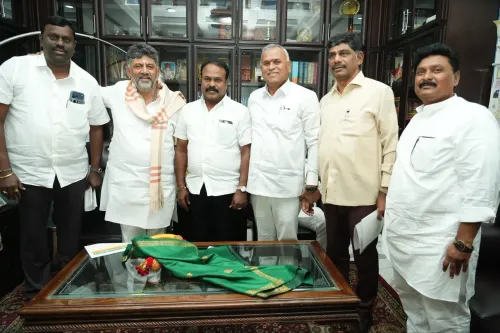
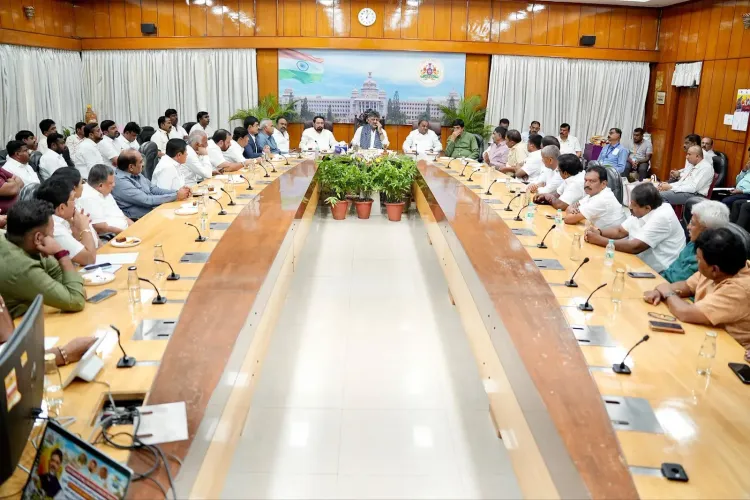
KMF and district milk union officials met CM DK Shivakumar at his official residence Krishna in Bengaluru to formally thank him for the decision.
Senior ministers, legislators, and BAMUL Chairman D.K.
Suresh attended the meeting alongside multiple district union office-bearers.
KMF operates the Nandini brand, which dominates Karnataka's organised dairy market through a cooperative network modelled on Gujarat's Amul.
For the first time in Karnataka's dairy history, the state government has raised the milk procurement price by ₹7 per litre — a decision that dairy cooperatives say will transform the livelihoods of roughly 11 lakh dairy-farmer families across the state. The Chief Minister's Office of Karnataka announced on Monday, 2 November 2026, that officials of the Karnataka Milk Federation (KMF) and various district milk unions called on Chief Minister DK Shivakumar at his official residence Krishna in Bengaluru to formally convey their gratitude for the landmark decision.
What the revision means at the farm gate and the checkout counter
The state government's order carries a twin impact: the farmer-facing procurement price rises by ₹7 per litre, while the consumer-end MRP climbs by ₹8 per litre. The spread between the two adjustments leaves room to cover operational and logistics costs within the cooperative chain. KMF and union officials described the procurement hike as ಐತಿಹಾಸಿಕ ನಿರ್ಧಾರ ('a historic decision') — the single largest per-litre increase in the federation's history.
The revision directly benefits an estimated 11 lakh dairy-farming households who supply milk to KMF's network of district unions under the Nandini brand. Union representatives at the meeting expressed satisfaction that the revision would strengthen the economic self-sufficiency of small producers who have long absorbed rising feed and fodder costs without a commensurate rise in returns.
Who was in the room at Krishna
The meeting at the CM's official residence brought together a cross-section of the state's dairy and political leadership. Ministers Lakshman Savadi and Puttarangshetty, legislators K.Y. Nanjegowda and C.P. Yogeshwar, BAMUL (Bangalore Milk Union) Chairman D.K. Suresh, and Chief Minister's Chief Adviser G.C. Chandrashekar were all present, alongside office-bearers from multiple district milk producers' associations.
KMF's cooperative model and why the hike matters now
Karnataka's dairy sector is built on a cooperative architecture closely modelled on Gujarat's Amul, with KMF functioning as the apex procurement and processing body. It aggregates supply from millions of smallholders — most of them marginal farmers for whom the milk cheque is a critical monthly income floor. Feed and fodder inflation in recent years had widened the gap between input costs and procurement returns, squeezing farmer margins and raising concerns about herd attrition and rural distress.
Periodic price revisions are a standard lever in cooperative dairy management, but a ₹7 per litre jump at the farm gate in a single revision is unusually steep — and, according to KMF officials, unprecedented. For a farmer supplying 10 litres a day, the revision translates to an additional ₹70 per day, or roughly ₹2,100 per month — meaningful income in rural Karnataka.
Consumer impact and the road ahead for Nandini pricing
The ₹8 per litre MRP increase will ripple through households that depend on Nandini-branded milk, which dominates the organised dairy market across Karnataka. The gap between the farm-gate hike and the retail hike suggests the cooperative system is absorbing a thin slice of the increase rather than passing it entirely to consumers — a balance cooperative managers will need to maintain as volumes and input costs evolve.
With the formal felicitation at Krishna now complete, attention shifts to the rollout of revised prices across all district unions and the pace at which the increased procurement payments reach farmer accounts. Eleven lakh families are watching the calendar.
Point of View
₹8 at retail — signals the Shivakumar government's calculated bet on rural welfare as a political and economic anchor ahead of future electoral cycles in a state where cooperative dairy membership runs deep. By framing the hike as 'historic,' the administration is staking reputational ground in agrarian constituencies where KMF's network functions as both a procurement lifeline and a grassroots political infrastructure. The thin spread between the farmer hike and the consumer hike also reflects a deft balancing act: protecting cooperative finances while making the urban consumer's price increase appear marginal against the farmer's gain. Whether the revision translates into sustained procurement volumes — or whether feed-cost inflation soon erodes the gains — will determine whether this moment is genuinely transformative or simply politically timed.
NationPress
2 Nov 2026
Frequently Asked Questions
By how much has Karnataka increased the milk procurement price for farmers?
The Karnataka government has raised the milk procurement price by ₹7 per litre for farmers — described by KMF officials as the single largest per-litre increase in the federation's history.
Will Nandini milk prices increase for consumers in Karnataka?
Yes. Alongside the ₹7 per litre farmer procurement hike, the consumer MRP for Nandini-brand milk has been increased by ₹8 per litre.
How many farmers will benefit from the Karnataka milk price hike?
Approximately 11 lakh dairy-farming households across Karnataka are expected to benefit from the revised procurement price.
What is KMF and what is its connection to Nandini milk?
KMF, the Karnataka Milk Federation, is the apex body of dairy cooperatives in Karnataka. It procures milk from millions of smallholder farmers and markets it under the Nandini brand, operating on a model similar to Gujarat's Amul.
Who attended the milk union felicitation meeting with CM DK Shivakumar?
Ministers Lakshman Savadi and Puttarangshetty, legislators K.Y. Nanjegowda and C.P. Yogeshwar, BAMUL Chairman D.K. Suresh, CM's Chief Adviser G.C. Chandrashekar, and office-bearers of several district milk unions attended the meeting at the CM's residence Krishna.