CM Saini Takes Dig at Rahul, Sonia Over Vande Mataram
Synopsis
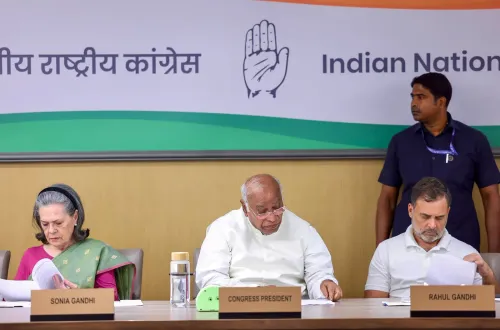
Haryana Chief Minister Nayab Singh Saini took aim at Rahul Gandhi and Sonia Gandhi on 2 November 2026, saying Congress leaders may object to singing Vande Mataram in full while Haryana sings the national song completely and with honour.
Key Takeaways
Haryana CM Nayab Singh Saini posted on X on 2 November 2026 criticising Rahul Gandhi and Sonia Gandhi over their alleged objection to the full recitation of Vande Mataram .
Saini stated that Haryana sings the national song in full — stopping at neither the first nor the last line — and does so 'with complete respect'.
Vande Mataram was adopted as India's national song by the Constituent Assembly in 1950 , separate from the national anthem Jana Gana Mana .
Congress figures have historically limited public renditions to the first stanza of Vande Mataram, citing concerns about later verses of Bankim Chandra Chatterjee's original composition.
The post continues a long-running BJP practice of framing the full recitation of Vande Mataram as a test of respect for national heritage, in contrast to the Congress position.
A pointed jab at the Gandhi family landed on Monday, 2 November 2026, when Haryana Chief Minister Nayab Singh Saini posted on X, contrasting his state's approach to Vande Mataram with what he framed as Congress leaders' reluctance to sing the national song in full.
Saini wrote in Hindi: 'Rahul baba-Sonia ji ko sampurna Vande Mataram par aapatti ho sakti hai.' ('Rahul baba and Sonia ji may have objections to the complete Vande Mataram.') He then drew a sharp contrast: 'In Haryana, we sing the national song in full and with honour. We don't stop at the first line, nor do we debate the last line — we simply sing it with complete respect.' The post carried a saluting emoji and the Indian tricolour flag.
The Vande Mataram Fault Line in Indian Politics
Vande Mataram has occupied contested political ground for decades. India's Constituent Assembly adopted it as the national song in 1950, even as Jana Gana Mana was designated the national anthem — a deliberate distinction that has never fully settled the debate around the two compositions. The song was written by Bankim Chandra Chatterjee and features prominently in his novel Anandamath.
Periodic controversies, particularly since the 1990s, have seen Congress figures limit public renditions to the first stanza of the song, citing concerns about later verses. That practice has repeatedly become a flashpoint, with BJP leaders using it to question the opposition's commitment to national symbols. Saini's post fits squarely into that pattern — crisp, culturally coded, and aimed directly at Rahul Gandhi and Sonia Gandhi by name.
Haryana's BJP Government as a Cultural Counterpoint
Haryana, under BJP rule since 2014 and governed by Saini since he took over from Manohar Lal Khattar in 2024, has consistently positioned itself as a state that champions nationalist cultural practices without equivocation. By invoking Haryana specifically, Saini signals that the full recitation of Vande Mataram is not a matter of debate here — it is settled policy of the heart, so to speak.
The framing is deliberate. Saini does not allege a specific incident or cite a Congress statement — he states a posture, inviting audiences to fill in the contrast themselves. It is the language of political shorthand: one side debates the song's lines, the other just sings them.
Whether Congress responds with a rebuttal or lets the post pass without comment will itself be a political signal as the two parties continue to spar over the ownership of India's national identity ahead of any major commemorative occasions.
Point of View
Resonates immediately with a core BJP base, and puts the opposition on the defensive without requiring any legislative or administrative action. The Vande Mataram debate has been a reliable BJP rhetorical tool since at least the 1990s, and invoking it ahead of any upcoming commemorative events carries a calculated electoral and identity-politics logic. By naming Rahul and Sonia Gandhi directly rather than referencing Congress as an institution, Saini personalises the charge, making it harder for the party to deflect with an institutional response. The broader arc here is BJP's sustained effort to own the grammar of patriotism in Indian public life — and each salvo makes Congress's silence or rebuttal equally politically costly.
NationPress
2 Nov 2026
Frequently Asked Questions
What did Haryana CM Nayab Singh Saini say about Vande Mataram?
Saini said that Rahul Gandhi and Sonia Gandhi may have objections to singing Vande Mataram in full, while Haryana sings the national song completely and with respect, stopping at neither the first line nor debating the last.
Why is Vande Mataram controversial in Indian politics?
Vande Mataram, written by Bankim Chandra Chatterjee, has been contested since the 1990s because some Congress leaders limit its public recitation to the first stanza, citing concerns about the content of later verses, which BJP leaders have repeatedly used to question their nationalist credentials.
Is Vande Mataram India's national anthem?
No. India's national anthem is Jana Gana Mana. Vande Mataram was adopted as the national song by the Constituent Assembly in 1950 — a separate but equally revered designation.
Who is Nayab Singh Saini?
Nayab Singh Saini is the Chief Minister of Haryana and a BJP leader, who assumed office in 2024 after Manohar Lal Khattar stepped down.
Has Congress responded to Saini's Vande Mataram remarks?
No official Congress response had been recorded at the time of this report. Whether the party issues a rebuttal or lets the post pass will itself be a politically significant signal.