CM Bhupendra Patel Backs Amit Shah on Vande Mataram Row
Synopsis
Gujarat Chief Minister Bhupendra Patel endorsed Home Minister Amit Shah's statement on Vande Mataram on 20 August 2026, accusing Congress of a history of sacrificing national self-respect for appeasement politics, and declaring that 140 crore Indians will no longer tolerate insults to national sentiment.
Key Takeaways
Gujarat CM Bhupendra Patel posted on X on 20 August 2026 defending Vande Mataram and endorsing Union Home Minister Amit Shah's recent statement on the national song.
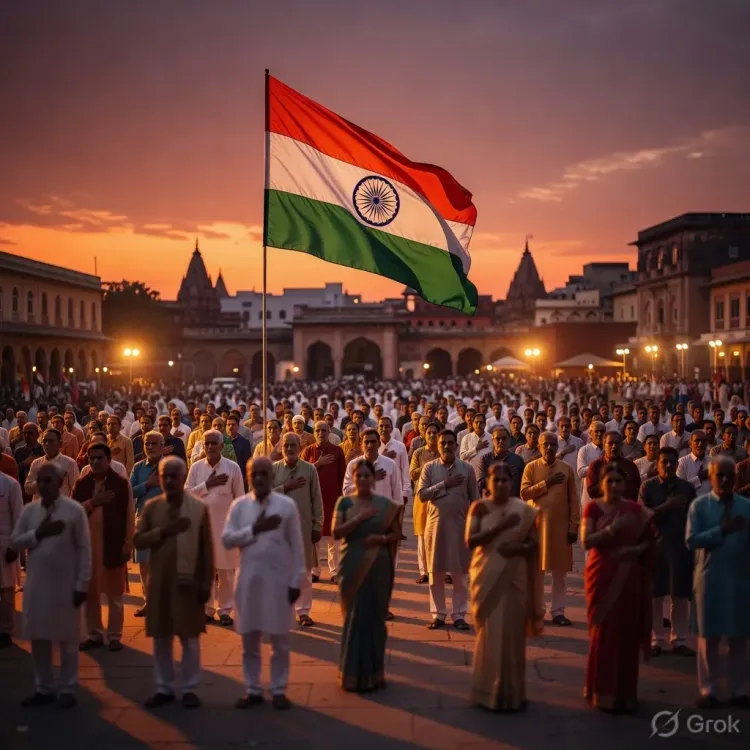
Patel described Vande Mataram as 'a symbol of the consciousness of our immortal martyrs' and 'the eternal proclamation of India's soul and freedom struggle.' He accused the Indian National Congress of having a history of 'playing with national self-respect for appeasement and vote-bank politics.' Vande Mataram was composed by Bankim Chandra Chattopadhyay in 1882 and adopted as India's national song by the Constituent Assembly in 1950 .
Patel invoked 140 crore Indians as a unified force that will no longer accept insults to national sentiment.
A national song is under political fire again — and Gujarat Chief Minister Bhupendra Patel has stepped squarely into the debate. On Thursday, 20 August 2026, Patel posted a sharp defence of Vande Mataram on X, endorsing Union Home Minister Amit Shah's recent statement and levelling a pointed charge at the Indian National Congress for what he called a history of compromising national pride for vote-bank politics.
Patel's post, written in Hindi, frames Vande Mataram not merely as a song but as something far weightier: 'maa Bharati ki vandana aur hamare amar balidaniyon ki chetna ka pratik' — 'a tribute to Mother India and a symbol of the consciousness of our immortal martyrs.' He calls it 'the eternal proclamation of India's soul and freedom struggle.' The language is deliberate. It positions the national song as sacred ground — ground the BJP argues Congress has repeatedly surrendered.
What Amit Shah Said — and Why Patel Amplified It
Home Minister Amit Shah had made a statement on Vande Mataram that Patel describes as the voice of every Indian citizen: 'desh ke jan-jan ki bhavana'. While the precise text of Shah's original remarks could not be independently verified at the time of publication, Patel's endorsement signals a coordinated BJP push on cultural nationalism. Senior party leaders amplifying each other on national-symbol messaging is a well-worn playbook — and this instance fits the pattern cleanly.
Vande Mataram was composed by Bankim Chandra Chattopadhyay in 1882 and became the battle hymn of India's independence movement. The Constituent Assembly adopted it as the national song in 1950, giving it constitutional standing alongside the national anthem. Its political valence, however, has never been neutral — debates over its mandatory recitation and its perceived religious undertones have flared across decades, often splitting along ideological lines.
Congress in the Crosshairs
Patel's sharpest line is a direct attack: Congress, he writes, has a history — 'itihas raha hai' — of playing with national self-respect for appeasement and vote-bank politics. The charge is not new; it is a foundational BJP critique stretching back to the party's origins. But the framing here is escalatory. Patel invokes 140 crore Indians — the full population — as a unified bloc that will no longer accept insults to national sentiment: 'rashtrabhavana ka apmaan katayi sweekar nahin karenge.'
The timing matters. Statements of this kind from state chief ministers typically surface around commemorative periods or in the run-up to electoral cycles, serving to consolidate identity-based mobilisation among the party's core base. Whether Gujarat institutions will see any follow-up directives on Vande Mataram recitation — as has happened in some BJP-governed states previously — remains to be watched.
India's argument over its national song is as old as the republic itself. What changes is who is making the argument, and how loudly. Today, it is a sitting chief minister invoking 140 crore voices — and daring the opposition to disagree.
Point of View
Then frame any perceived slight as a Congress-era original sin. By invoking Home Minister Shah's statement and 140 crore citizens in a single breath, Patel is doing more than defending a song — he is reinforcing the BJP's claim to be the sole custodian of Indian identity. The Congress, named but not quoted, is left to respond to a charge that is deliberately broad enough to be unanswerable without appearing defensive. Watch for whether this becomes a coordinated state-level campaign or remains a social-media moment.
NationPress
5 Oct 2026
Frequently Asked Questions
What did Gujarat CM Bhupendra Patel say about Vande Mataram?
Patel said Vande Mataram is not merely a song but a tribute to Mother India and a symbol of the consciousness of India's martyrs. He endorsed Home Minister Amit Shah's statement on the national song and accused Congress of compromising national pride for vote-bank politics.
What is the controversy around Vande Mataram in India?
Vande Mataram has been politically contested for decades, with debates over its mandatory recitation and perceived religious undertones. The BJP has consistently championed it as a national symbol, while critics argue its compulsory singing raises questions about religious inclusivity.
When was Vande Mataram adopted as India's national song?
The Constituent Assembly of India adopted Vande Mataram as the national song in 1950. It was originally composed by Bankim Chandra Chattopadhyay in 1882 and became a rallying cry during the independence movement.
What did Amit Shah say about Vande Mataram?
The precise text of Home Minister Amit Shah's statement on Vande Mataram could not be independently verified at the time of publication. Gujarat CM Bhupendra Patel described Shah's remarks as reflecting 'the sentiment of every citizen of the country.'
Why is BJP raising the Vande Mataram issue against Congress?
The BJP has long accused Congress of minority appeasement at the expense of national symbols and pride. Raising Vande Mataram is part of the party's broader cultural nationalism messaging, which typically intensifies around commemorative periods or ahead of electoral cycles.