Karnataka launches Prajaaseva Aayuktaalaya for unified citizen services
Synopsis
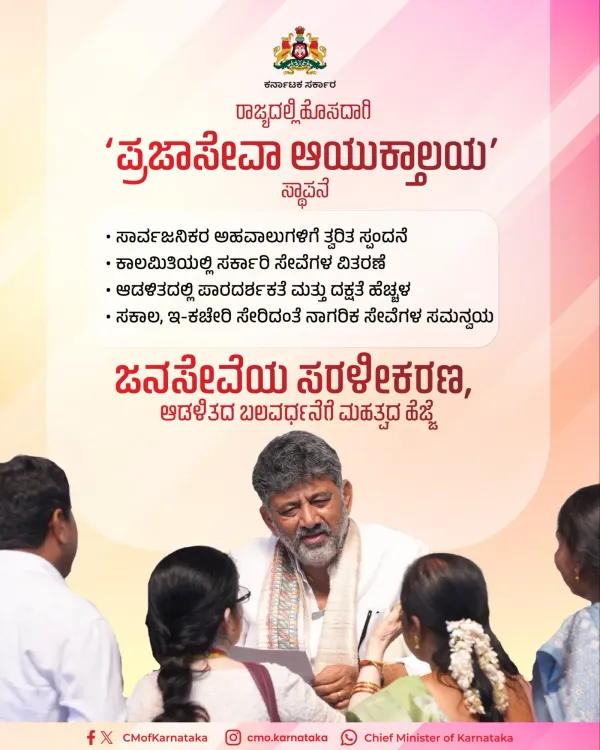
Karnataka's Chief Minister's Office announced the Prajaaseva Aayuktaalaya on 20 November 2026 — a new centralised commission to unify Sakala, RTI, IPGRS, e-Kacheri, CCMS and EDCS under one coordinated system for faster, transparent, time-bound public service delivery.
Key Takeaways
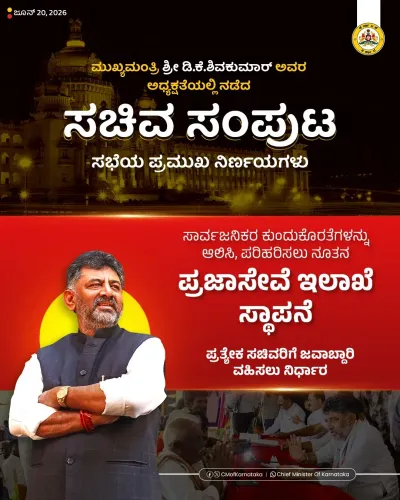
The Prajaaseva Aayuktaalaya ( ಪ್ರಜಾಸೇವಾ ಆಯುಕ್ತಾಲಯ ) was announced by Karnataka's CMO on 20 November 2026 .
It will centralise the management of Sakala, IPGRS, RTI, e-Kacheri, CCMS and EDCS platforms.
The body's mandate covers faster grievance disposal, time-bound service delivery, and greater administrative transparency.
Karnataka's foundational Sakala Services Act was enacted in 2011 , making it one of India's earliest time-bound service delivery laws.
Specific organisational structure, leadership and integration timeline are yet to be detailed in official notifications.
Karnataka just rewired the backbone of its public administration. The Chief Minister's Office of Karnataka announced on 20 November 2026 the establishment of the Prajaaseva Aayuktaalaya (ಪ್ರಜಾಸೇವಾ ಆಯುಕ್ತಾಲಯ), a new centralised commission designed to deliver government services to citizens without delay, transparently, and with ease — a single institutional nerve-centre for the state's fragmented civic infrastructure.
What the Prajaaseva Aayuktaalaya will actually do
The new body will bring together a cluttered portfolio of citizen-service platforms under one roof. As the CMO's post states, 'ಸಕಾಲ, IPGRS, ಆರ್ಟಿಐ, ಇ-ಕಚೇರಿ, ಸಿಸಿಎಂಎಸ್, ಇಡಿಸಿಎಸ್' — that is, Sakala, IPGRS, RTI, e-Kacheri, CCMS and EDCS — will all fall under a centralised management and coordination system. The stated goals are three: faster disposal of public grievances, time-bound service delivery, and greater transparency in administration. Each of those is a known, chronic pain point in state-level governance — naming them together in a single institutional mandate is a pointed move.
Sakala's long shadow — and why integration matters
Karnataka's track record here is worth noting. The state passed the Sakala Services Act in 2011, guaranteeing time-bound delivery of notified government services — one of the earliest such legislative commitments in India. The law gave citizens the right to receive specified services within a fixed number of days, with provisions for appeals if deadlines were missed. It was a credible first-generation reform. What it lacked, over the following decade-and-a-half, was a single authority empowered to coordinate across all related platforms — Sakala, RTI portals, integrated grievance systems, digital office tools — rather than leaving each to run in its own silo. The Prajaaseva Aayuktaalaya is pitched as precisely that missing layer.
Karnataka's e-governance arc — from silos to a spine
The new commission fits a broader pattern. Karnataka has pursued successive e-governance reforms across administrations, gradually pushing citizen services toward digital consolidation — a direction aligned with the national Digital India framework. Other large states have attempted similar integration: unified dashboards, single-window clearance desks, consolidated grievance portals. The ambition is consistent; the execution is where most efforts have stumbled. What the Prajaaseva Aayuktaalaya's organisational structure, leadership appointment, and integration timeline will look like in practice remains to be detailed in official notifications — those specifics will determine whether this is a genuine architectural shift or another layer on an already layered stack.
Karnataka has drawn the blueprint. Now comes the harder work of building it.
Point of View
But without a coordinating authority, they create new silos rather than eliminating old ones. By bundling Sakala, RTI, IPGRS and digital office tools under one commission, the state is essentially admitting that legislative guarantees alone — however well-designed — are insufficient without institutional coherence. The move tracks a national pattern under the Digital India framework, where states are under pressure to show consolidated, measurable service-delivery outcomes. Whether the new body gets genuine administrative teeth — a credible commissioner, enforcement powers, and a live integration dashboard — will reveal whether this is structural reform or organisational rebranding.
NationPress
20 Nov 2026
Frequently Asked Questions
What is Prajaaseva Aayuktaalaya in Karnataka?
The Prajaaseva Aayuktaalaya is a new centralised commission established by the Karnataka state government to coordinate and manage citizen-facing services including Sakala, RTI, IPGRS, e-Kacheri, CCMS and EDCS under a single institutional framework, aiming to ensure faster and transparent service delivery.
What is the Sakala Services Act in Karnataka?
The Sakala Services Act was passed by Karnataka in 2011, guaranteeing time-bound delivery of notified government services to citizens. It is one of India's earliest legislative frameworks mandating fixed deadlines for public service delivery.
What services will be managed by Prajaaseva Aayuktaalaya?
The commission will oversee Sakala (time-bound services), IPGRS (integrated public grievance redressal), RTI (Right to Information), e-Kacheri (digital office), CCMS and EDCS, centralising their management and coordination.
Why did Karnataka create a new commission for citizen services?
Despite multiple e-governance platforms, Karnataka lacked a single authority to coordinate across all systems, leading to fragmentation. The Prajaaseva Aayuktaalaya is designed to fill that gap, ensuring unified oversight and faster grievance resolution.
How does Karnataka's Prajaaseva Aayuktaalaya fit under Digital India?
The new body aligns with the national Digital India framework's push for state-level consolidation of citizen services into unified digital systems, mirroring similar integration efforts pursued by other large Indian states.