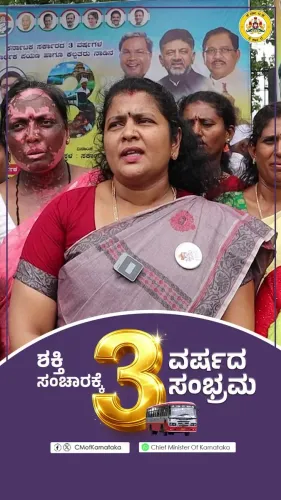
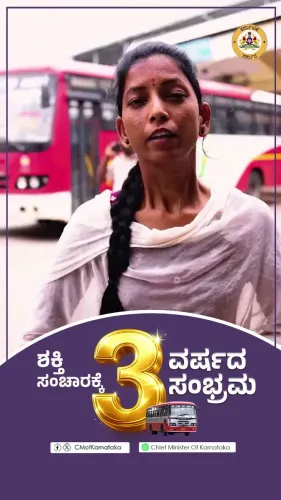
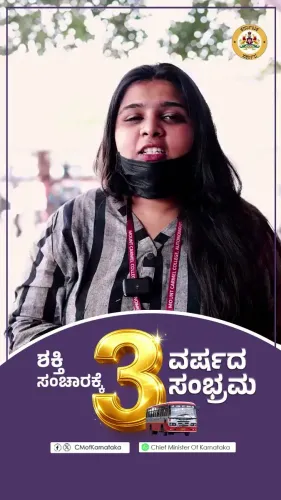
CM Siddaramaiah marks 3 years of Karnataka's Shakti Yojane
Synopsis
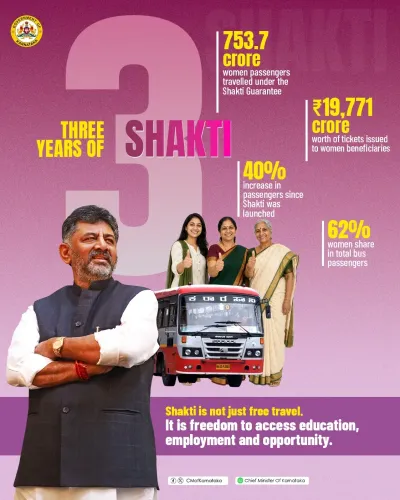
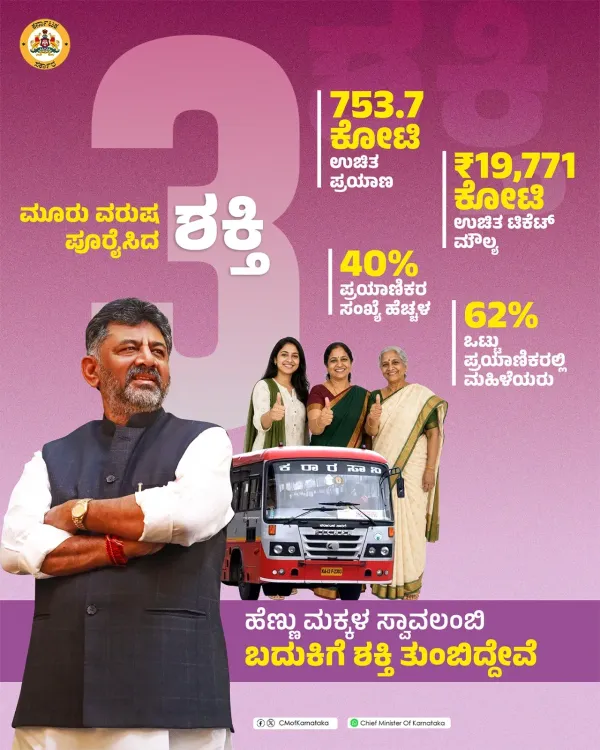
Karnataka's Chief Minister's Office marks three years of Shakti Yojane, the state's free-bus scheme for women. The government claims 753.7 crore trips, a Rs 19,771 crore cumulative ticket value, a 40 per cent rise in overall ridership, and women forming 60 per cent of all bus passengers.
Key Takeaways
Shakti Yojane, Karnataka's free bus travel scheme for women, completed three years on 11 June 2026 .
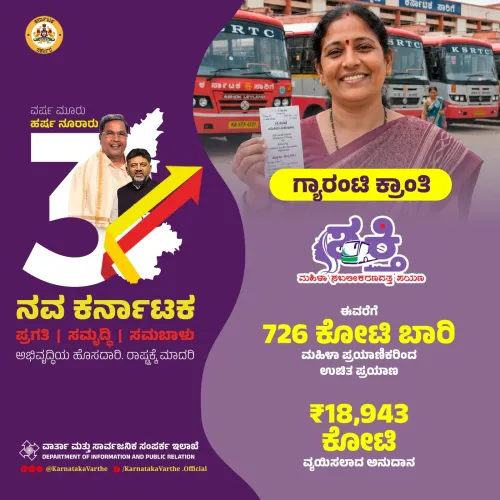
Women have made 753.7 crore trips on state transport buses since the scheme's launch in June 2023.
The cumulative notional ticket value of free travel provided stands at Rs 19,771 crore .
Overall bus ridership on state transport has risen by 40 per cent since the scheme's implementation.
Women now account for 60 per cent of total passengers on Karnataka state transport buses.
The scheme was one of five guarantee commitments made by the Karnataka Congress government ahead of the 2023 state elections.
The Chief Minister's Office of Karnataka on Thursday, 11 June 2026 announced that the state government's flagship free-bus travel scheme for women, Shakti Yojane, has completed three years of implementation, citing record ridership and a cumulative ticket value of Rs 19,771 crore.
Context
The post, attributed to Deputy Chief Minister and senior Congress leader DK Shivakumar, states in Kannada: 'ನಾಡಿನ ಪ್ರತಿ ಹೆಣ್ಣು ಸ್ವತಂತ್ರವಾಗಿ ಸಂಚರಿಸಿ, ಸ್ವಾವಲಂಬಿ ಬದುಕನ್ನು ಕಟ್ಟಿಕೊಂಡು ನೆಮ್ಮದಿಯ ಜೀವನವನ್ನು ಕಾಣಬೇಕು' ('Every woman in the state should travel freely, build a self-reliant life, and find a peaceful existence'). The statement frames Shakti Yojane as central to that vision. The scheme was launched in June 2023 as one of the Karnataka Congress government's five pre-election guarantee commitments.
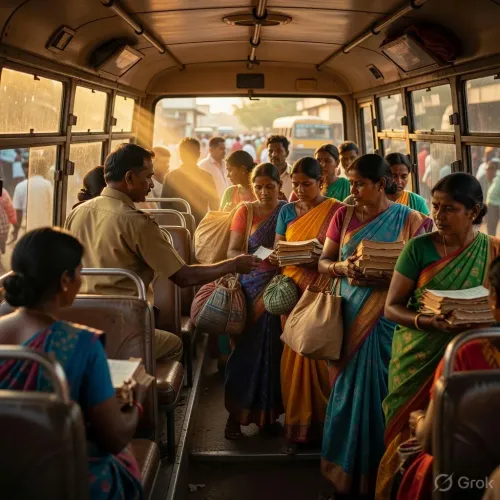
The government claims women have undertaken 753.7 crore trips on state transport buses since the scheme's launch, covering purposes including employment, education, and healthcare access.
Policy Backdrop
Shakti Yojane allows women to travel free of charge on buses operated by Karnataka State Road Transport Corporation (KSRTC) and affiliated state transport undertakings. It was conceived as a gender-mobility intervention — reducing the financial barrier to commuting for women across urban and rural Karnataka.
The government's post claims overall bus ridership has risen by 40 per cent since the scheme's implementation, and that women now constitute 60 per cent of total passengers on state transport buses. The cumulative ticket value of Rs 19,771 crore represents the notional cost of travel provided free to women beneficiaries over three years.
Karnataka's programme is part of a broader national pattern. States including Delhi, Tamil Nadu, and Rajasthan have rolled out women-only or free-travel bus schemes since 2019, using transport subsidies as a tool for gender-focused welfare and improved urban and rural mobility.
Stakeholders and Impact
DK Shivakumar noted in the post that the scheme has 'reached the deserving beyond our expectations and is bringing about a positive change in society,' adding that this gives him 'a sense of satisfaction.' The statement signals the government's intent to position Shakti Yojane as a model of welfare delivery under the #KarnatakaModel tag.
The primary beneficiaries are women commuters — particularly daily wage earners, students, and patients — who use state bus networks to access opportunities otherwise constrained by transport costs. KSRTC and associated transport bodies bear the operational cost, reimbursed by the state exchequer.
The 40 per cent rise in overall ridership cited by the government also has indirect implications for state transport revenues, bus fleet utilisation, and pressure on existing route infrastructure.
What's Next
The government has not announced any modifications to the scheme's scope or eligibility criteria as part of this anniversary communication. Independent evaluation of the scheme's effect on women's labour-force participation and long-term mobility patterns remains a key metric to watch.
Observers will look to the next Karnataka state budget for signals on whether Shakti Yojane's allocation will be expanded, integrated with new transport corridors, or supplemented with complementary welfare measures. The three-year milestone also sets a political benchmark as the state heads deeper into the second half of the current government's term.
Point of View
Measurable metric: trip counts. By publishing a cumulative ticket value of Rs 19,771 crore, the Karnataka Congress is framing fiscal cost as social investment, pre-empting opposition criticism about subsidy burden. The scheme fits a well-established pattern among state governments of using transport subsidies to signal gender-inclusive governance, but Karnataka's scale and the 60 per cent female ridership share, if borne out by independent audit, would represent a meaningful shift in public mobility behaviour. The timing — mid-term in the government's tenure — suggests the party is already building its 2028 electoral narrative around the five-guarantee framework.
NationPress
26 Oct 2026
Frequently Asked Questions
What is Shakti Yojane in Karnataka?
Shakti Yojane is a Karnataka government scheme launched in June 2023 that provides free travel to women on state-run buses operated by KSRTC and affiliated transport undertakings, covering trips for work, education, and healthcare.
How many trips have women made under Shakti Yojane?
According to the Karnataka government, women have made 753.7 crore trips on state transport buses under Shakti Yojane since its launch, with a cumulative ticket value of Rs 19,771 crore .
Has Shakti Yojane increased bus ridership in Karnataka?
The Karnataka government claims overall bus ridership has increased by 40 per cent since the scheme's implementation, with women now making up 60 per cent of all passengers on state transport buses.
Who announced Shakti Yojane's three-year milestone?
The milestone was announced by the Chief Minister's Office of Karnataka on 11 June 2026, with the post attributed to DK Shivakumar .
Which other Indian states have similar free bus schemes for women?
States including Delhi, Tamil Nadu, and Rajasthan have launched women-only or free-travel bus schemes since 2019, reflecting a broader national trend of using transport subsidies for gender-focused welfare.