Is There a Sugarcane Crisis Due to the State Government's Inaction?
Synopsis
Union Minister Pralhad Joshi has pointed fingers at Karnataka's Congress government for the ongoing sugarcane crisis. He highlights the government's failure to implement crucial reforms and manage tariffs, which has adversely impacted farmers and mills. This article delves into Joshi's accusations and the implications for the sugar industry in Karnataka.
Key Takeaways
Union Minister Pralhad Joshi addresses the sugarcane crisis in Karnataka.
The crisis is attributed to the state government's policies and inaction.
Rising power tariffs and outdated PPAs are significant issues.
The Centre's FRP is set to benefit farmers, but state support is lacking.
Policy reforms are essential for the sustainability of the sugar sector.
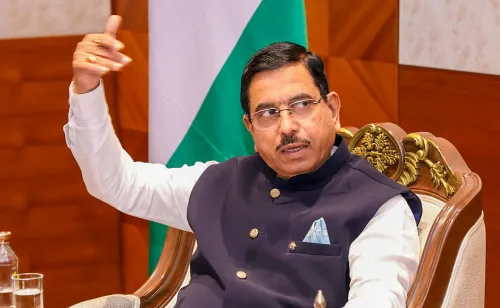
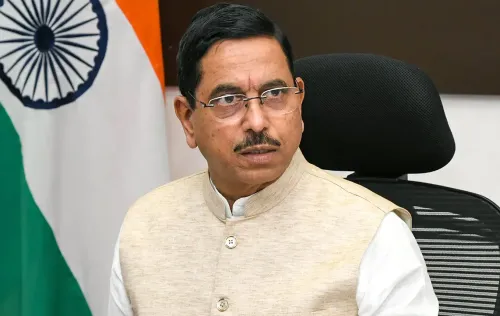
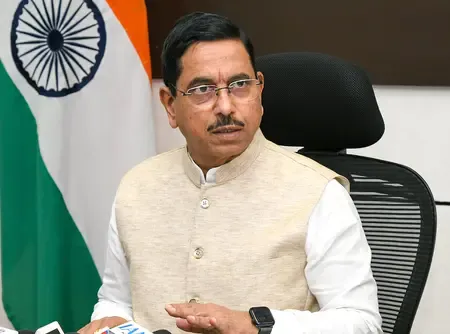
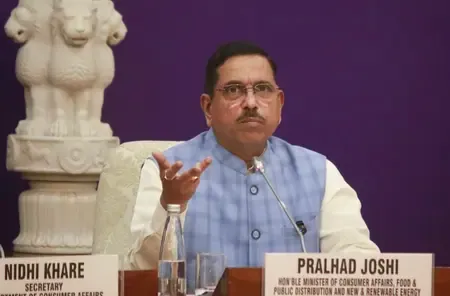
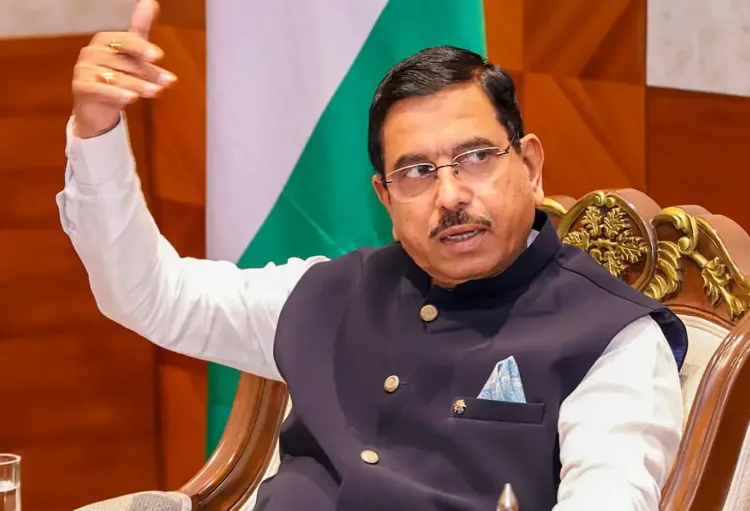
New Delhi, Nov 12 (NationPress) Union Minister for Consumer Affairs, Food, and Public Distribution Pralhad Joshi addressed Karnataka's Chief Minister Siddaramaiah in a letter, attributing the current sugarcane crisis in the state to the policies enacted by the ruling Congress government.
He claimed that the state is hiding the Centre’s reform initiatives while unjustly accusing the Union government. “Blaming the Centre is unfair since the government has provided both price stability and market diversification. The responsibility of enforcing payment implementation, irrigation, and subsidy distribution lies with the state government, which cannot be overlooked,” he stated.
Joshi emphasized that the Central government is dedicated to promoting the welfare of farmers, ensuring stability in the sugar sector, and fostering long-term prosperity.
He provided several examples to illustrate that the state government is to blame for the ongoing distress faced by sugarcane growers and mills.
For instance, while neighboring Maharashtra has introduced a new electricity power purchase agreement (PPA) that will take effect in April 2025, Karnataka continues to operate under the outdated 2017-18 PPA.
The Union Minister pointed out that PPAs guarantee revenue for production units and sugar mills, thereby facilitating bank financing. However, Karnataka’s failure to update its PPA has left sugar mills without a reliable income source, he noted.
The state has raised power tariffs twice — first in April 2023 by 70 paise per unit, and again in April 2025 with an additional surcharge of 36 paise per unit.
“These increases have diminished the income for both farmers and sugar mills,” Joshi remarked.
He highlighted that due to these tariff hikes, transportation costs have surged to Rs 750-Rs 800 per tonne over the past three years.
Additionally, under the Karnataka Motor Vehicles Tax (Amendment) Act 2024, the government has imposed an extra 3 percent road tax on new commercial vehicles, further burdening farmers, Joshi wrote.
He pointed out that while the Centre’s Fair and Remunerative Price (FRP) is merely a minimum guideline, states have the authority to announce a higher State Advisory Price (SAP) to safeguard farmers' interests — yet Karnataka has yet to declare any SAP.
“The State Government ought to have prioritized alleviating the farmers’ burden,” Joshi said. “Instead, it has stifled the productive sectors of the economy under the guise of ‘guarantee schemes.’”
Joshi accused the state of showing “indifference” towards sugarcane farmers and mills, while tightening financial regulations and imposing heavy taxes on essential sectors.
“The minister stated that the state’s financial and regulatory policies have worsened the crisis for both sugar mills and sugarcane growers,” he mentioned.
He queried, “When the state’s own shortcomings have exacerbated the situation, how just is it to blame the Centre?”
Moreover, the Centre has set the FRP for 2025-26 at Rs 355 per quintal of sugarcane at a 10.25 percent recovery rate, based on recommendations from the Commission for Agricultural Costs and Prices (CACP).
This offers farmers a margin exceeding 105 percent above production costs, marking a significant advancement in farmer welfare, he asserted.
“Through the Ethanol Blending Programme, the Centre has fortified the sugar sector by generating alternative, stable income streams for sugar mills and ensuring better prices for farmers,” he added.
He concluded that, thanks to the Centre’s ongoing pro-farmer initiatives, the FRP has consistently risen each year, and cane arrears across the nation are currently at a historic low.
Point of View
It is crucial to present an unbiased perspective on the ongoing sugarcane crisis in Karnataka. While Union Minister Pralhad Joshi has raised significant concerns regarding the state government's policies, it is essential to consider both sides of the issue. The complexities of agricultural economics require an in-depth analysis of the factors at play, ensuring that the narrative remains fair and comprehensive.
NationPress
28 Sept 2026
Frequently Asked Questions
What is the sugarcane crisis in Karnataka?
The sugarcane crisis in Karnataka refers to the ongoing issues faced by sugarcane farmers and mills due to several factors, including rising power tariffs, outdated power purchase agreements, and lack of supportive policies from the state government.
Who is responsible for the crisis according to Union Minister Pralhad Joshi?
Union Minister Pralhad Joshi attributes the sugarcane crisis to the policies of the incumbent Congress government in Karnataka, claiming they have failed to implement necessary reforms and support farmers adequately.
What are the impacts of rising power tariffs?
Rising power tariffs have significantly reduced the income of both farmers and sugar mills, increasing operational costs and affecting overall profitability in the sugar sector.
What is the Fair and Remunerative Price (FRP)?
The Fair and Remunerative Price (FRP) is a minimum price set by the central government for sugarcane, aimed at ensuring fair compensation to farmers based on production costs.
What solutions are being proposed?
Potential solutions include updating power purchase agreements, revising state advisory prices, and implementing policies to alleviate the financial burden on farmers.