Kishan Reddy: KAVACH 4.0 Live on 108 km SCR Route
Synopsis
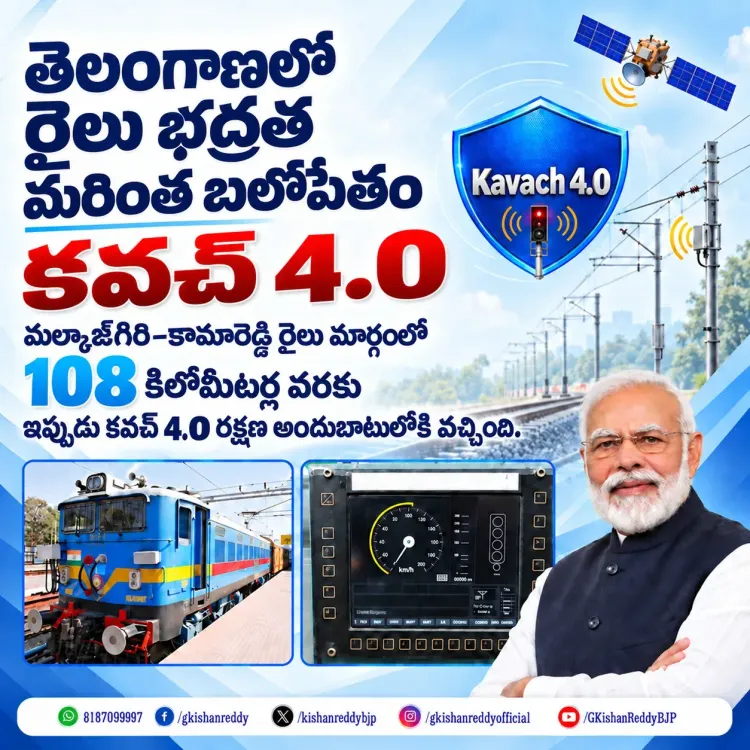
Union Minister G. Kishan Reddy announced the commissioning of KAVACH 4.0 on the 108 km Malkajgiri–Kamareddy corridor — the first such deployment in South Central Railway's zone — enhancing collision prevention and all-weather safety for Telangana passengers.
Key Takeaways
KAVACH 4.0 has been successfully commissioned on a 108-kilometre stretch from Malkajgiri to Kamareddy in Telangana.
This is the first-ever KAVACH deployment within the South Central Railway (SCR) zone, headquartered in Secunderabad.
The system automatically prevents collisions when two trains approach each other on the same track.
KAVACH 4.0 is designed to ensure safe, reliable train operations even in adverse weather conditions such as heavy fog or rain.
The announcement was made by Union Coal and Mines Minister G.
Kishan Reddy , who is also the BJP Telangana state president .
The deployment forms part of Indian Railways' broader phased national rollout of indigenous automatic train protection technology.
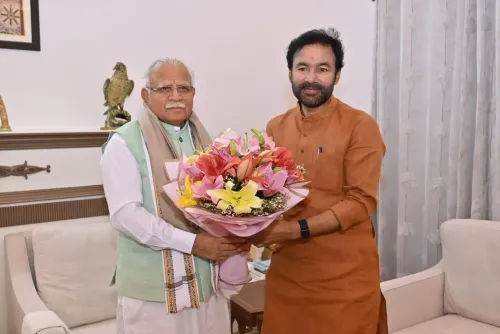
For the first time in the South Central Railway (SCR) zone, a 108-kilometre stretch of track — running from Malkajgiri in suburban Hyderabad to Kamareddy in northern Telangana — is now guarded by India's most advanced indigenous train-protection system. Union Coal and Mines Minister G. Kishan Reddy, also the BJP Telangana state president, announced the milestone on Thursday, 24 September 2026, calling it a critical step by the Central government toward stronger railway infrastructure and passenger safety in the state.
What KAVACH 4.0 actually does on this corridor
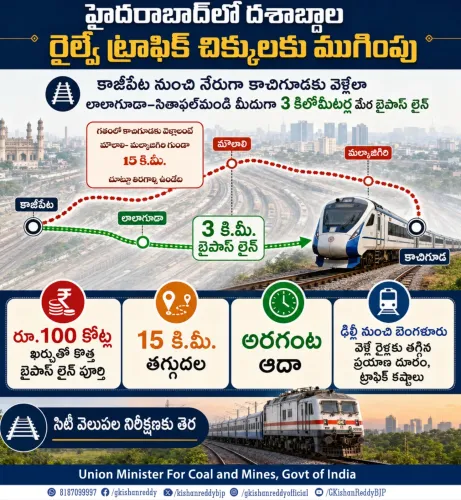
Posting in Telugu, Kishan Reddy outlined three core benefits the newly commissioned system delivers. Trains on the Malkajgiri–Kamareddy corridor will now travel faster and safer; the system will automatically intervene to prevent head-on or rear-end collisions when two trains approach each other on the same track; and adverse weather — fog, heavy rain, poor signal visibility — will no longer be the liability it once was for drivers and passengers alike.
KAVACH, developed indigenously by Indian Railways through its Research Designs and Standards Organisation (RDSO), works by continuously monitoring train position and speed, applying brakes automatically if a collision risk is detected. Version 4.0 is the latest iteration of that system, incorporating refined communication protocols and faster response logic compared with earlier generations.
SCR's first — and why that matters
South Central Railway, headquartered in Secunderabad, is one of 18 zones of Indian Railways and handles a dense web of passenger and freight traffic across Telangana and parts of neighbouring states. The fact that this is SCR's first-ever KAVACH deployment underscores how much of the national network still awaits coverage — even as Indian Railways has progressively rolled out the system on priority sections under successive railway budgets and safety action plans.
The Malkajgiri–Kamareddy route connects Hyderabad's northern commuter belt with a rapidly growing district headquarters, making it a high-utility corridor for both daily commuters and intercity passengers. Protecting that stretch is not a ceremonial tick-box — it is a tangible safety upgrade for tens of thousands of daily travellers.
The national rollout behind this single corridor
Indian Railways initiated KAVACH development in the mid-2010s as a fully indigenous answer to the Automatic Train Protection systems common on European and East Asian railways. The programme gained urgency after a string of high-profile collisions underlined the cost — in lives — of signal-passed-at-danger incidents. Successive railway budgets have allocated funds to scale deployment, with the stated ambition of covering high-density and vulnerable sections across all zones.
The SCR commissioning is a measurable data-point in that larger arc. The next markers to watch: which additional SCR sections are queued for installation, and what coverage targets and funding the next Railway Budget assigns to finish the job.
One corridor protected. Thousands of kilometres still to go. The clock is running.
Point of View
Amplifying this milestone in Telugu serves a dual purpose: it reinforces the BJP-led Centre's developmental narrative in Telangana, a state the party is keen to reclaim, while associating the Union government directly with a visible passenger-safety upgrade. The broader question the deployment raises is pace — with vast stretches of SCR and other zones still unprotected, the gap between ambition and ground-level coverage remains the most scrutinised metric for any future railway safety reckoning.
NationPress
24 Sept 2026
Frequently Asked Questions
What is KAVACH 4.0 and how does it work?
KAVACH 4.0 is the latest version of Indian Railways' indigenous Automatic Train Protection system, developed by RDSO. It continuously monitors train position and speed, automatically applying brakes if a collision risk — such as two trains approaching on the same track — is detected, and functions reliably even in poor weather conditions.
Where has KAVACH 4.0 been installed in Telangana?
KAVACH 4.0 has been installed on the 108-kilometre Malkajgiri–Kamareddy route within the South Central Railway zone, marking the first such deployment in SCR's history.
Who announced the KAVACH 4.0 deployment in Telangana?
Union Coal and Mines Minister and BJP Telangana state president G. Kishan Reddy announced the commissioning via a post on X on 24 September 2026 .
What is South Central Railway (SCR)?
South Central Railway is one of the 18 zones of Indian Railways, headquartered in Secunderabad, Hyderabad . It manages rail operations across Telangana and parts of neighbouring states.
Will KAVACH be extended to other routes in SCR?
The Malkajgiri–Kamareddy corridor is SCR's first KAVACH-enabled route. Indian Railways has a phased national rollout underway; future sections within SCR and other zones will be identified through railway budget allocations and safety action plans.