Kejriwal questions Centre on reported sale of country's gold
Synopsis
AAP convenor Arvind Kejriwal questioned the Modi government on X over reports suggesting India's gold is being sold, asking whether the country's finances have deteriorated sharply. He urged the Centre to publicly explain the economic situation, recalling that sovereign gold was not sold in 76 years since Independence despite past crises.
Key Takeaways
Arvind Kejriwal posted on X on 3 June 2026 questioning reports about the sale of India's gold.
He asked whether the government had become bankrupt and demanded a public clarification on the economy.
Kejriwal noted that in 76 years since Independence, India's gold had never been sold despite difficult times.
He invoked PM Narendra Modi's remark about walking away with a bag, contrasting it with citizens who must stay in the country.
India's gold and forex reserves are managed by the Reserve Bank of India , with the 1991 crisis a key reference point.
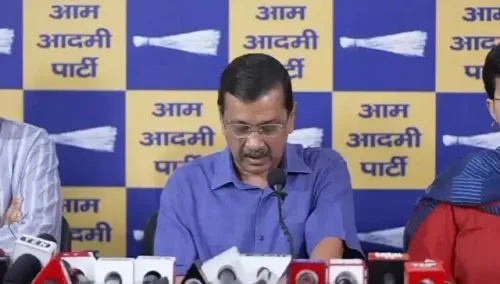
AAP convenor Arvind Kejriwal on Wednesday, 3 June 2026, publicly questioned the central government over what he described as reports of the country's gold being sold, demanding clarity on the state of the Indian economy. In a post on X, the former Delhi Chief Minister asked whether the situation had become so dire that sovereign gold was being liquidated, and pressed the Union government to address citizens directly.
'Is this news correct? Is the country's gold being sold? Has the government become so bankrupt?' Kejriwal wrote in Hindi, adding that in 76 years since Independence, India had faced many difficult moments but had never sold its gold. 'Iska matlab haalat bahut zyaada kharab hain?' (Does this mean conditions are extremely bad?), he asked.
He went on to challenge Prime Minister Narendra Modi to explain the country's economic situation, invoking a remark the Prime Minister has made in the past about being able to walk away with just a bag on his shoulder. 'Modi ji says he will just pick up his bag and leave. But we have to stay here, in this country,' Kejriwal said.
Context
The post does not name a specific transaction, agency, or document, but frames the question around a news item Kejriwal says he has seen. He uses the rhetorical device of asking the government to confirm or deny, rather than making a direct allegation of a sale.
Kejriwal, who serves as national convenor of the Aam Aadmi Party, has frequently used X to press the Union government on inflation, unemployment and fiscal management. The June 3 message extends that line of attack to sovereign assets, an area that historically carries heavy symbolic weight in Indian politics.
Policy backdrop
India's gold and foreign exchange reserves are held and managed by the Reserve Bank of India, which reports its position periodically through its weekly statistical supplement and annual report. Gold is treated as a strategic reserve asset alongside foreign currency holdings and Special Drawing Rights.
The political sensitivity around sovereign gold is rooted in the 1991 balance of payments crisis, when India pledged a portion of its gold reserves with the Bank of England and other institutions to secure emergency financing. That episode remains a reference point in any discussion of national reserves, and Kejriwal's invocation of '76 years' since Independence implicitly draws on that memory.
In subsequent years, the RBI has at times added to its gold holdings, including a notable purchase from the International Monetary Fund. Movements in reserves are typically disclosed through official statements rather than political channels.
Stakeholders and impact
The intervention places pressure on the Union Finance Ministry and the RBI to either confirm the underlying report Kejriwal references or to publicly rebut it. For ordinary citizens, gold reserves are a familiar shorthand for national financial strength, which is why such claims travel quickly across social media.
For the Aam Aadmi Party, the post fits a broader strategy of positioning Kejriwal as a national-level critic of the Modi government's economic record. Opposition parties have in recent months sharpened their focus on fiscal deficit, public debt and the management of state-owned assets.
The ruling Bharatiya Janata Party has consistently maintained that India's macroeconomic fundamentals remain strong and that reserves are at comfortable levels. Any formal response to Kejriwal's post is likely to follow that line.
What's next
Attention will turn to the RBI's forthcoming disclosures on foreign exchange and gold reserves, as well as to any clarifications issued by the Finance Ministry. Parliamentary questions on the management of sovereign assets are also a likely follow-up, particularly from opposition benches.
If the central government chooses to respond directly to Kejriwal's questions, the exchange could escalate into a broader debate on transparency around India's reserves, an arena where political messaging and technical economic policy frequently collide.
Point of View
Using the emotionally charged symbol of national gold to force the Centre to engage. By anchoring his question in the '76 years since Independence' frame, he taps the lingering political memory of 1991, when pledged gold became shorthand for national humiliation. The move signals that AAP intends to contest the Modi government's economic record on terrain beyond inflation and jobs, extending it to sovereign asset stewardship. Whether the Centre or RBI responds will shape whether this remains a one-day flare or hardens into a sustained opposition theme.
NationPress
21 Oct 2026
Frequently Asked Questions
What did Arvind Kejriwal say about India's gold?
Kejriwal questioned whether reports of India's gold being sold are correct and asked if the government's finances have deteriorated to that extent. He demanded that the Centre publicly explain the country's economic situation.
When did Kejriwal post about the gold sale?
He posted the message on X on the morning of 3 June 2026 . The post was written in Hindi and addressed directly to Prime Minister Narendra Modi and the Union government.
Has India ever sold its gold reserves?
India has not sold its sovereign gold in the way Kejriwal's post implies, but during the 1991 balance of payments crisis the country pledged a portion of its gold reserves abroad to secure emergency financing. Since then, the RBI has at times added to its gold holdings.
Who manages India's gold reserves?
The Reserve Bank of India holds and manages the country's gold and foreign exchange reserves. It discloses reserve positions through periodic statistical releases and its annual report.
Why is gold politically sensitive in India?
Sovereign gold is widely seen as a symbol of national financial strength and independence. The 1991 episode, when gold was pledged abroad during a crisis, has made any suggestion of selling reserves politically charged.