Quantum physics meets the brain: Nobel laureate Frank Wilczek on mind and mechanics
Synopsis
Nobel laureate Frank Wilczek links Victorian cat-dropping experiments by Maxwell and Stokes to quantum physics, free will, and the mechanics of the brain — arguing that a 2026 cat-spine study and century-old biomechanics still hold clues to consciousness and modern robotics.
Key Takeaways
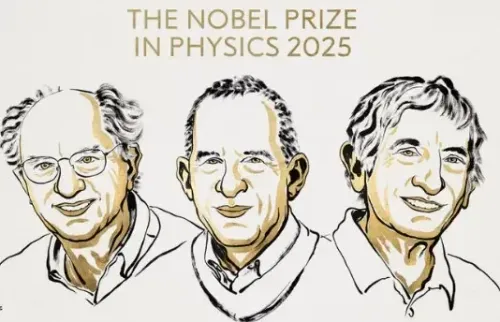
Frank Wilczek , winner of the 2004 Nobel Prize in Physics , has written about the intersection of quantum physics and brain mechanics in September 2026 .
James Clerk Maxwell and Sir George Gabriel Stokes conducted 'cat-turning' experiments at Trinity College, Cambridge in the 1850s to study how cats land on their feet.
French physiologist Etienne-Jules Marey used a chronophotographic camera recording 12 frames per second to document cat reorientation in 1894 .
A formal dynamical model of cat-turning was published in 1969 ; a 2026 study updated it using measured properties of a real cat's spine.
Wilczek connects the cat-turning problem to broader questions of determinism, free will, control theory , and the mechanics of conscious experience.
The research has direct implications for modern robotics and self-driving car systems that rely on real-time biological-style control solutions.
Nobel Prize-winning physicist Frank Wilczek has turned his attention to one of science's most enduring puzzles: what happens when the principles of quantum physics are applied to the mechanics of the brain and conscious experience. Writing in September 2026, Wilczek — awarded the Nobel Prize in Physics in 2004 for his discovery of asymptotic freedom in the theory of the strong interaction — traces a surprising intellectual lineage from Victorian cat-dropping experiments to the frontier of neuroscience and determinism.
From Victorian parlours to quantum consciousness
The story begins, improbably, with cats. Sir George Gabriel Stokes and James Clerk Maxwell, two of the nineteenth century's foremost mathematical physicists, were captivated in the 1850s by a cat's uncanny ability to land on its feet even when dropped upside-down. Maxwell, writing of his time at Trinity College, Cambridge, described the methodology with characteristic precision: 'There is a tradition in Trinity that when I was here I discovered a method of throwing a cat so as not to light on its feet, and that I used to throw cats out of windows. I had to explain that the proper object of research was to find how quick the cat would turn round, and that the proper method was to let the cat drop on a table or bed from about two inches, and that even then the cat lights on her feet.'
High-speed photography and the science of cat-turning
Technology eventually caught up with the question. French physiologist Etienne-Jules Marey deployed a chronophotographic camera capable of recording 12 frames per second, and in 1894 published a landmark stop-action sequence revealing precisely how cats reorient mid-fall. The images remain a classic of biomechanics. A formal dynamical model followed in 1969, and the subject has not stood still since: a 2026 study pushed the research further by replacing idealised hinges and cylinders with measured properties of a real cat's spine, bringing the model closer to biological reality.
Why it matters: mechanics, mind, and free will
Wilczek's broader argument connects this thread of classical and biomechanical inquiry to deeper questions about Newtonian mechanics, control theory, determinism, and ultimately free will. The cat-turning problem — how a body with zero net angular momentum can still reorient itself — is a concrete illustration of the gap between simple physical laws and complex biological outcomes. That gap, Wilczek suggests, is precisely where questions about the mind become interesting. The same principles animating modern robotics and self-driving car systems have their roots in understanding how biological bodies solve control problems in real time.
The competitive backdrop: physics, neuroscience, and AI
Wilczek's intervention arrives at a moment when the intersection of physics and neuroscience is attracting serious institutional attention. Researchers drawing on Schrödinger's legacy — particularly his famous thought experiment involving a cat — have long used quantum indeterminacy as a conceptual wedge into debates about consciousness and free will. The 2026 cat-spine study signals that even century-old biomechanics problems retain the capacity to generate new empirical knowledge, with direct implications for robotics design and neural modelling.
What's next
As computational neuroscience and quantum biology continue to converge, Wilczek's framing suggests the most productive frontier may lie not in grand unified theories of consciousness, but in granular, measurable problems — like how a spine bends mid-fall — that constrain speculation with data. Researchers in biomechanics, AI motor control, and theoretical neuroscience are the communities most likely to carry this line of inquiry forward.
Point of View
Not just quantum computing centres. The cat-turning lineage — from Maxwell's Trinity parlour to a 2026 spine-measurement study — illustrates how physical constraints on biological bodies generate the very control-theory insights now embedded in robotics and autonomous vehicles. Mainstream coverage of 'quantum consciousness' tends to leap to grand claims; Wilczek's grounding in measurable, falsifiable mechanics is a useful corrective. The deeper implication is that free will and determinism debates may be resolved not by philosophy alone, but by sufficiently detailed physical models of how brains and bodies actually move.
NationPress
4 Sept 2026
Frequently Asked Questions
What is Frank Wilczek's argument about quantum physics and the brain?
Frank Wilczek argues that the principles underlying quantum physics and classical mechanics — including control theory and biomechanics — offer a rigorous framework for examining how the brain generates complex behaviour, touching on questions of free will and determinism. He traces this argument through the history of cat-turning experiments, from Maxwell in the 1850s to a 2026 study on cat spines.
Who were the first scientists to study how cats land on their feet?
Sir George Gabriel Stokes and James Clerk Maxwell were among the first to study cat-turning scientifically, conducting experiments in the 1850s at Trinity College, Cambridge. Maxwell famously described dropping cats from two inches onto a table to measure how quickly they could reorient.
What did Etienne-Jules Marey discover about cats?
Etienne-Jules Marey used a chronophotographic camera recording 12 frames per second to capture the precise sequence of movements cats use to right themselves mid-fall, publishing his findings in 1894. His stop-action photographs remain a landmark in biomechanics.
Why does cat-turning matter for robotics and AI?
The cat-turning problem — how a body with zero net angular momentum reorients itself — is a foundational control-theory challenge directly relevant to robotics and self-driving car systems. Solutions developed through biomechanics research inform how autonomous machines manage balance and motion in real time.
What did the 2026 cat-spine study find?
A 2026 study advanced the classic 1969 dynamical model of cat-turning by replacing idealised mechanical components with measured properties of a real cat's spine, bringing the theoretical model closer to biological reality. The research signals continued scientific interest in the biomechanics of animal motion.