China sets 420km atom entanglement record, quadrupling prior mark
Synopsis
Chinese physicists have entangled rubidium atoms across 420km of optical fibre — more than four times the previous record — crossing the physical threshold beyond which direct transmission fails. The result, published in Physical Review Letters, brings repeater-based intercity quantum networks a decisive step closer to reality.
Key Takeaways
Chinese scientists achieved quantum entanglement of cold atoms across 420km (260 miles) , more than four times any prior demonstration.
The experiment used laser-cooled rubidium atom clouds as quantum memory nodes, connected by an optical fibre link.
Results were published in the peer-reviewed journal Physical Review Letters on August 11, 2026 .
The team included Pan Jianwei of the University of Science and Technology of China in Hefei, Anhui province .
The distance exceeded the fundamental physical limit at which direct photon transmission becomes infeasible, making the quantum memory approach essential for scaling.
The team described the setup as a ‘test bed for studying quantum-network applications beyond the metropolitan scale.’
Chinese scientists have entangled cold atoms across a record 420 kilometres (260 miles), more than four times any previously demonstrated distance, in a breakthrough that could underpin intercity quantum communication networks. The findings were published in the peer-reviewed journal Physical Review Letters on August 11, 2026, marking a significant milestone in the global race to build practical quantum infrastructure.
The experiment explained
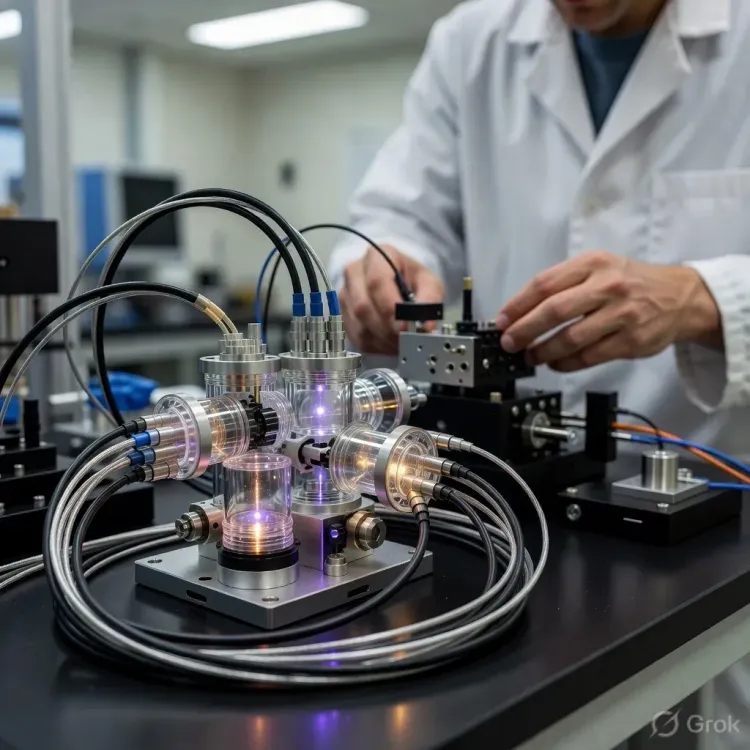
The research team deployed two quantum memory units — each comprising laser-cooled clouds of rubidium atoms — positioned 420km apart and connected via an optical fibre link. The goal was to achieve quantum entanglement, the phenomenon in which two or more particles become inextricably linked and share a joint quantum state regardless of the physical distance separating them.
Crucially, the achieved distance also exceeded the threshold at which direct photon transmission runs into fundamental physical limits, making quantum memory nodes essential for any real-world long-distance network.
Why it matters
Entangling light particles across open space or optical fibre has been demonstrated before, but incorporating quantum memory into the chain significantly complicates the process. Successfully doing so at this scale is considered a prerequisite for building repeater-based quantum networks that can span cities and eventually nations.
“Our experiment provides a test bed for studying quantum-network applications beyond the metropolitan scale,” the team said. The group included Pan Jianwei, a leading quantum physicist at the University of Science and Technology of China in Hefei, Anhui province.
The competitive backdrop
China has invested heavily in quantum communication infrastructure over the past decade, including the world’s first quantum satellite and a Beijing-to-Shanghai quantum backbone network. This latest result extends that lead in ground-based entanglement distance and adds a critical capability — quantum memory — that earlier demonstrations lacked.
Rival programmes in the United States, Europe, and Japan are pursuing similar repeater-node architectures, but none have publicly reported fibre-based atom entanglement at comparable distances.
What’s next
The researchers describe the setup as a “test bed”, signalling that further scaling and integration with existing fibre infrastructure are the immediate priorities. Practical intercity quantum key distribution — enabling theoretically unbreakable encrypted communications — is the near-term application most likely to benefit from this advance.
As quantum hardware matures and signal-loss mitigation improves, the architecture demonstrated in Hefei could form the backbone of a national — and eventually international — quantum internet.
Point of View
Which is the exact engineering bottleneck blocking real-world quantum repeater networks. Mainstream coverage tends to frame such milestones as abstract science wins, but the strategic dimension is sharper: China is systematically closing the hardware gaps between laboratory physics and deployable quantum communication infrastructure, an area with direct implications for sovereign encrypted communications. The inclusion of Pan Jianwei — architect of China’s quantum satellite programme — signals institutional continuity and state-level prioritisation. Western quantum networking programmes, largely fragmented across academic consortia, have yet to publish comparable fibre-based atom entanglement results at this scale.
NationPress
28 Sept 2026
Frequently Asked Questions
What did Chinese scientists achieve in quantum entanglement?
Chinese scientists entangled cold rubidium atoms across 420km of optical fibre, more than four times the previous record distance. The experiment used quantum memory nodes at each end and was published in Physical Review Letters on August 11, 2026 .
Why is the 420km quantum entanglement record significant?
The distance surpasses the physical threshold beyond which direct photon transmission through fibre becomes impossible due to signal loss. Successfully using quantum memory to bridge this gap is a prerequisite for building practical long-distance quantum communication networks.
Who led the quantum entanglement experiment in China?
The research team included Pan Jianwei , a prominent quantum physicist at the University of Science and Technology of China in Hefei, Anhui province . Pan has previously led China’s quantum satellite programme.
What is quantum memory and why does it matter for quantum networks?
Quantum memory stores quantum states in matter — in this case, laser-cooled clouds of rubidium atoms — allowing quantum information to be held and synchronised across network nodes. Without it, building repeater-based quantum networks that extend beyond city scale is not feasible.
How does China’s result compare to other countries’ quantum network efforts?
No rival programme in the United States , Europe , or Japan has publicly reported fibre-based atom entanglement at a comparable distance. China’s result extends a lead it has built through investments including the world’s first quantum satellite and the Beijing -to- Shanghai quantum backbone network.