China builds world's first superfast quantum memory, unlocking big-data computing
Synopsis
Scientists at Zhejiang University have built the world's first superfast quantum random access memory (QRAM) on a superconducting processor, eliminating the classical data-access bottleneck that has long prevented quantum computers from delivering real-world speed-ups in drug discovery and financial fraud detection.
Key Takeaways
Zhejiang University researchers announced the world's first superfast quantum random access memory (QRAM) on 5 June 2026 .
The breakthrough was published in the peer-reviewed journal Nature Physics , led by researcher Lu Liqiang .
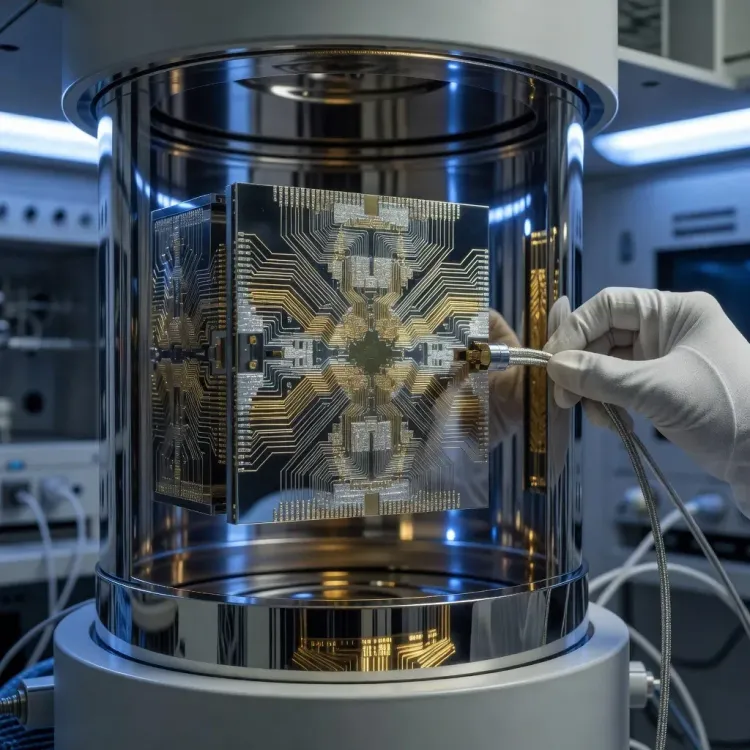
The device is built on a superconducting quantum processor , the dominant hardware platform in global quantum computing.
QRAM resolves a critical bottleneck: without it, quantum machines must process large classical datasets sequentially, negating their speed advantage.
Priority applications include drug discovery , financial fraud detection , and artificial intelligence workloads requiring large-scale data access.
The work is a proof-of-concept; scaling to enterprise-grade qubit counts remains the next engineering hurdle.
A team led by Zhejiang University has developed the world's first superfast quantum random access memory (QRAM), solving a long-standing data-access bottleneck that has held back practical quantum computing. The breakthrough, published in Nature Physics and announced on 5 June 2026, could accelerate quantum applications in drug discovery, financial fraud detection, and other big-data domains.
Why it matters
Quantum computers rely on qubits — units of information that, unlike classical bits, can represent zero and one simultaneously through a phenomenon called superposition. Combined with quantum entanglement, this allows quantum machines to tackle certain problems exponentially faster than even the most powerful conventional supercomputers. However, without a high-speed interface to classical data, even the fastest quantum processor is throttled when forced to ingest large datasets sequentially.
According to the research team, QRAM 'enables efficient access to classical data for quantum computers and is a prerequisite for many quantum algorithms in achieving quantum speed-up.' The new device directly addresses that prerequisite, removing a critical architectural constraint.
The technical backdrop
The memory system was built on a superconducting quantum processor, the same hardware architecture used by leading quantum computing programmes globally. The team was led by researcher Lu Liqiang, according to reports citing Science and Technology Daily. Superconducting platforms have been central to quantum computing advances by Google, IBM, and China's own national research programmes, making this development directly relevant to the mainstream hardware roadmap.
Classical computers store and retrieve data in random-access memory at nanosecond speeds; quantum computers have lacked an equivalent. The new QRAM architecture reportedly bridges that gap, enabling quantum algorithms that require rapid, parallel lookups across large classical datasets.
Real-world applications
The implications extend well beyond the laboratory. Quantum speed-up in database search underpins algorithms for drug discovery — where molecules must be screened against vast biological datasets — and for detecting fraudulent financial activities, where anomaly detection across millions of transactions demands extraordinary processing throughput. Both sectors have been identified by China's national science strategy as priority areas for quantum advantage.
Artificial intelligence workloads that involve large-scale optimisation and pattern recognition are also expected to benefit, as QRAM could allow hybrid classical-quantum pipelines to operate without the sequential data-loading penalty that currently limits them.
What's next
The research marks a proof-of-concept milestone rather than a commercially deployable product, and scaling QRAM to the qubit counts needed for enterprise workloads remains an open engineering challenge. Nonetheless, the publication in Nature Physics signals peer-validated progress at a moment when the global race to demonstrate practical quantum advantage is intensifying. Observers will be watching whether Zhejiang University's team can demonstrate the architecture at larger qubit scales, and whether international competitors move to replicate or extend the design.
Point of View
Though independent replication at scale will be the real test. If the architecture holds up, it could shift the quantum computing timeline for hybrid AI-quantum workloads faster than current industry roadmaps anticipate.
NationPress
21 Oct 2026
Frequently Asked Questions
What is QRAM and why does it matter for quantum computing?
QRAM, or quantum random access memory, is a high-speed interface that allows quantum computers to efficiently retrieve large amounts of classical data. Without it, quantum processors must read data sequentially, eliminating the speed advantage that makes quantum computing valuable for big-data tasks like drug discovery and fraud detection.
Who developed the world's first superfast quantum memory?
The breakthrough was developed by a team led by researcher Lu Liqiang at Zhejiang University in China , with findings published in Nature Physics on 5 June 2026 .
What practical applications does this QRAM breakthrough enable?
The technology is expected to accelerate quantum algorithms used in drug discovery , financial fraud detection , and artificial intelligence optimisation — all tasks that require rapid, parallel access to massive classical datasets.
What hardware platform was used to build the quantum memory?
The QRAM was implemented on a superconducting quantum processor , the same class of hardware used by leading global quantum computing programmes, making the approach compatible with the mainstream development roadmap.
Is this quantum memory ready for commercial use?
Not yet. The current work is a proof-of-concept milestone. Scaling the QRAM architecture to the qubit counts required for enterprise applications remains an open engineering challenge, and independent replication of the results will be a key next step.