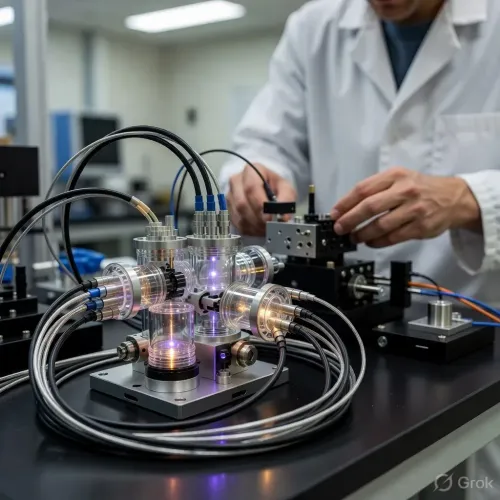
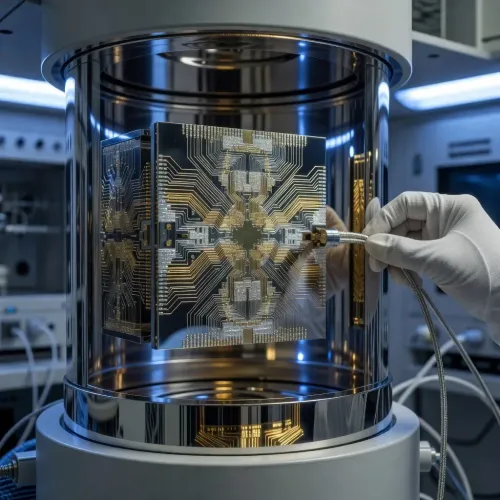
China's handheld quantum magnetometer tracks subway trains underground
Synopsis
A pencil-sized, 5-watt quantum magnetometer built by Chinese researchers tracked a subway train underground — a real-world proof-of-concept for a device explicitly designed to hunt submarines, published in peer review on September 14.
Key Takeaways
Peng Xinhua and colleagues at the University of Science and Technology of China developed a handheld quantum magnetometer for anti-submarine warfare applications.
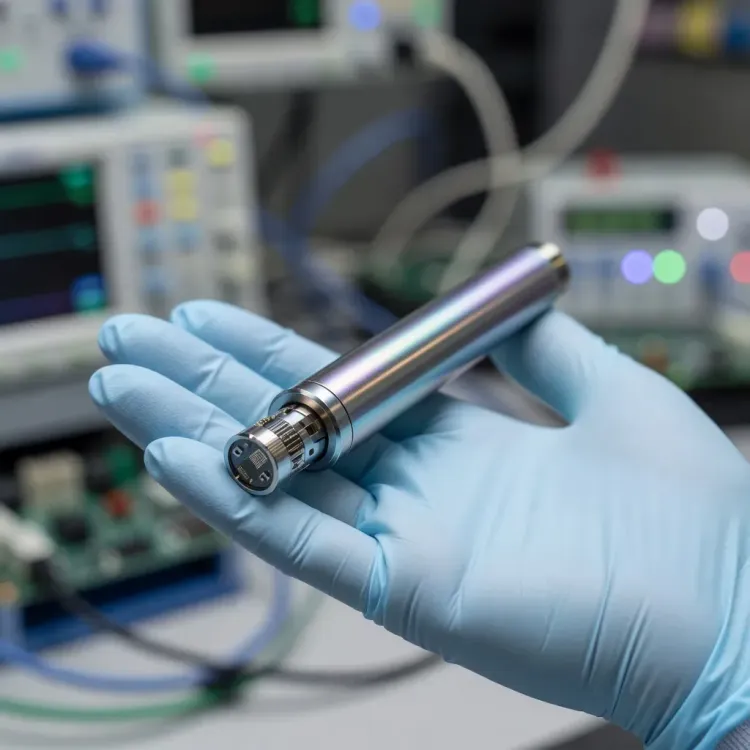
The device is scarcely larger than a pencil and consumes only 5 watts of power.
In a real-world test, it tracked a subway train braking, stopping, and departing underground — demonstrating its ability to isolate magnetic anomalies in noisy field conditions.
The research was published on September 14 in Acta Physica Sinica , signalling peer-reviewed validation of the technology.
Commercial competitors such as QuSpin of California produce quantum magnetometers, but the Chinese device's combination of size, power draw, and field performance represents a notable advance.
The technology's dual-use nature places it at the centre of ongoing competition in naval surveillance among China , the United States , and South Korea .
A pencil-sized quantum magnetometer developed by Chinese researchers has successfully tracked a moving subway train beneath a city street, demonstrating capabilities directly relevant to anti-submarine warfare (ASW). The device, built by Peng Xinhua and colleagues at the University of Science and Technology of China, was described in a peer-reviewed study published on September 14 in Acta Physica Sinica.
What the device can do
Despite drawing just 5 watts of power and being scarcely larger than a pencil, the handheld sensor can isolate the faint magnetic disturbance generated by a large moving metallic object within the Earth's vast background geomagnetic field. In testing, it clearly recorded a train braking into a station, its complete stop, and its subsequent departure under traction — all from above ground.
The significance lies in what this implies for open-water deployment: a submarine's steel hull produces a comparable magnetic anomaly, meaning a compact, low-power instrument of this kind could, in principle, detect submerged vessels from aircraft, ships, or even unmanned platforms.
Why it matters for defence
Quantum magnetometers operate on atomic physics principles that give them sensitivity orders of magnitude beyond conventional fluxgate sensors. Until recently, such instruments were largely laboratory-bound due to size, power, and operational complexity constraints. A field-portable version changes the calculus for anti-submarine warfare, a domain where the United States, South Korea, and other naval powers have invested heavily for decades.
The study's publication in Acta Physica Sinica, a leading Chinese physics journal, signals that this research has cleared peer review and is being made available to the broader scientific community — a notable choice given its dual-use sensitivity.
The competitive backdrop
Commercial quantum sensing has advanced rapidly, with firms such as QuSpin, based in California, producing optically pumped magnetometers for research and geophysical surveying. However, achieving the combination of miniaturisation, low power draw, and operational robustness demonstrated in this University of Science and Technology of China study represents a meaningful step beyond currently available commercial products.
The research also acknowledges the challenge of geomagnetic noise. Real-world ASW operations must contend with geomagnetic storms and other background interference, problems that the International Real-time Magnetic Observatory Network monitors globally. The team's ability to extract a clear signal from a subway train — itself an electrically noisy, magnetically cluttered environment — suggests the signal-processing algorithms are already operating under realistic conditions.
What's next
The immediate question is whether the device can perform equivalently at sea, where wave motion, saltwater interference, and deeper target depths complicate detection. Regional naval rivals including South Korea — which operates the Cheongyang magnetic observatory — and Japan will be watching closely. Further miniaturisation and integration with autonomous platforms are the logical next steps, and how quickly China moves from laboratory demonstration to operational fielding will define the device's strategic impact.
Point of View
Not concealing it. Mainstream coverage focuses on the subway-train demonstration as a curiosity, but the deeper story is that miniaturised quantum sensing is eroding the acoustic and magnetic stealth advantages that Western submarine fleets have relied on for generations. This development sits squarely within the broader dual-use technology competition: the same sensor miniaturisation race driving commercial quantum computing investment is now yielding field-portable ASW tools that bypass the need for large, expensive towed-array sonar systems. Nations like South Korea, which sits closest to both Chinese and North Korean submarine activity, face the most immediate pressure to accelerate their own quantum sensing programmes.
NationPress
25 Sept 2026
Frequently Asked Questions
What did China's quantum magnetometer actually detect in its test?
The device detected the magnetic disturbance of a subway train moving underground, clearly recording the train braking into a station, stopping, and departing under traction. The test was conducted by researchers at the University of Science and Technology of China and published on September 14 in Acta Physica Sinica .
Why is a handheld quantum magnetometer significant for anti-submarine warfare?
Submarines generate a magnetic anomaly as their steel hulls distort the Earth's background geomagnetic field — the same physical principle that allowed detection of the subway train. A compact, low-power sensor capable of isolating these anomalies could be deployed on aircraft, ships, or unmanned platforms, dramatically expanding the coverage area for submarine hunting compared to traditional towed-array sonar.
How does this Chinese device compare to existing quantum magnetometers?
Commercial producers such as QuSpin of California already make optically pumped magnetometers for research and geophysical use. The advance in the Chinese study is the combination of pencil-scale size, a 5-watt power draw, and demonstrated field performance in a magnetically noisy real-world environment, which together go beyond currently available commercial products.
Which countries are most affected by this development?
The United States and South Korea — both of which have invested heavily in anti-submarine warfare infrastructure — face the most direct strategic implications. South Korea operates the Cheongyang magnetic observatory and sits adjacent to some of the most contested submarine transit corridors in the region.
What are the next steps for this technology?
Researchers will need to demonstrate equivalent performance at sea, where wave motion, saltwater interference, and greater target depth complicate magnetic anomaly detection. Integration with autonomous aerial or naval platforms is the most strategically significant next step, and the pace at which China transitions from laboratory demonstration to operational deployment will be the key variable to watch.