Australian researchers predict new quantum matter from boson-fermion droplets

Synopsis
Scientists at Monash University have predicted a form of quantum matter that most physicists thought couldn't exist — stable droplets formed from two fundamentally opposite particle types. With existing lab equipment potentially able to confirm the finding, this could be one of the more consequential theoretical leaps in ultracold physics in years.
Key Takeaways
Monash University researchers, in collaboration with Heidelberg University , have predicted a new type of quantum matter called quantum droplets formed from mixtures of bosons and fermions .
The study, published in Physical Review Letters , challenges long-held assumptions that such droplets could not form in strongly interacting Bose-Fermi systems.
The droplets are held together by a precise balance between inter-particle attraction and the outward pressure of fermions — a purely quantum mechanical effect.
Lead author Sam Foster , a PhD candidate at Monash, said previous theories were limited to weak interactions; the new framework extends to stronger, more complex regimes.
The research team says the predicted droplets are achievable using existing ultracold atom experiments , making experimental verification a realistic near-term step.
Potential applications span quantum computing , ultra-precise sensors , and broader quantum materials science.
Researchers at Monash University in Melbourne, Australia have predicted a previously unknown form of quantum matter, potentially overturning decades of scientific consensus about how ultracold particles behave under extreme conditions. The findings, published in Physical Review Letters, were developed in collaboration with scientists at Heidelberg University in Germany.
What Was Discovered
The study demonstrates that under precisely controlled conditions, mixtures of two fundamentally distinct categories of quantum particles — bosons and fermions — can form stable, self-bound structures known as 'quantum droplets.' Until now, the scientific community broadly held that such exotic droplets were unlikely to form in strongly interacting Bose-Fermi systems.
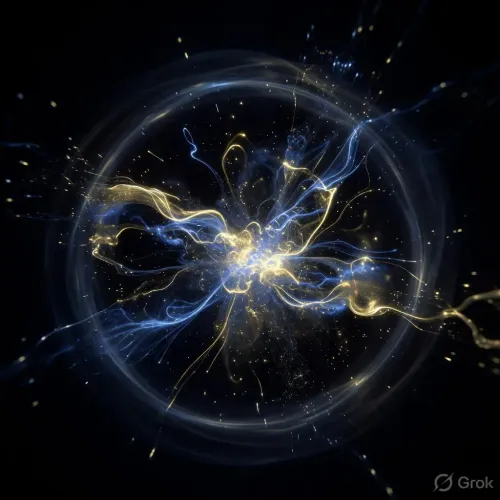
Unlike an ordinary liquid droplet held together by surface tension, a quantum droplet is governed entirely by the strange rules of quantum mechanics. According to the study, an attractive force between the two particle types is precisely counterbalanced by the outward pressure generated by the fermions — preventing the system from collapsing in on itself.
What the Lead Researcher Said
Sam Foster, a PhD candidate at Monash University's School of Physics and Astronomy and lead author of the study, described the result as resolving a long-standing theoretical challenge. 'These two very different types of particles could balance each other perfectly to create a stable droplet that effectively holds itself together,' Foster said.
Foster noted that previous theoretical frameworks could only describe such systems when particle interactions were relatively weak. The new approach, he said, allows researchers to explore stronger interaction regimes 'where more complex physics emerges.'
Why This Matters
The predicted droplets are not merely a theoretical curiosity. According to the research team, the conditions required to produce them are achievable using existing ultracold atom experiments, making laboratory confirmation a realistic near-term goal. This is significant: many quantum predictions remain confined to theory for years before experimental infrastructure catches up.
Researchers said the discovery provides a new theoretical roadmap for laboratories worldwide and could deepen understanding of quantum materials that underpin next-generation technologies — from ultra-precise sensors to quantum computing platforms.
Broader Scientific Context
The study adds to a growing body of research into quantum droplets, a field that has expanded rapidly since the first experimental confirmation of purely bosonic quantum droplets roughly a decade ago. Extending the phenomenon to mixed Bose-Fermi systems represents a qualitative leap, as the interplay between the two particle types introduces far greater complexity. Notably, this is also the kind of foundational theoretical work that historically precedes experimental breakthroughs by months to a few years, as global ultracold atom labs race to verify predictions.
What Comes Next
The Monash-Heidelberg team's findings are expected to inform experimental programmes at ultracold atom facilities across Europe, North America, and Asia. If confirmed in the lab, quantum droplets in Bose-Fermi mixtures could open entirely new avenues in quantum materials science and accelerate the development of quantum sensing and computing technologies.
Point of View
Which is rare for a finding of this theoretical depth. Most coverage will focus on the 'new form of matter' framing, but the harder question is whether the Bose-Fermi droplet survives contact with real-world experimental noise and decoherence. If it does, this reshapes the theoretical landscape for quantum materials. If it doesn't, it joins a long list of elegant predictions that reality refused to cooperate with. The collaboration between Monash and Heidelberg also signals that foundational quantum physics is increasingly a globally distributed enterprise, with Australia punching above its weight in this space.
NationPress
1 Oct 2026
Frequently Asked Questions
What is the new form of quantum matter predicted by Australian researchers?
Researchers at Monash University have predicted stable, self-bound structures called 'quantum droplets' that form from mixtures of bosons and fermions — two fundamentally different types of quantum particles. These droplets are held together not by conventional forces but by a precise quantum mechanical balance between inter-particle attraction and fermion pressure.
Where was the study published and who were the collaborators?
The study was published in Physical Review Letters, one of the leading journals in physics. It was conducted by researchers at Monash University in Melbourne, Australia, in collaboration with scientists at Heidelberg University in Germany.
Why is this discovery considered significant?
Until now, scientists believed stable quantum droplets were unlikely to exist in strongly interacting Bose-Fermi systems. The new theoretical framework extends beyond earlier weak-interaction models, opening a largely unexplored regime of quantum physics with implications for quantum computing and sensing technologies.
Can these quantum droplets actually be created in a laboratory?
According to the research team, yes. The conditions required to produce the predicted droplets are achievable using existing ultracold atom experiments, making experimental confirmation a realistic near-term goal rather than a distant prospect.
Who led the research?
The study was led by Sam Foster, a PhD candidate at Monash University's School of Physics and Astronomy, working alongside collaborators from Heidelberg University in Germany.