Kejriwal Questions Why Champat Rai Hasn't Been Removed Over Ram Mandir Donation Controversy
Synopsis
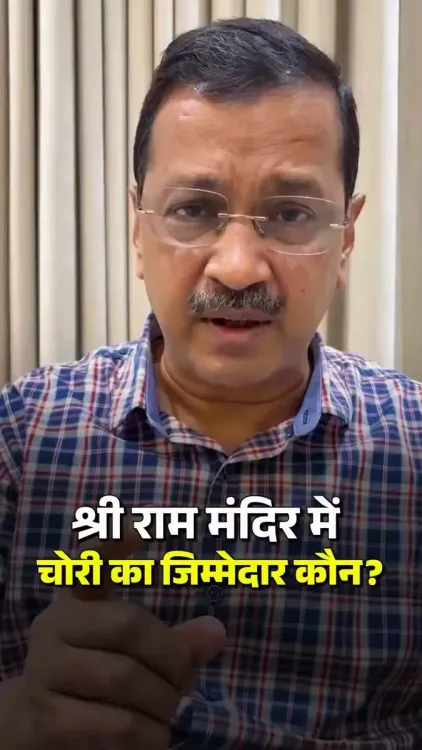
AAP convenor Arvind Kejriwal on 23 June 2026 publicly challenged the government to explain why Champat Rai, general secretary of the Ram Mandir trust, remains in his post despite mounting allegations of crores in stolen donations, warning that Rai's removal could expose senior figures.
Key Takeaways
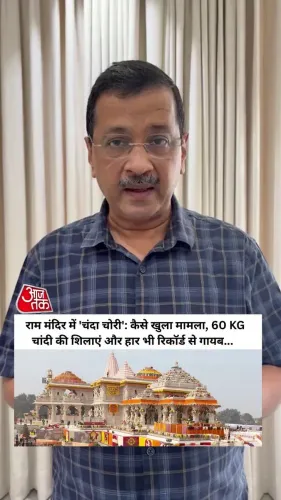
Kejriwal posted on 23 June 2026 demanding accountability over alleged theft of crores in donations from the Ayodhya Ram Mandir .
He specifically targeted Champat Rai , general secretary of the Shri Ram Janmabhoomi Teerth Kshetra Trust , asking why he has not been removed.
Kejriwal suggested Rai's continued tenure may be linked to fears that his removal could 'expose many big faces.' The Ram Mandir Trust was constituted in February 2020 following the Supreme Court's November 2019 verdict on the Ayodhya title dispute.
Kejriwal framed this as his 'first question' to the government, indicating further challenges are planned.
The specific allegations of large-scale donation theft remain unverified by established public records as of publication.
AAP convenor Arvind Kejriwal on Tuesday, 23 June 2026, publicly demanded that the central government explain why Champat Rai, general secretary of the Shri Ram Janmabhoomi Teerth Kshetra Trust, has not been removed amid mounting allegations of financial irregularities in donations collected for the Ayodhya Ram Mandir. Kejriwal said he was posing his 'first question' to the government on the matter, framing the controversy as a betrayal of crores of Ram devotees.
In his post, Kejriwal wrote: 'राम मंदिर से करोड़ों का चंदा चोरी हो गया।' ('Crores in donations have been stolen from the Ram Mandir.') He added that devotees are 'very angry and have many questions in their minds.' Directing his challenge squarely at the government, he said: 'The entire Ram Mandir is under the control of Champat Rai. The maximum allegations are being levelled against him. Why has he not been removed yet?'
Context
The Shri Ram Janmabhoomi Teerth Kshetra Trust was constituted in February 2020 following the Supreme Court's landmark November 2019 verdict on the Ayodhya title dispute. The trust was mandated to oversee the construction of the Ram Mandir and to receive and manage public donations for the project. Champat Rai, a senior functionary associated with the Vishwa Hindu Parishad (VHP) and RSS, has served as the trust's general secretary since its formation.
The temple, built at the site of the former Babri Masjid in Ayodhya, Uttar Pradesh, attracted donations from millions of devotees across the country. Public donations have formed a significant portion of the project's funding base, making financial accountability a matter of wide public interest.
Policy Backdrop
Opposition leaders have questioned the financial oversight mechanisms of the Ram Mandir trust since its inception. The trust, constituted through a government notification, operates under a degree of public scrutiny given the scale of donations involved and the religious significance of the project to a large section of the population.
Kejriwal's intervention follows a broader pattern in Indian politics where accountability at prominent religious sites and large-scale donation-funded projects becomes a flashpoint between the ruling dispensation and the opposition. He went further, suggesting a possible reason for Rai's continued tenure: 'Is there a fear that if Champat Rai opens his mouth, many big faces will be exposed?' This framing implies alleged complicity at higher levels, though no specific individuals beyond Rai are named in the post.
Stakeholders and Impact
The controversy directly concerns the millions of devotees — referred to by Kejriwal as 'Ram bhakts' — who contributed donations to the temple's construction and upkeep. For these donors, questions of financial propriety carry both civic and religious weight. The trust's management and its accountability structures are therefore of immediate concern to a vast and emotionally invested constituency.
The allegations, if substantiated through any formal inquiry or audit, could have significant implications for the trust's credibility and for the political standing of those associated with it. As of the time of publication, the trust had not issued a public response to Kejriwal's questions, and the specific allegations of large-scale donation theft remain unverified by established public records.
What's Next
Kejriwal indicated this is his 'first question' to the government, signalling that further questions are likely to follow, potentially building into a sustained political campaign around the issue. Any formal audit disclosure, trust response, or government statement on the matter will be closely watched.
The controversy may also prompt broader discussion in upcoming parliamentary sessions about the regulatory framework governing financial oversight of religious endowments and publicly-funded trusts in India. Whether opposition pressure translates into any institutional review of the trust's finances remains to be seen.
Point of View
AAP seeks to occupy moral ground that is difficult for the ruling dispensation to contest without appearing defensive. The 'first question' framing is a classic serial-pressure tactic, designed to generate a news cycle with each successive post. More broadly, this fits a pattern of opposition parties attempting to wedge the government on the governance of institutions that carry deep popular and religious legitimacy. The durability of this line of attack will depend entirely on whether any formal audit or institutional response emerges to either substantiate or refute the underlying allegations.
NationPress
23 Jun 2026
Frequently Asked Questions
What did Kejriwal say about the Ram Mandir donations?
Kejriwal alleged on 23 June 2026 that crores of rupees in donations to the Ayodhya Ram Mandir had been stolen, and demanded the government explain why Champat Rai, the trust's general secretary, has not been removed despite facing the most allegations.
Who is Champat Rai and what is his role in the Ram Mandir trust?
Champat Rai is a senior VHP and RSS-linked functionary who serves as the general secretary of the Shri Ram Janmabhoomi Teerth Kshetra Trust, the body constituted in February 2020 to oversee the construction and administration of the Ayodhya Ram Mandir.
What is the Shri Ram Janmabhoomi Teerth Kshetra Trust?
It is the trust set up by the central government in February 2020, following the Supreme Court's November 2019 Ayodhya verdict, to manage the construction and ongoing administration of the Ram Mandir and to receive public donations for the project.
Has the Ram Mandir trust responded to Kejriwal's allegations?
As of the time of publication, no public response from the Shri Ram Janmabhoomi Teerth Kshetra Trust had been issued in reply to Kejriwal's questions posted on 23 June 2026.
Are the Ram Mandir donation theft allegations verified?
The specific allegations of large-scale donation theft from the Ram Mandir have not been verified by established public records as of publication. Kejriwal's post raises questions but no formal audit finding or court order has been cited.