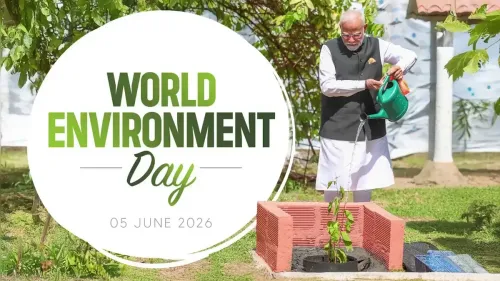
Kerala CM Pinarayi Vijayan Marks World Environment Day

Synopsis
Kerala Chief Minister Pinarayi Vijayan marked World Environment Day on 5 June 2026 by attributing climate change and biodiversity loss to capitalism, calling nature preservation a necessity and urging commitment to sustainable development across present and future generations.
Key Takeaways
Kerala CM Pinarayi Vijayan posted on World Environment Day, 5 June 2026 , linking capitalism directly to climate change and biodiversity loss.
He described preserving nature as 'not a choice but a necessity,' calling for stronger commitment to sustainable development.
World Environment Day was established by the UN General Assembly in 1972 and is coordinated by UNEP each year on 5 June .
Kerala launched the Haritha Keralam Mission in 2018 covering afforestation, water conservation, and waste reduction following the state's devastating floods.
The statement continues a pattern of CPI(M) using international observance days to advance a systemic critique of market-driven development models.
Stakeholders including coastal communities, small farmers , and urban local bodies in Kerala remain most exposed to climate-related disruptions.
Kerala Chief Minister Pinarayi Vijayan used World Environment Day on 5 June 2026 to issue a sharp critique of capitalism, calling its 'ruthless drive for profit' the primary driver of climate change, biodiversity loss, and environmental degradation. The CPI(M) Politburo member called preserving nature 'not a choice but a necessity' and urged collective commitment to sustainable development.
Context
World Environment Day is observed annually on 5 June, a date designated by the UN General Assembly through resolution 2994 (XXVII) in 1972 and coordinated by the United Nations Environment Programme (UNEP). It serves as the principal global platform for raising awareness on environmental protection and mobilising political action.
Vijayan's post stated that 'the future of humanity is inseparable from the future of nature,' framing the day not as a ceremonial occasion but as a call to systemic change. His explicit attribution of ecological crises to capitalist production priorities is consistent with CPI(M)'s long-standing official position on the roots of the climate emergency.
Policy Backdrop
Kerala has faced repeated climate-related disasters, most notably the catastrophic floods of 2018 and 2019, which accelerated state-level environmental policy action. In 2018, the state launched the Haritha Keralam Mission, a wide-ranging programme covering afforestation, water conservation, and waste reduction across urban and rural local bodies.
At the national level, India's National Action Plan on Climate Change, released in 2008, laid out eight national missions including sustainable agriculture and habitat protection. Left-led administrations in Kerala have frequently argued that market-driven development models — including industrial clearances in ecologically sensitive zones such as the Western Ghats — undermine these frameworks from within.
Stakeholders and Impact
Coastal communities, small farmers, and urban local bodies in Kerala are among the most directly exposed to the consequences of biodiversity loss and erratic monsoons. Environmental advocates have long pointed to the state's high human development indicators as evidence that ecological sensitivity and social welfare can advance together.
Vijayan's framing — linking global capitalism to local environmental harm — resonates with grassroots groups in the Western Ghats corridor, where land-use conflicts between conservation mandates and development projects remain unresolved. His call to 'build a greener, healthier future for all' also signals continued state interest in positioning Kerala as a model for sustainable governance within India's federal structure.
What's Next
Observers will watch Kerala's next annual budget for concrete environment-sector allocations that translate the Chief Minister's rhetoric into measurable commitments. Any state-level participation in upcoming Conference of Parties sessions will also indicate how far Vijayan's administration intends to carry its climate agenda onto an international stage.
For now, the post reinforces a pattern: Vijayan consistently uses major international observance days to restate a systemic critique of development models, keeping the party's ideological framework visible in public discourse even on occasions typically marked by consensus messaging.
Point of View
Using a globally recognised occasion to restate CPI(M)'s structural critique of capitalism at a moment when climate discourse is increasingly dominated by technocratic solutions. By insisting that profit-driven systems are the root cause — rather than a contributing factor — of ecological crises, he positions Kerala's Left government as a counterweight to mainstream development narratives within India's federal polity. The reference to 'present and future generations' also signals an intergenerational framing that aligns with global climate-justice movements, potentially broadening the statement's appeal beyond the party's traditional base. Whether this translates into measurable policy divergence from the Centre will depend on Kerala's forthcoming budget allocations for environment and its engagement with international climate forums.
NationPress
20 Oct 2026
Frequently Asked Questions
What did Kerala CM Pinarayi Vijayan say on World Environment Day 2026?
Vijayan said the future of humanity is inseparable from the future of nature, blamed capitalism's 'ruthless drive for profit' for accelerating climate change and biodiversity loss, and called preserving nature 'not a choice but a necessity.'
When is World Environment Day and who established it?
World Environment Day is observed every year on 5 June . It was established by the UN General Assembly through resolution 2994 (XXVII) in 1972 and is coordinated by UNEP .
What is Kerala's Haritha Keralam Mission?
The Haritha Keralam Mission is a state-wide programme launched by the Kerala government in 2018 focused on afforestation, water conservation, and waste reduction, partly in response to the severe floods that struck the state that year.
Why does Pinarayi Vijayan link environment issues to capitalism?
As a senior CPI(M) Politburo member , Vijayan reflects his party's long-standing official position that ecological crises stem from capitalist production priorities that place profit above environmental sustainability.
What are the main environmental challenges facing Kerala?
Kerala faces recurrent climate-related disasters including major floods — most notably in 2018 and 2019 — alongside biodiversity pressures in the Western Ghats and coastal erosion affecting fishing and farming communities.