Rijiju Marks World Environment Day, Highlights India's Climate Commitments

Synopsis
Union Parliamentary Affairs Minister Kiren Rijiju marked World Environment Day on 5 June 2026 by highlighting India's conservation and climate commitments, calling on citizens to strengthen their bond with the planet as the country pursues net-zero goals and ecosystem restoration.
Key Takeaways
Union Parliamentary Affairs Minister Kiren Rijiju posted on World Environment Day, 5 June 2026 , calling for renewed commitment to the planet.
Rijiju stated that India's efforts in conservation, climate action, and sustainability are helping build 'a future where progress and nature go hand in hand.' India's Panchamrit pledges, announced at COP26 in 2021 , include a net-zero emissions target by 2070 .
The government's LiFE (Lifestyle for Environment) movement, launched in 2022 , promotes sustainable consumption among citizens.
India frames climate policy as compatible with economic growth, advancing programmes for forests, wildlife, and renewables simultaneously.
Upcoming UNFCCC sessions and domestic parliamentary debates on environment bills will be key indicators of how these commitments are operationalised.
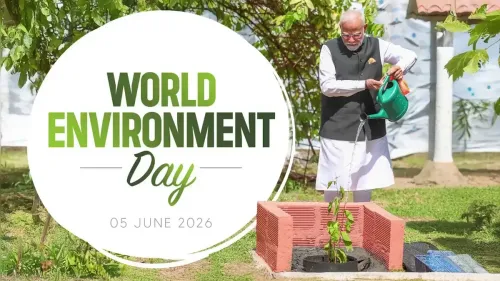
Union Parliamentary Affairs Minister Kiren Rijiju on Friday, 5 June 2026 — World Environment Day — called on citizens to renew their commitment to the planet, pointing to India's ongoing efforts in conservation, climate action, and sustainability as evidence that progress and nature can advance together.
Context
World Environment Day, observed every year on 5 June under the aegis of the United Nations, is the principal global platform for raising awareness and driving action on environmental issues. Rijiju's post, carrying the hashtags #WorldEnvironmentDay, #WorldEnvironmentDay2026, and #NowForClimate, aligns with the day's global call to action. He wrote: 'A greener future begins with the choices we make today. From protecting wildlife to restoring ecosystems, every step matters.'
The minister underscored that India's conservation and sustainability programmes are helping build 'a future where progress and nature go hand in hand' — a framing consistent with the government's broader position that economic development and ecological responsibility are complementary, not competing, goals.
Policy Backdrop
India's climate commitments have been anchored by the Panchamrit pledges announced at COP26 in 2021, which include achieving net-zero emissions by 2070 and significantly scaling up renewable energy capacity. These pledges represent India's Nationally Determined Contributions under the Paris Agreement.
Complementing the energy transition, the government launched the LiFE (Lifestyle for Environment) movement in 2022 to encourage sustainable consumption habits among citizens. Domestic programmes spanning forest conservation, wildlife protection, and ecosystem restoration form the operational backbone of these commitments. Ministerial communications on global observance days serve as a recurring channel to keep these policy priorities in public view.
Stakeholders and Impact
The message is directed at Indian citizens and conservation communities, reinforcing that individual choices — from consumption patterns to participation in local ecological initiatives — have aggregate national significance. Civil society groups and environmental organisations working on ground-level conservation are the principal partners in translating these commitments into measurable outcomes.
India's approach also carries weight in multilateral forums, where the country positions itself as a large developing economy that is nonetheless shouldering serious climate responsibilities. Rijiju's emphasis on wildlife protection and ecosystem restoration signals continued political support for biodiversity programmes alongside the more prominent renewable-energy narrative.
What's Next
Attention will now turn to upcoming UNFCCC sessions, where India's negotiating positions on climate finance, technology transfer, and updated emissions targets will be closely watched. Domestically, parliamentary debates on pending environment-related legislation will test how the government's stated commitments translate into binding policy. As World Environment Day 2026 galvanises public discourse, the alignment between India's international pledges and domestic legislative action will remain a key measure of progress.
Point of View
Which seeks to distribute climate responsibility across citizens rather than placing it solely on industrial or policy actors. By invoking wildlife protection and ecosystem restoration alongside the broader sustainability narrative, the post subtly broadens the climate conversation beyond energy transition, which dominates most official discourse. As UNFCCC negotiations evolve and domestic environment legislation faces parliamentary scrutiny, such high-visibility messaging will be tested against the specifics of policy delivery.
NationPress
20 Oct 2026
Frequently Asked Questions
Why did Kiren Rijiju post about World Environment Day 2026?
Rijiju posted on 5 June 2026 to mark World Environment Day , a UN observance, using the occasion to highlight India's conservation and climate action efforts and call on citizens to renew their commitment to environmental protection.
What is India's net-zero target?
India has pledged to achieve net-zero emissions by 2070 , a commitment announced as part of the Panchamrit climate pledges at COP26 in Glasgow in 2021 .
What is the LiFE movement in India?
The LiFE (Lifestyle for Environment) movement was launched by the Indian government in 2022 to promote sustainable and mindful consumption habits among citizens as part of the country's broader climate strategy.
What does India do for wildlife conservation and ecosystem restoration?
India runs domestic programmes covering forest conservation, wildlife protection, and ecosystem restoration, which form a key part of its commitments under the Paris Agreement and its Nationally Determined Contributions.
What is World Environment Day and when is it observed?
World Environment Day is the United Nations' principal platform for global environmental awareness, observed every year on 5 June to encourage action on pressing environmental challenges worldwide.