Petroleum Minister Puri Calls for Climate Action on World Environment Day
Synopsis
Union Petroleum Minister Hardeep Singh Puri marked World Environment Day on 5 June 2026 by calling for renewed global commitment to a cleaner, greener planet, invoking the intergenerational stewardship principle and linking it to India's broader climate ambitions under the Panchamrit framework.
Key Takeaways
Union Petroleum Minister Hardeep Singh Puri posted a World Environment Day message on 5 June 2026 calling for collective climate action.
He cited the stewardship principle: 'We have not inherited the planet from our parents, but are borrowing it from our children.' India's climate strategy, the Panchamrit framework, targets net-zero emissions by 2070 , announced at COP26 in 2021 .
The Ministry of Petroleum and Natural Gas is pursuing decarbonisation through ethanol blending, compressed biogas, and the National Green Hydrogen Mission .
Progress on India's updated Nationally Determined Contributions (NDCs) and green hydrogen milestones will be key indicators of policy follow-through.
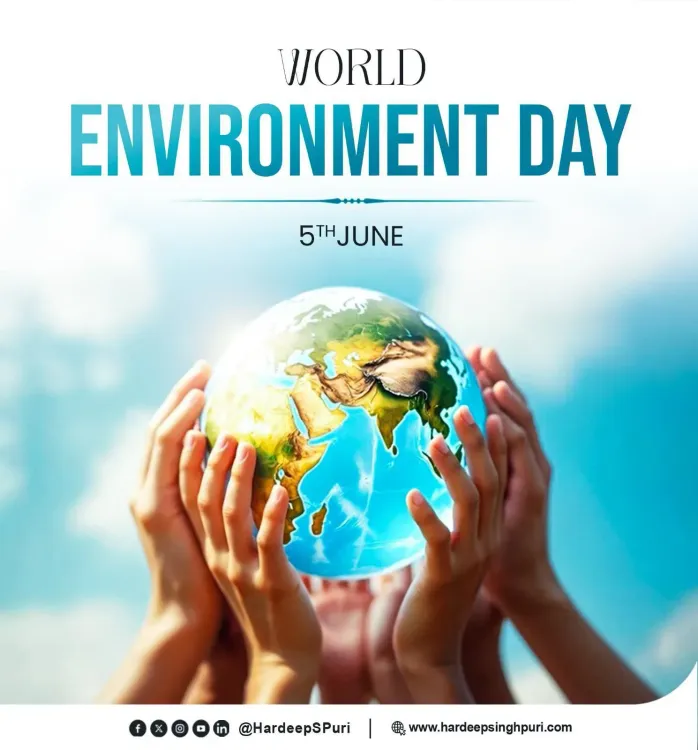
Union Petroleum Minister Hardeep Singh Puri on Friday, 5 June 2026 marked World Environment Day with a call for collective action, urging citizens and nations alike to renew their commitment to a 'cleaner, greener and better' planet for all living beings.
Context
World Environment Day, observed every year on 5 June under the auspices of the United Nations, is the largest global platform for environmental public outreach. This year's observance comes as nations worldwide face mounting pressure to accelerate climate commitments and translate pledges into measurable action. Minister Puri's message, posted under the hashtags #WorldEnvironmentDay and #NowForClimate, invoked the widely cited stewardship principle: 'We have not inherited the planet from our parents, but are borrowing it from our children and the generations that follow.'
The quote encapsulates the intergenerational equity argument that has been central to India's diplomatic positioning in multilateral climate forums. It frames environmental responsibility not as a regulatory burden but as a moral compact with future generations.
Policy Backdrop
India's climate ambitions were formally crystallised at COP26 in 2021, when Prime Minister Narendra Modi unveiled the Panchamrit commitments — a five-pronged strategy that includes achieving net-zero emissions by 2070. The pledge set India apart as one of the few major economies to articulate a long-horizon decarbonisation roadmap in that summit cycle.
The Ministry of Petroleum and Natural Gas has pursued parallel tracks of energy security and decarbonisation, including expanded natural gas infrastructure, ambitious ethanol blending targets, and a growing compressed biogas programme. These sectoral initiatives position the petroleum ministry as an active participant in India's broader clean-energy transition, even as it manages the country's fossil-fuel supply chain.
The National Green Hydrogen Mission, a flagship initiative aimed at making India a global hub for green hydrogen production and export, represents one of the most watched milestones in the ministry's decarbonisation portfolio. Progress on that mission and India's updated Nationally Determined Contributions (NDCs) ahead of future COP sessions will signal how swiftly policy intent is being converted into ground-level outcomes.
Stakeholders and Impact
The minister's message is addressed implicitly to multiple audiences: Indian citizens being encouraged to adopt sustainable habits, industry stakeholders in the energy sector being reminded of the government's green transition agenda, and the international community watching India's climate credibility. The emphasis on 'all creations of God' broadens the frame beyond human welfare to encompass biodiversity and ecological balance.
For ordinary Indians, the message reinforces a theme the government has consistently amplified — that environmental stewardship is a shared civic responsibility, not solely a state function. Civil society groups and environmental advocates have long called for such high-profile political messaging to be backed by enforceable local-level action on air quality, water conservation, and waste management.
What's Next
Attention will now turn to whether World Environment Day 2026 serves as a launchpad for any new policy announcements from the petroleum or environment ministries. Key milestones to watch include progress benchmarks under the National Green Hydrogen Mission, updates to India's NDCs, and the government's ethanol blending roadmap targets. Minister Puri's public messaging on this occasion signals that the ministry intends to keep climate responsibility at the centre of its public-facing narrative as India advances toward its 2070 net-zero goal.
Point of View
He sidesteps the tension between India's growing hydrocarbon demand and its net-zero commitments. The post fits a consistent pattern in which senior BJP leaders use UN observance days to reinforce India's climate credentials ahead of multilateral negotiations. The real test, however, will be whether the ministry's operational milestones on green hydrogen and ethanol blending keep pace with the rhetorical ambition.
NationPress
20 Oct 2026
Frequently Asked Questions
What did Hardeep Singh Puri say on World Environment Day 2026?
Minister Puri called on people to pledge renewed efforts for a cleaner, greener planet, quoting the principle that 'we are borrowing the planet from our children,' and posted under the hashtags #WorldEnvironmentDay and #NowForClimate.
What is India's net-zero target?
India has committed to achieving net-zero carbon emissions by 2070 , a goal announced by Prime Minister Modi at COP26 in 2021 as part of the five-point Panchamrit climate strategy.
What is the National Green Hydrogen Mission?
The National Green Hydrogen Mission is a Government of India initiative aimed at making the country a major producer and exporter of green hydrogen, a key pillar of the petroleum ministry's decarbonisation agenda.
Why does the petroleum minister speak about the environment?
The Ministry of Petroleum and Natural Gas oversees India's energy transition, including ethanol blending, compressed biogas, and green hydrogen programmes, making environmental messaging a core part of the ministry's public mandate alongside fuel security.
When is World Environment Day observed?
World Environment Day is observed every year on 5 June , established by the United Nations as the principal vehicle for promoting global awareness and action on environmental issues.