Kishan Reddy marks World Environment Day, cites India's green strides

Synopsis
On World Environment Day 2026, Union Coal and Mines Minister G. Kishan Reddy reaffirmed India's environmental commitments, citing Asiatic lion and cheetah population recoveries, Mission LiFE, and the Ek Ped Maa Ke Naam campaign as evidence that development and conservation can advance together under PM Modi's vision.
Key Takeaways
World Environment Day, June 5, 2026 : Union Minister G.
Kishan Reddy reaffirmed India's commitment to sustainable development and conservation.
The minister cited the rising population of Asiatic lions and the return of cheetahs to Indian soil as conservation milestones.
Mission LiFE and Ek Ped Maa Ke Naam were highlighted as citizen-led movements making individuals partners in climate action.
India's Panchamrit strategy, announced at COP26 in 2021 , targets 500 GW non-fossil energy by 2030 and net-zero by 2070 .
Cheetahs were reintroduced to Kuno National Park in 2022 after local extinction, marking a landmark biodiversity restoration effort.
As Union Coal and Mines Minister , Kishan Reddy's statement underscores India's dual challenge of sustaining energy output while advancing its green transition.
Union Coal and Mines Minister G. Kishan Reddy on Friday, June 5, 2026 marked World Environment Day by reaffirming India's commitment to environmental stewardship and sustainable development, invoking the vision of Prime Minister Narendra Modi and highlighting conservation milestones from wildlife recovery to clean energy expansion.
Context
Posting on the occasion of World Environment Day, Kishan Reddy pointed to a broad spectrum of progress — expanding forest cover, accelerating clean energy adoption, and protecting biodiversity. He specifically cited the rising population of Asiatic lions, the return of cheetahs to Indian soil, and continued efforts to safeguard wildlife habitats as evidence that 'development and conservation can go hand in hand.'
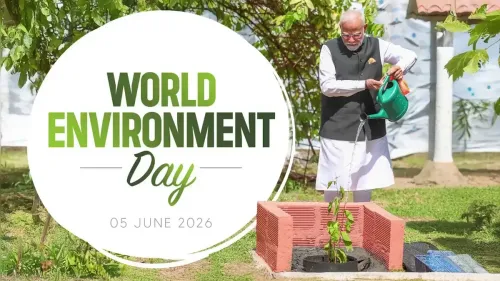
The minister also highlighted two citizen-facing campaigns — Mission LiFE and Ek Ped Maa Ke Naam — as examples of people's movements that are making every citizen a partner in climate action.
Policy Backdrop
India's current environmental posture is anchored in commitments made at successive UNFCCC summits. At COP26 in 2021, Prime Minister Modi announced the Panchamrit strategy, which includes a target of 500 GW of non-fossil energy capacity by 2030 and achieving net-zero emissions by 2070.
Mission LiFE — Lifestyle for Environment — was formally launched in 2022 at COP27 as a global movement to encourage individuals to adopt sustainable living practices. The initiative frames climate action not merely as a government responsibility but as a mass social movement rooted in traditional Indian values of frugality and harmony with nature.
On the biodiversity front, cheetahs were reintroduced to Kuno National Park in 2022 following the species' local extinction decades earlier, marking a landmark moment in India's wildlife restoration efforts. The Asiatic lion population, concentrated in Gir, Gujarat, has shown a consistent upward trend in successive censuses, widely cited as a conservation success story.
Stakeholders and Impact
Kishan Reddy's statement carries particular resonance given his portfolio: as Union Minister of Coal and Mines, he oversees sectors that remain central to India's energy mix even as the country accelerates its renewable transition. The dual mandate — sustaining coal output for development needs while championing green goals — reflects the broader tension India navigates in its climate diplomacy.
Wildlife conservation groups and environmental advocates have long called for stronger protections for habitats beyond designated reserves. Campaigns like Ek Ped Maa Ke Naam — a tree-planting drive — seek to build a grassroots constituency for conservation that complements top-down policy.
What's Next
The next Forest Survey of India report will be closely watched for data on whether forest cover has continued to expand in line with stated goals. Progress updates on cheetah population monitoring at Kuno National Park and ongoing Asiatic lion census results in Gujarat will serve as key benchmarks for India's biodiversity commitments. Internationally, India's performance against its Panchamrit targets will shape its standing at future climate negotiations.
Point of View
The statement seeks to reinforce India's international climate credibility ahead of future UNFCCC engagements. The invocation of people's movements like Mission LiFE and Ek Ped Maa Ke Naam also serves a domestic political function, framing environmental action as a mass Jan Andolan rather than elite technocratic policy. The real test of these commitments will come in hard data — forest cover surveys, cheetah survival rates, and renewable capacity additions — that will determine whether the rhetoric translates into measurable outcomes.
NationPress
20 Oct 2026
Frequently Asked Questions
What is Mission LiFE and who launched it?
Mission LiFE — Lifestyle for Environment — is a global citizen movement launched by India at COP27 in 2022, championed by Prime Minister Narendra Modi, to encourage individuals to adopt sustainable and environmentally friendly lifestyle choices.
Why did Kishan Reddy post about the environment on June 5, 2026?
June 5 is observed globally as World Environment Day, and Kishan Reddy used the occasion to reaffirm India's environmental commitments and highlight conservation milestones including wildlife recovery and clean energy progress.
What is the Ek Ped Maa Ke Naam campaign?
Ek Ped Maa Ke Naam — meaning 'One Tree in Mother's Name' — is a tree-planting initiative promoted by the Indian government to mobilise citizens in expanding green cover as part of broader environmental goals.
Have cheetahs returned to India and where are they?
Yes, cheetahs were reintroduced to Kuno National Park in Madhya Pradesh in 2022 after the species became locally extinct in India decades earlier, as part of a government-led biodiversity restoration programme.
What are India's Panchamrit climate targets?
India's Panchamrit targets, announced by PM Modi at COP26 in 2021, include achieving 500 GW of non-fossil energy capacity by 2030, reducing emissions intensity of GDP by 45 percent, and reaching net-zero emissions by 2070.