CM Siddaramaiah marks World Environment Day with conservation pledge
Synopsis
Karnataka Chief Minister Siddaramaiah marked World Environment Day on 5 June 2026 by calling environmental protection a 'sacred duty', urging citizens to preserve nature and resources for future generations, in line with India's national climate commitments and Karnataka's conservation focus.
Key Takeaways
Karnataka Chief Minister Siddaramaiah posted a World Environment Day message on 5 June 2026 .
He described protecting nature as 'not just our responsibility' but a 'sacred duty'.
World Environment Day has been observed annually on 5 June since 1974 , established by the UN General Assembly after the 1972 Stockholm Conference .
Karnataka has pursued solar expansion, Western Ghats forest protection, and urban greening under national climate frameworks.
India's commitments under the 2015 Paris Agreement and the National Action Plan on Climate Change (2008) guide state-level environmental action.
Karnataka's environment budget and state participation in national climate reviews later in 2026 will be the next key milestones to watch.
Karnataka Chief Minister Siddaramaiah on Friday, 5 June 2026, marked World Environment Day by calling environmental protection a 'sacred duty' and urging citizens to renew their commitment to preserving nature and resources for future generations.
Context
World Environment Day is observed every year on 5 June under the auspices of the United Nations. The observance was established by the UN General Assembly in 1972 following the landmark Stockholm Conference on the Human Environment, and has been marked annually since 1974. It serves as the UN's principal platform for raising global awareness on environmental protection.
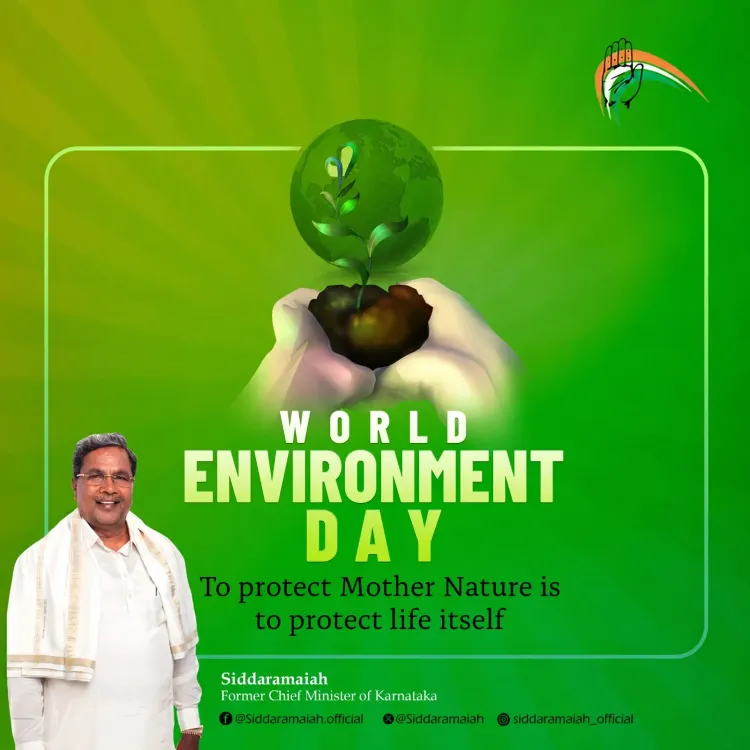
In his post, Siddaramaiah wrote: 'Protecting Mother Nature is not just our responsibility, it is our sacred duty. On this World Environment Day, let us renew our commitment to preserve nature, protect our resources, and leave behind a healthier planet for future generations.'
Policy Backdrop
India's National Action Plan on Climate Change (2008) and its Nationally Determined Contributions under the 2015 Paris Agreement provide the overarching framework within which state governments operate on environmental matters. Karnataka has aligned its programmes with these national goals, focusing on expanding solar energy capacity, protecting Western Ghats forests, and maintaining urban green spaces.
The Western Ghats, a UNESCO World Heritage biodiversity hotspot that runs through Karnataka, has been a recurring focus of state-level conservation debates. Successive administrations in Bengaluru have introduced measures to regulate land use and forest cover in the ecologically sensitive region.
Stakeholders and Impact
Karnataka's citizens, farming communities dependent on monsoon-fed agriculture, and urban residents dealing with air and water quality concerns are the primary stakeholders in the state's environmental agenda. Environmental advocates have long called for stronger enforcement of forest and water-body protection laws across the state.
The Chief Minister's message, addressed broadly to citizens, reinforces the moral framing of conservation — moving beyond regulatory compliance to personal and collective responsibility. Such statements from senior elected officials are often accompanied by policy directions to state departments in subsequent weeks.
What's Next
Observers will watch Karnataka assembly proceedings later in 2026 for discussions on the state's environment budget and its participation in national climate review meetings. The government's follow-through on conservation commitments — particularly around Western Ghats protection, renewable energy targets, and urban greening — will be the practical measure of the pledge made on World Environment Day.
As climate pressures intensify across peninsular India, the alignment between symbolic observances and concrete policy action will remain a key test for state administrations heading into the next budget cycle.
Point of View
Such statements carry added weight and invite accountability. The real test will come in budget allocations and legislative action, where symbolic commitments are either reinforced or quietly shelved.
NationPress
20 Oct 2026
Frequently Asked Questions
Why does Karnataka CM Siddaramaiah post on World Environment Day?
As the head of a state government responsible for forest cover, water resources, and climate policy, Siddaramaiah uses World Environment Day to publicly reaffirm Karnataka's commitment to conservation and align with national and UN environmental goals.
When is World Environment Day and who started it?
World Environment Day is observed on 5 June every year. It was established by the United Nations General Assembly in 1972 following the Stockholm Conference on the Human Environment and has been marked annually since 1974 .
What environmental issues does Karnataka focus on?
Karnataka has prioritised expanding solar energy, protecting Western Ghats forests — a UNESCO World Heritage biodiversity hotspot — and improving urban green spaces, in line with India's National Action Plan on Climate Change and Paris Agreement commitments.
What is India's commitment under the Paris Agreement on climate?
India submitted its Nationally Determined Contributions (NDCs) under the 2015 Paris Agreement , committing to reducing the emissions intensity of its GDP, increasing the share of non-fossil fuel energy, and creating additional carbon sinks through forest cover.
What should Karnataka citizens watch for after World Environment Day 2026?
Observers are watching Karnataka assembly discussions on the state's environment budget and its participation in national climate review meetings scheduled later in 2026 , which will indicate whether the Day's pledges translate into concrete policy action.