Kishan Reddy: ₹2,814 Cr Capex to Boost Lithium, Nickel Processing
Synopsis
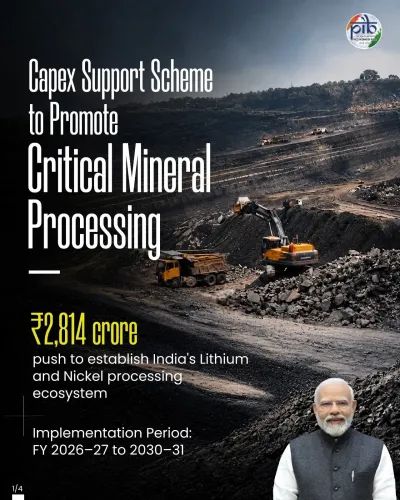
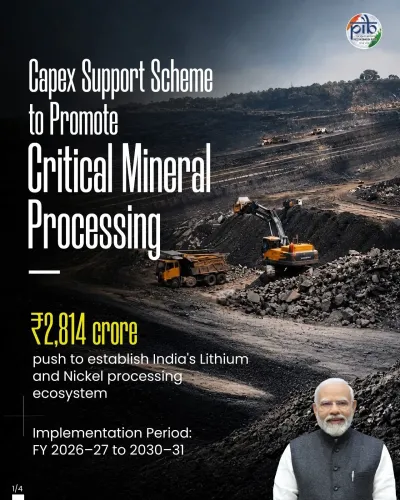
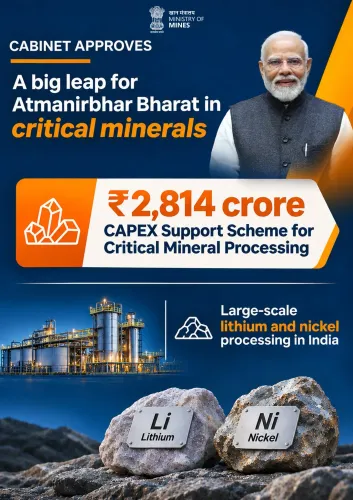
The Union Cabinet has approved ₹2,814 crore in Capex Support to strengthen India's lithium and nickel processing capabilities. With lithium demand projected to rise 12–13 times by 2030, Mines Minister G. Kishan Reddy says the move will deepen self-reliance in critical minerals and power the country's EV and energy-storage manufacturing ecosystem.
Key Takeaways
The Union Cabinet has cleared ₹2,814 crore in Capex Support for domestic lithium and nickel processing infrastructure.
India's lithium demand is projected to increase 12–13 times by 2030 ; nickel demand is expected to nearly double .
Both minerals are essential inputs for electric vehicles, battery manufacturing, and energy storage systems.
The move builds on the MMDR Amendment Act 2023 , KABIL's overseas acquisitions, and the 2021 PLI scheme for Advanced Chemistry Cells.
Processing capacity — not just mining — is the strategic gap this outlay is designed to close.
The National Critical Minerals Mission , if formalised, would consolidate India's end-to-end minerals strategy under a single framework.
India's lithium demand is on course to surge 12–13 times by 2030 — and the Union Cabinet has just moved to ensure the country is not scrambling to catch up. Union Coal and Mines Minister G. Kishan Reddy announced on Friday, November 6, 2026, that the government will deploy a ₹2,814 crore Capex Support to build domestic lithium and nickel processing capabilities, a move designed to anchor India's electric-mobility and energy-storage ambitions in self-reliance rather than import dependence.
What ₹2,814 crore buys India in the minerals race
The Cabinet-cleared outlay is not a subsidy cheque — it is targeted capital expenditure support aimed at standing up processing infrastructure that India currently lacks at scale. Nickel demand, Reddy noted, is expected to nearly double over the same horizon. Both minerals sit at the heart of lithium-ion battery chemistry: lithium for the cathode, nickel for energy density. Without domestic processing, every EV rolling off an Indian assembly line pulls those inputs through a global supply chain India does not control.
The announcement carries the hashtag #CabinetDecisions, placing it squarely within a broader slate of decisions cleared at the highest executive level. The Ministry of Mines is the nodal body for implementation, and industry observers will watch closely for the operational roadmap that follows.
A policy arc three years in the making
This capex push does not arrive in a vacuum. The Mines and Minerals (Development and Regulation) Amendment Act, 2023 unlocked commercial exploration and auction of critical mineral blocks — lithium, nickel and others — for the first time, breaking open a category that had long been off-limits to private enterprise. Before that, Khanij Bidesh India Ltd (KABIL), incorporated in 2019 as a joint-venture PSU, was tasked with securing lithium and cobalt assets overseas precisely because domestic supply lines were thin. The 2021 Production-Linked Incentive scheme for Advanced Chemistry Cells added a demand-side pull by seeding battery cell manufacturing capacity.
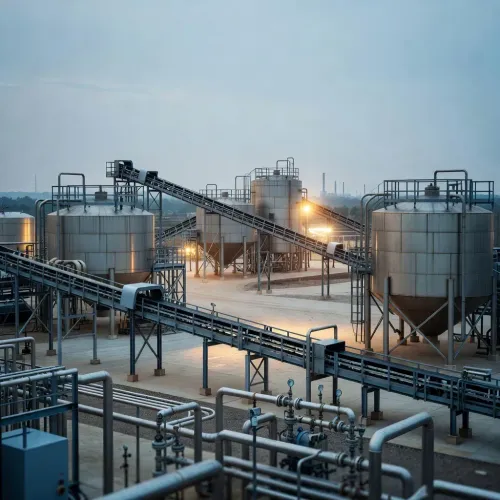
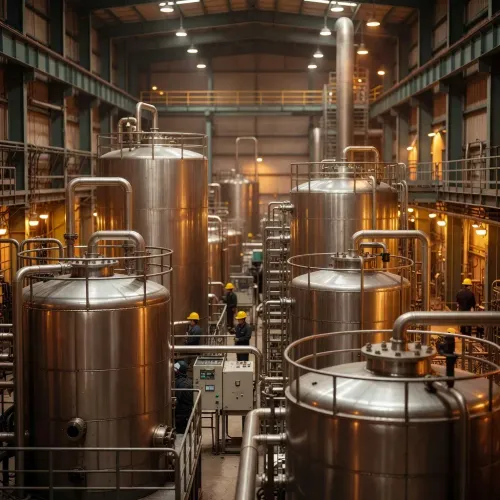
What the ₹2,814 crore capex does is plug the gap between raw or partially processed ore — whether mined domestically or acquired abroad — and the refined material that battery and EV manufacturers actually need. Processing has been the missing link. Securing a lithium block in Argentina or Chile means little if the ore still has to travel to China for refining before it reaches Pune or Bengaluru.
India's place in the global critical-minerals contest
The strategic logic mirrors moves underway in the United States, European Union, and Australia, each of which has enacted dedicated critical-minerals strategies to diversify away from supplier concentration — particularly China's dominance in processing. India's parallel push, framed under Atmanirbhar Bharat and its 2070 net-zero commitment, now has a firmer financial foundation with this capex announcement.
EV manufacturers, battery firms, and domestic mining companies stand to benefit directly. For the broader economy, reduced import dependence in a commodity class that is only going to tighten in global markets is a hedge worth far more than the sticker price of ₹2,814 crore.
The next milestones to track: implementation details of the capex disbursement mechanism, fresh auctions of lithium and nickel blocks enabled under the amended MMDR Act, and the shape of the proposed National Critical Minerals Mission — which, if launched, would bring all of these threads under one strategic roof.
Point of View
814 crore capex announcement marks a deliberate pivot from upstream security — acquiring mineral blocks at home and abroad — to midstream capability, the processing bottleneck that has historically forced India to route critical inputs through third-country refiners. This sequencing reflects a maturing industrial strategy rather than reactive procurement. Placed alongside the MMDR amendments of 2023 and the PLI for battery cells, the capex support completes a policy triangle: legal access, manufacturing pull, and now processing muscle. The real test, however, is speed of implementation — in a global race where the EU's Critical Raw Materials Act and the US Inflation Reduction Act are already disbursing capital, India's window to build competitive processing capacity is measured in years, not decades.
NationPress
6 Nov 2026
Frequently Asked Questions
What is the ₹2,814 crore Capex Support for critical minerals?
It is a Union Government capital expenditure outlay approved by the Cabinet to build domestic lithium and nickel processing infrastructure in India, reducing dependence on imported refined minerals for the EV and battery industries.
Why is lithium important for India's EV goals?
Lithium is a core component of lithium-ion batteries used in electric vehicles and energy storage systems. India's lithium demand is projected to rise 12–13 times by 2030, making domestic processing capacity strategically critical.
What is KABIL and what does it do?
Khanij Bidesh India Ltd (KABIL) is a government-owned joint-venture PSU incorporated in 2019 to acquire overseas lithium, cobalt, and other strategic mineral assets, securing supply for India's energy transition needs.
How does the MMDR Amendment Act 2023 relate to critical minerals?
The Mines and Minerals (Development and Regulation) Amendment Act 2023 enabled the commercial exploration and auction of critical mineral blocks — including lithium and nickel — opening them to private investment for the first time.
What is the National Critical Minerals Mission?
The National Critical Minerals Mission is a proposed overarching framework that would consolidate India's exploration, acquisition, processing, and recycling strategies for critical minerals under a single national programme.