Kishan Reddy: 32 Lakh Beneficiaries Under Food Security in Hyderabad-Secunderabad
Synopsis
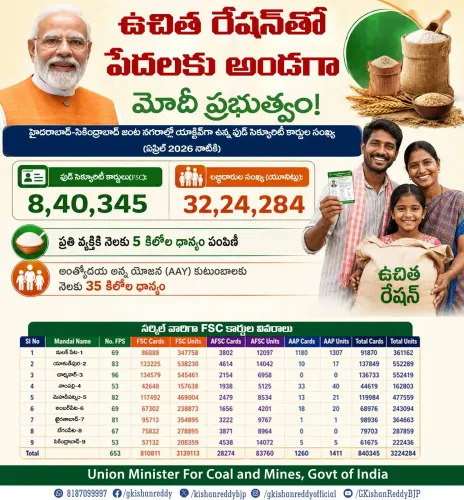
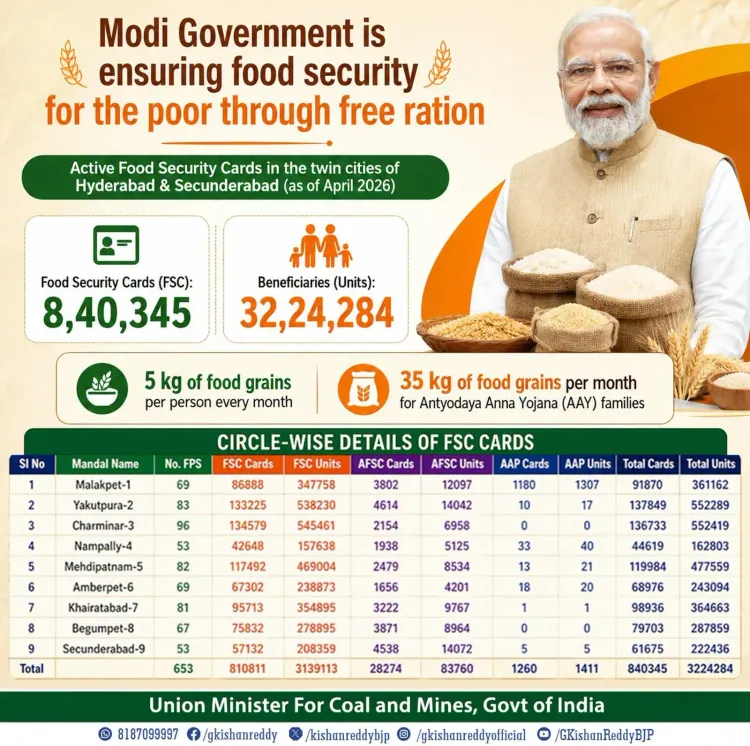
Union Minister G. Kishan Reddy has shared April 2026 data showing 8,40,345 active Food Security Cards covering over 32 lakh beneficiaries in Hyderabad and Secunderabad, spotlighting the Central Government's PDS reach under PM Modi's 'Sabka Saath, Sabka Vikas' framework.
Key Takeaways
8,40,345 active Food Security Cards are in operation across the twin cities of Hyderabad and Secunderabad as of April 2026 .
A total of 32,24,284 individuals are enrolled as beneficiaries under these cards.
Each beneficiary is entitled to 5 kg of food grains per person per month under the National Food Security Act.
Antyodaya Anna Yojana (AAY) families receive a higher allocation of 35 kg of food grains per month per household.
Kishan Reddy cited the data as evidence of PM Modi's welfare vision being implemented on the ground in Telangana.
The figures were shared on July 10, 2026 , framed under the government's 'Sabka Saath, Sabka Vikas' policy mantra.
Union Coal and Mines Minister and BJP Telangana state president G. Kishan Reddy on Friday, July 10, 2026, shared data showing that 8,40,345 active Food Security Cards cover 32,24,284 beneficiaries across the twin cities of Hyderabad and Secunderabad, crediting the Central Government's food security drive under Prime Minister Narendra Modi.
Context
Reddy's post highlights figures as of April 2026, presenting the reach of the Public Distribution System (PDS) in the twin cities as evidence of the Centre's welfare commitment. Each cardholder is entitled to 5 kg of food grains per person per month, while families covered under the Antyodaya Anna Yojana (AAY) receive 35 kg of food grains per month — a higher allocation designed for the most economically vulnerable households. The minister framed the data under the government's guiding principle of 'Sabka Saath, Sabka Vikas' (Together with all, development for all).
As BJP's Telangana state president, Reddy has a direct political stake in demonstrating the Central Government's welfare footprint in a state currently governed by the opposition Congress party. Spotlighting urban food security data in Hyderabad and Secunderabad allows the BJP to assert federal delivery even where it does not hold state power.
Policy Backdrop
The entitlements cited by Reddy flow from two foundational frameworks. The National Food Security Act (NFSA), 2013 converted existing welfare food programmes into legal entitlements, covering roughly two-thirds of India's population and guaranteeing 5 kg of subsidised grains per person per month through the PDS. The Antyodaya Anna Yojana, launched in December 2000, predates the NFSA and specifically targets the poorest households, providing the higher allocation of 35 kg per month per family.
Between 2014 and 2020, the Central Government undertook large-scale digitisation of PDS beneficiary lists and Aadhaar-seeding of ration cards to reduce leakages and ensure accurate targeting. Telangana, formed after bifurcation of Andhra Pradesh in 2014, integrated central NFSA grain allocations with its own civil supplies machinery to serve both urban and rural cardholders across the state.
Stakeholders and Impact
The 32,24,284 beneficiaries enumerated in Reddy's post represent a significant share of the urban poor population in the twin cities. For these families, the monthly grain entitlement under the PDS constitutes a critical nutritional and economic buffer, reducing household expenditure on food staples. AAY families — identified as the poorest among PDS beneficiaries — receive the largest per-family allocation and are considered the most dependent on the scheme.
State-level civil supplies departments in Telangana are responsible for the day-to-day administration of Fair Price Shops (FPS) through which grains are distributed. The accuracy and updation of Food Security Card rolls directly determines how many families access these entitlements without disruption.
What's Next
The NFSA mandates periodic reviews of beneficiary coverage, and any revision to population-based allocation norms could affect the number of cards issued in states like Telangana. Observers will watch for supplementary budget announcements related to grain procurement, FPS modernisation, or card renewal drives in the twin cities. For the BJP in Telangana, continued amplification of Central welfare delivery data is likely to remain a key political messaging strategy ahead of future electoral cycles in the state.
Point of View
The BJP attempts to shift the welfare narrative from intent to delivery. The framing under 'Sabka Saath, Sabka Vikas' also signals the party's broader strategy of presenting central schemes as ideologically inclusive, countering narratives that welfare delivery is selective. With Telangana's next state election on the horizon, such data-driven outreach in the urban heartland of Hyderabad is likely to intensify.
NationPress
8 Oct 2026
Frequently Asked Questions
How many Food Security Cards are active in Hyderabad and Secunderabad?
As of April 2026, there are 8,40,345 active Food Security Cards in the twin cities of Hyderabad and Secunderabad, covering 32,24,284 beneficiaries.
How much food grain do PDS beneficiaries get per month in India?
Under the National Food Security Act , eligible beneficiaries receive 5 kg of food grains per person per month . Households covered under the Antyodaya Anna Yojana receive a higher entitlement of 35 kg per family per month .
What is the Antyodaya Anna Yojana scheme?
Antyodaya Anna Yojana (AAY) is a Central Government scheme launched in December 2000 that provides 35 kg of subsidised food grains per month to the poorest households identified under the Public Distribution System.
What is G. Kishan Reddy's role in Telangana?
G. Kishan Reddy is the Union Minister of Coal and Mines and also serves as the BJP Telangana state president , making him the senior-most BJP leader in the state.
What is the National Food Security Act?
The National Food Security Act (NFSA) was enacted in 2013 to give legal entitlement to subsidised food grains to approximately two-thirds of India's population through the Public Distribution System, guaranteeing 5 kg per person per month .