Kishan Reddy: PMMY sanctions 1.19L loans in Hyderabad
Synopsis
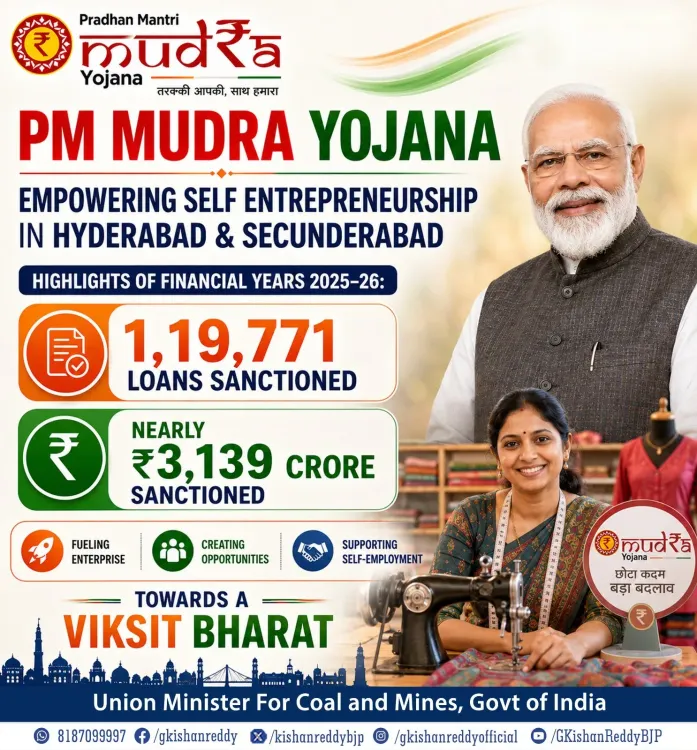
Union Minister G. Kishan Reddy has highlighted that PMMY sanctioned 1,19,771 loans worth nearly ₹3,139 crore in Hyderabad and Secunderabad in FY 2025–26, covering traders, service providers, and agri-allied entrepreneurs across all four Mudra tiers.
Key Takeaways
1,19,771 loans were sanctioned under PMMY in Hyderabad and Secunderabad during FY 2025–26 .
Total sanctions amounted to nearly ₹3,139 crore in collateral-free institutional credit.
Beneficiaries span small traders, service providers, and agri-allied activities including dairy, poultry, and beekeeping .
The scheme covers four tiers: Shishu (up to ₹50,000), Kishore (up to ₹5 lakh), Tarun (up to ₹10 lakh), and Tarun Plus (up to ₹20 lakh for repeat borrowers).
PMMY was launched on 8 April 2015 and is part of India's broader Atmanirbhar Bharat financial inclusion framework.
Union Coal and Mines Minister and BJP Telangana president G. Kishan Reddy on Wednesday, 24 June 2026 highlighted the performance of the Pradhan Mantri Mudra Yojana (PMMY) in Hyderabad and Secunderabad, citing 1,19,771 loans sanctioned and nearly ₹3,139 crore disbursed in the region during Financial Year 2025–26.
Context
Reddy's post underscores the reach of PMMY in Telangana's twin cities, pointing to collateral-free credit flowing to small traders, service providers, and agri-allied enterprises including dairy, poultry, and beekeeping. He attributed the scheme's momentum to the leadership of Prime Minister Narendra Modi, framing the data as evidence of grassroots economic empowerment. The minister noted that the scheme is helping 'thousands transform ideas into opportunities and opportunities into sustainable livelihoods.'
Policy Backdrop
PMMY was launched on 8 April 2015 by the Ministry of Finance to extend institutional credit to non-farm micro enterprises that had historically been excluded from the formal banking system. The scheme operates across four tiers: Shishu (up to ₹50,000), Kishore (₹50,000 to ₹5 lakh), Tarun (₹5 lakh to ₹10 lakh), and Tarun Plus (up to ₹20 lakh for successful repeat borrowers). The Tarun Plus category, introduced in later years, is designed to reward creditworthy micro-entrepreneurs and encourage business scaling. PMMY sits within a broader post-2014 financial inclusion architecture that includes Jan Dhan accounts, direct benefit transfers, and credit guarantee mechanisms for MSMEs. Successive Union Budgets have progressively raised loan ceilings and widened eligible activity categories to cover agri-allied and service-sector livelihoods. The scheme's integration with the Atmanirbhar Bharat programme — launched in 2020 — has further positioned Mudra lending as a tool for domestic entrepreneurship and self-reliance.
Stakeholders and Impact
The primary beneficiaries in Hyderabad and Secunderabad span a wide economic cross-section: street vendors, small retailers, artisans, and first-generation entrepreneurs in agri-allied sectors. Collateral-free access is particularly significant for borrowers who lack property titles or credit histories, groups that have traditionally been shut out of formal lending channels. In Telangana, BJP leaders have consistently cited PMMY outcomes to illustrate the on-ground delivery of central welfare programmes, and Reddy's post continues that pattern ahead of what is expected to be a politically active budget season.
What's Next
The Department of Financial Services is expected to publish its next annual PMMY performance report covering national disbursement data, which will allow independent assessment of the figures cited for FY 2025–26. Any revision to scheme loan limits or the introduction of interest subvention provisions in the Union Budget 2026–27 could further expand the programme's reach. For Hyderabad and Secunderabad, the focus will be on whether the current pace of sanctions translates into measurable improvements in self-employment rates and micro-enterprise survival.
Point of View
Reinforcing the BJP's claim that central programmes are delivering tangible outcomes in a state where the party is in opposition. By anchoring the data to Hyderabad and Secunderabad specifically, the minister is making a constituency-level argument rather than a purely policy one. The emphasis on agri-allied activities such as dairy and poultry broadens the scheme's appeal beyond urban micro-entrepreneurs to rural and peri-urban voters. Coming ahead of what could be a politically significant budget cycle, the messaging fits a pattern of BJP leaders using welfare delivery data to build ground-level credibility in competitive states.
NationPress
22 Sept 2026
Frequently Asked Questions
What is Pradhan Mantri Mudra Yojana (PMMY)?
PMMY is a Government of India scheme launched on 8 April 2015 that provides collateral-free institutional loans to micro and small non-farm enterprises. Loans are available in four tiers: Shishu (up to ₹50,000), Kishore (up to ₹5 lakh), Tarun (up to ₹10 lakh), and Tarun Plus (up to ₹20 lakh for successful repeat borrowers).
How many PMMY loans were sanctioned in Hyderabad in FY 2025-26?
According to Union Minister G. Kishan Reddy, 1,19,771 loans were sanctioned in Hyderabad and Secunderabad under PMMY during FY 2025–26, amounting to nearly ₹3,139 crore .
Who is eligible for a Mudra loan?
Any Indian citizen running a non-farm micro or small enterprise — including small traders, service providers, artisans, and agri-allied businesses such as dairy, poultry, and beekeeping — can apply for a Mudra loan through scheduled banks, microfinance institutions, and NBFCs. No collateral is required.
What is the Tarun Plus category under PMMY?
Tarun Plus is an enhanced loan tier under PMMY that allows successful repeat borrowers to access loans of up to ₹20 lakh. It was introduced to reward creditworthy micro-entrepreneurs and encourage them to scale their businesses.
How does PMMY relate to Atmanirbhar Bharat?
PMMY is integrated into the Atmanirbhar Bharat programme launched in 2020, which positions collateral-free Mudra lending as a key instrument for fostering domestic entrepreneurship, self-employment, and economic self-reliance at the grassroots level.