Kishan Reddy: Cabinet Clears SARTHAK-PDS, Rs 25,530 Cr Outlay
Synopsis
The Union Cabinet chaired by PM Modi has approved SARTHAK-PDS, a Rs 25,530 crore scheme merging two existing PDS programmes to modernise food distribution for 81.35 crore NFSA beneficiaries using AI, blockchain, and e-PoS technology until March 2031.
Key Takeaways
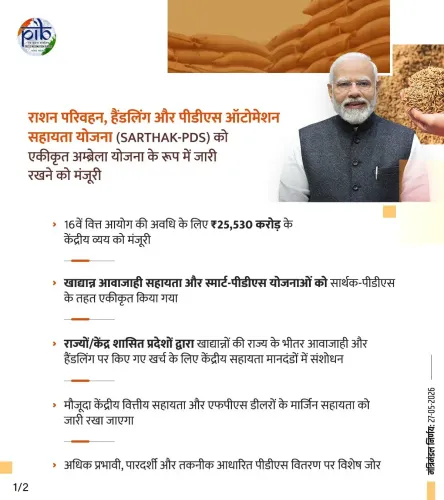
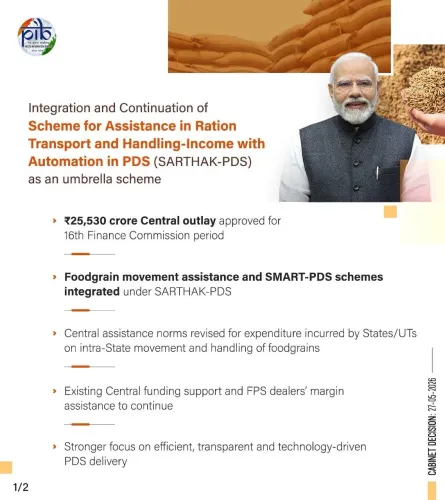
The Union Cabinet approved SARTHAK-PDS , a unified scheme to reform the public distribution system, on 28 May 2026 .
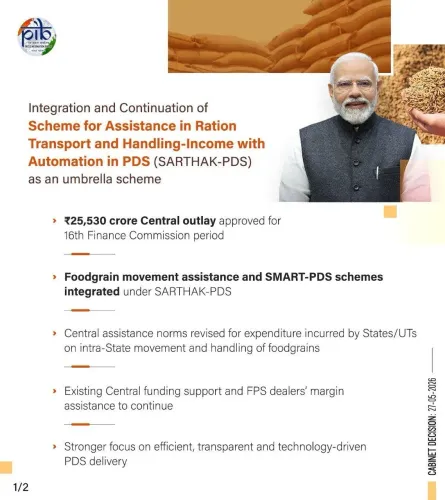
The scheme merges the Food Grains Transportation Assistance programme and SMART-PDS into a single platform.
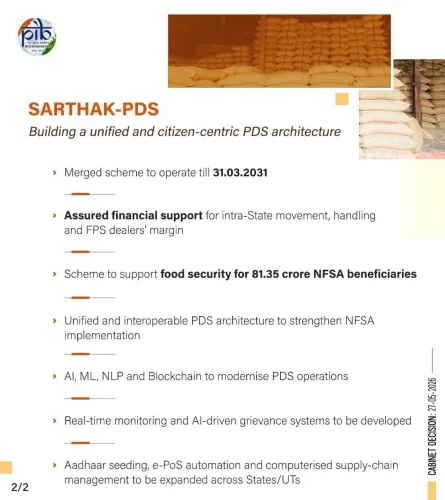
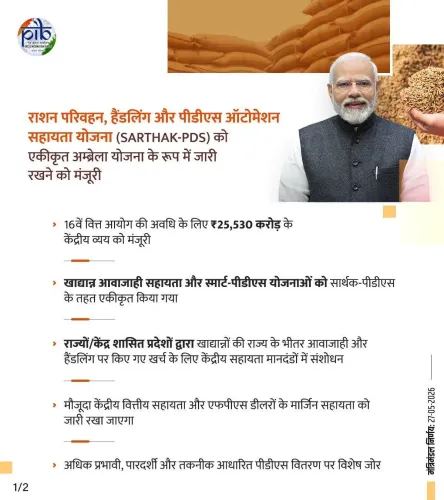
Central outlay is Rs 25,530 crore ; the scheme runs until 31 March 2031 .
81.35 crore NFSA beneficiaries across India are covered under the scheme.
Technologies including AI, ML, NLP, and Blockchain will be deployed for real-time monitoring and grievance redressal.
Aadhaar linking, e-PoS automation , and computerised supply chains will be extended to all states and Union Territories.
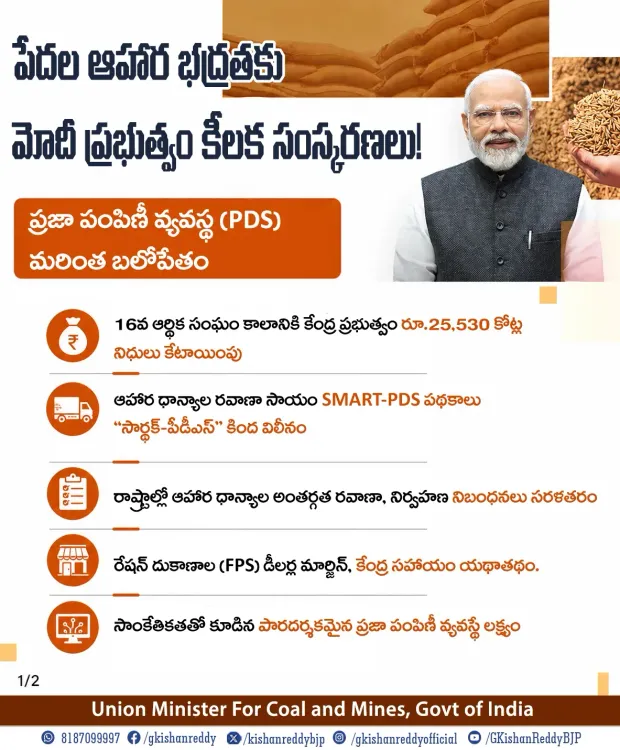
Union Coal and Mines Minister G. Kishan Reddy on Thursday, 28 May 2026, announced that the Union Cabinet, chaired by Prime Minister Narendra Modi, has approved a comprehensive new scheme called SARTHAK-PDS to overhaul the country's public distribution system and secure food entitlements for over 81 crore beneficiaries under the National Food Security Act (NFSA).
Context
Reddy, who is also the BJP Telangana state president, shared the Cabinet decision on X in Telugu, stating: 'దేశంలోని 81 కోట్లకు పైగా పేద ప్రజలకు నాణ్యమైన ఆహార ధాన్యాలు పారదర్శకంగా అందేలా కేంద్ర ప్రభుత్వం మరో కీలక నిర్ణయం తీసుకుంది' — ('The central government has taken another key decision to ensure quality foodgrains reach more than 81 crore poor people across the country in a transparent manner.')
The newly approved SARTHAK-PDS scheme merges two existing central programmes — the Food Grains Transportation Assistance scheme and the technology-reform initiative SMART-PDS — into a single unified platform. The scheme carries a central outlay of Rs 25,530 crore and will remain operational until 31 March 2031.
Policy Backdrop
The National Food Security Act, enacted in 2013, legally entitles approximately 81.35 crore beneficiaries — covering up to 75 per cent of the rural population and 50 per cent of the urban population — to subsidised foodgrains through the public distribution system. End-to-end computerisation of the PDS was initiated as early as 2012–13, with Aadhaar linkage and direct-benefit-transfer reforms accelerated from 2014 onwards to reduce diversion and plug leakages.
SMART-PDS, the predecessor scheme, had already introduced e-PoS (electronic Point of Sale) devices and supply-chain digitisation across states. The integration of the transportation-assistance component into the same umbrella is intended to reduce administrative fragmentation and create a single data backbone for the entire PDS delivery chain.
Key Features of SARTHAK-PDS
According to the minister's post, the scheme will deploy Artificial Intelligence (AI), Machine Learning (ML), Natural Language Processing (NLP), and Blockchain technologies to modernise ration-shop operations and enable real-time monitoring of grain movement. Aadhaar linking, e-PoS automation, and computerised supply chains will be extended to all states and Union Territories.
The scheme also promises faster grievance redressal through AI-driven tools, and aims to build a more integrated, citizen-friendly ration system. The consolidation reflects a broader central government pattern of merging parallel digitisation and logistics schemes into unified, data-driven welfare delivery platforms.
Stakeholders and Impact
The primary beneficiaries are the 81.35 crore NFSA-enrolled households spread across the country, who depend on the PDS for subsidised rice, wheat, and coarse grains. State food and civil supplies departments will be the key implementation partners, responsible for integrating their existing infrastructure with the new unified platform.
The merged scheme is expected to reduce the compliance burden on states by channelling both transportation support and technology investments through a single nodal framework, potentially speeding up reforms that have so far varied widely in pace across different states and Union Territories.
What's Next
Attention will now turn to state-level rollout timelines, the operationalisation of blockchain and AI pilots at ration shops, and the mechanism for transferring transportation assistance under the new unified structure. Parliamentary scrutiny of implementation milestones and any supplementary budgetary demands are also likely as the scheme moves from Cabinet approval to ground-level execution before its March 2031 sunset date.
The Cabinet's decision signals a continued push to make food-subsidy delivery fully technology-mediated — a trajectory that, if realised at scale, could set a template for other centrally sponsored welfare programmes seeking to reduce leakages and improve last-mile accountability.
Point of View
The Centre is reducing the scope for states to treat these as separate, siloed programmes — a structural fix as significant as the technology additions themselves. The deployment of blockchain and AI in the PDS, if implemented at the pace promised, would represent a meaningful escalation beyond the e-PoS reforms of the previous decade. However, the scheme's real test will be in state-level absorption capacity and the political will to enforce Aadhaar-linked authentication uniformly across all 81 crore beneficiaries.
NationPress
16 Sept 2026
Frequently Asked Questions
What is the SARTHAK-PDS scheme approved by the Cabinet?
SARTHAK-PDS is a new central scheme approved by the Union Cabinet on 28 May 2026 that merges the Food Grains Transportation Assistance programme and SMART-PDS to create a unified, technology-driven public distribution system for 81.35 crore NFSA beneficiaries, with a budget of Rs 25,530 crore valid until 31 March 2031.
How much money has the government allocated for SARTHAK-PDS?
The central government has allocated Rs 25,530 crore for the SARTHAK-PDS scheme, which will be operational until 31 March 2031 .
How many people will benefit from the SARTHAK-PDS scheme?
The scheme is designed to secure food entitlements for 81.35 crore beneficiaries enrolled under the National Food Security Act (NFSA) across India.
What technologies will be used in SARTHAK-PDS?
SARTHAK-PDS will use Artificial Intelligence (AI), Machine Learning (ML), Natural Language Processing (NLP) , and Blockchain for real-time monitoring of grain supply chains, faster grievance resolution, and Aadhaar-linked e-PoS automation at ration shops.
What is the difference between SMART-PDS and SARTHAK-PDS?
SMART-PDS was an earlier scheme focused on technology reforms such as e-PoS devices and supply-chain computerisation. SARTHAK-PDS absorbs SMART-PDS and also integrates the Food Grains Transportation Assistance scheme, creating a single unified platform with expanded AI and blockchain capabilities.