CM Saini Backs Centre's Sarthak-PDS Scheme Worth ₹25,530 Cr
Synopsis
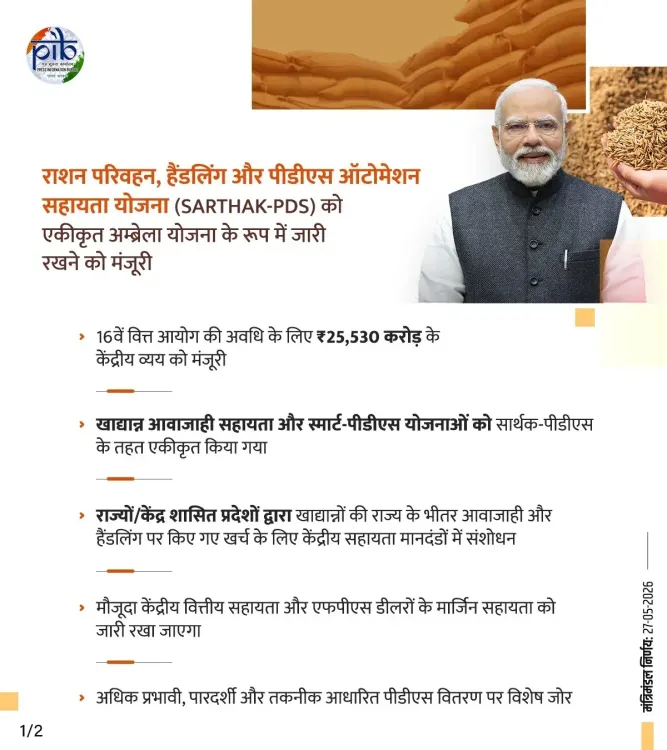
The Centre has approved the Sarthak-PDS scheme with a ₹25,530 crore outlay to integrate grain distribution, transport, and smart PDS infrastructure over five years. Haryana CM Nayab Singh Saini welcomed the move as a major step for food security transparency.
Key Takeaways
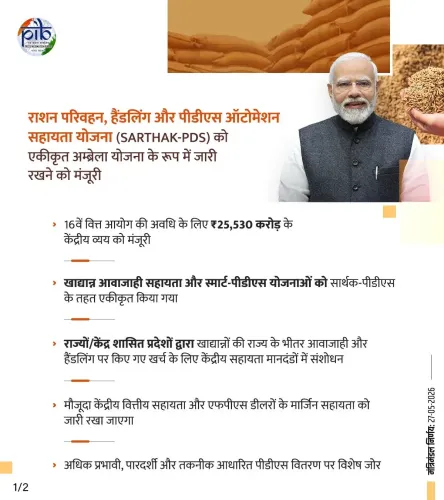
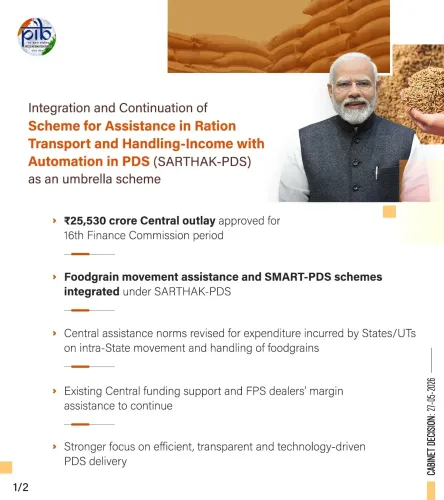
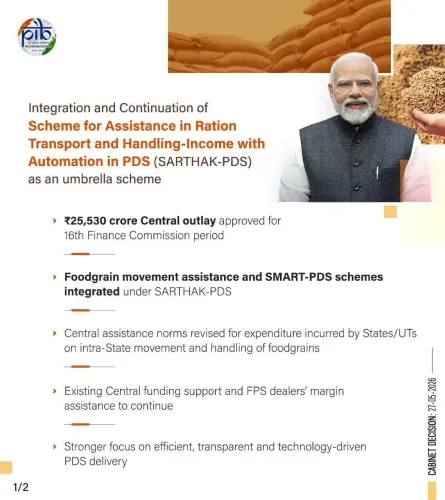
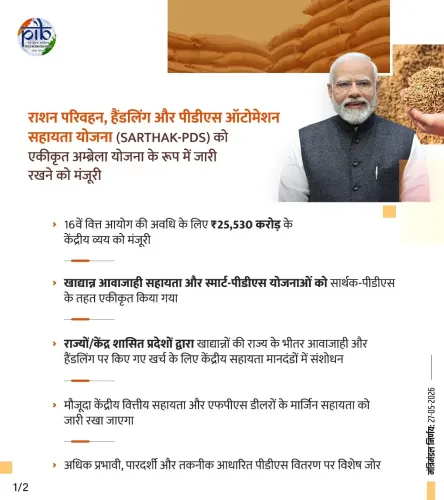
The central government has approved the Sarthak-PDS scheme with a total outlay of ₹25,530 crore .
The scheme will run over five years , integrating food grain distribution, ration transport, and smart PDS systems.
Haryana CM Nayab Singh Saini credited Prime Minister Narendra Modi for the initiative on 27 May 2026 .
The scheme builds on earlier reforms including Aadhaar seeding , e-PoS devices , and the One Nation One Ration Card programme launched in 2019.
Primary beneficiaries are ration card holders and needy families covered under the National Food Security Act, 2013 .
State-wise phased rollout and mid-term reviews will determine the scheme's on-ground effectiveness.
Haryana Chief Minister Nayab Singh Saini on Wednesday, 27 May 2026 welcomed the central government's approval of the Sarthak-PDS scheme, calling it a significant step for the welfare of needy families across the country. Saini credited the initiative to the leadership of Prime Minister Narendra Modi, stating that the scheme will transform food security delivery nationwide.
In his post, Saini wrote: 'Pradhan Mantri Shri Narendra Modi ji ke netritva mein Kendra Sarkar ne Sarthak-PDS yojana ko sweekruti pradan kar zarooratmand parivaron ke hit mein ek mahatvapurn kadam uthaya hai' — [Under the leadership of Prime Minister Narendra Modi, the central government has taken an important step in the interest of needy families by approving the Sarthak-PDS scheme.]
Context
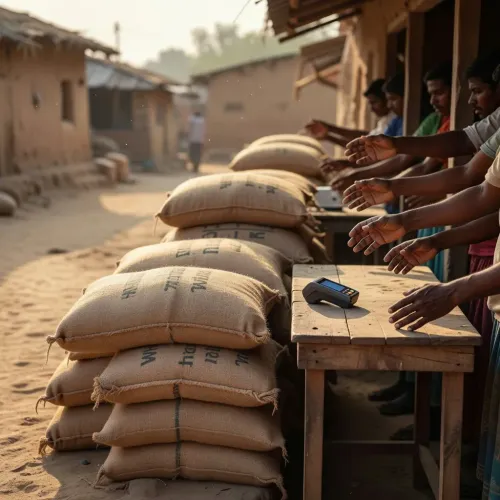
The Sarthak-PDS scheme, approved by the Union government, carries an outlay of ₹25,530 crore to be spent over the next five years. The scheme aims to integrate food grain distribution, ration transportation, and smart PDS infrastructure into a unified system. The goal is to make India's food security architecture more effective and transparent.
India's Public Distribution System (PDS) is one of the world's largest food welfare networks, supplying subsidised grains to eligible households under the National Food Security Act, 2013, which legally entitles roughly 67 per cent of the country's population to subsidised food grains.
Policy Backdrop
The Sarthak-PDS scheme is the latest step in a long arc of PDS reform that successive central governments have pursued through technology. Aadhaar seeding of ration cards, electronic Point-of-Sale (e-PoS) devices at fair price shops, and real-time monitoring dashboards have progressively been introduced to curb leakages and improve targeting.
A landmark in this reform journey was the One Nation One Ration Card (ONORC) initiative, rolled out from 2019 onwards, which enabled inter-state portability of ration entitlements — allowing migrant workers and mobile families to access their food grain quota anywhere in the country. The Sarthak-PDS scheme's integrated logistics and smart systems component extends this trajectory further.
Stakeholders and Impact
The primary beneficiaries are ration card holders and economically vulnerable families who depend on subsidised grain for food security. By integrating transport and distribution with a smart PDS layer, the scheme is designed to reduce delays, plug supply-chain gaps, and ensure last-mile delivery reaches intended recipients.
At the state level, chief ministers and food supply departments will be key implementing partners. Haryana, like other states, will be expected to align its existing PDS infrastructure with the new integrated framework as the rollout progresses.
What's Next
Attention will now turn to the phased, state-wise rollout of the integrated system, with observers watching how quickly digitisation and transport components are operationalised on the ground. Any mid-term review of implementation progress will be a key indicator of whether the scheme meets its five-year targets.
With ₹25,530 crore committed over five years, the scheme's success will ultimately be measured by improvements in transparency, reduction in leakages, and the experience of crores of beneficiary households at the ration shop level.
Point of View
Combining logistics, digitisation, and distribution under a single integrated framework. For BJP chief ministers like Nayab Singh Saini, publicly endorsing such central schemes serves a dual purpose: reinforcing alignment with New Delhi's welfare narrative and signalling state-level commitment to implementation. The ₹25,530 crore outlay over five years is substantial, but the real test will be execution — previous PDS technology initiatives have faced uneven adoption across states. The scheme's success could become a significant political asset ahead of future electoral cycles if beneficiaries experience measurable improvement in grain access and transparency.
NationPress
11 Oct 2026
Frequently Asked Questions
What is the Sarthak-PDS scheme?
The Sarthak-PDS scheme is a central government initiative approved in 2026 that integrates food grain distribution, ration transportation, and smart PDS infrastructure with an outlay of ₹25,530 crore over five years to improve transparency and effectiveness of India's food security system.
How much money has been allocated for the Sarthak-PDS scheme?
The central government has allocated ₹25,530 crore for the Sarthak-PDS scheme, to be spent over a period of five years.
Who will benefit from the Sarthak-PDS scheme?
Ration card holders and economically vulnerable families covered under the National Food Security Act, 2013 — approximately 67 per cent of India's population — are the primary intended beneficiaries.
What did Haryana CM Nayab Singh Saini say about the Sarthak-PDS scheme?
Haryana CM Nayab Singh Saini welcomed the scheme's approval on 27 May 2026, calling it an important step for needy families taken under the leadership of Prime Minister Narendra Modi.
How is Sarthak-PDS different from previous PDS reforms?
Unlike earlier reforms that focused on individual components such as Aadhaar seeding or e-PoS devices, Sarthak-PDS takes an integrated approach combining grain distribution, transport logistics, and smart systems under one unified framework over a five-year period.