Kishan Reddy highlights Coal Gasification Mission goals
Synopsis
Union Coal Minister G. Kishan Reddy has shared a Telugu article by EAC-PM Chairman Prof. S. Mahendra Dev explaining how the National Mission for Coal Gasification aims to produce syngas from domestic coal, advancing India's energy security and industrial growth toward a 100-million-tonne gasification target by 2030.
Key Takeaways
Union Coal and Mines Minister G.
Kishan Reddy shared an article by EAC-PM Chairman Prof.
Mahendra Dev on coal gasification on June 18, 2026 .
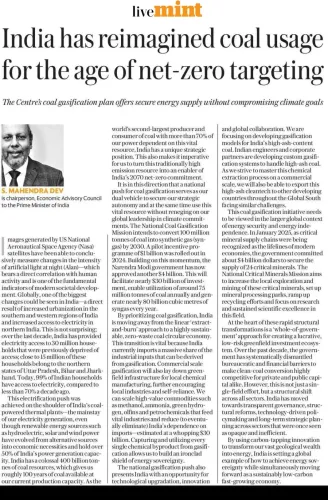
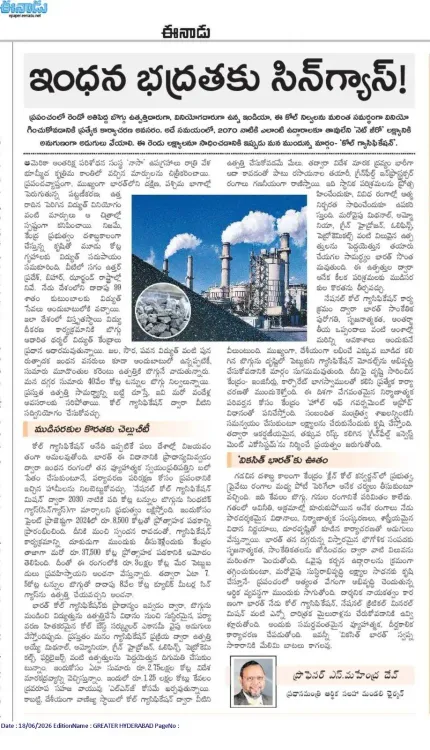
The article, titled 'Syngas for Energy Security,' was published in the Telugu daily Eenadu and explains the goals of the National Mission for Coal Gasification .
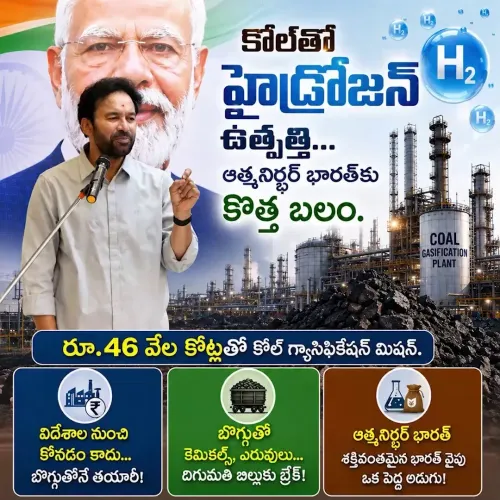
The Central government has set a target to gasify 100 million tonnes of coal by 2030 to produce syngas for power, fertilizers, and chemicals.
The mission aims to reduce India's dependence on imported oil and gas by substituting them with domestically produced syngas.
The chemical and fertilizer sectors are key beneficiaries, as syngas can replace imported naphtha and natural gas as industrial feedstock.
The article's amplification in Telugu signals an effort to communicate the mission's benefits to a regional audience in Telangana and Andhra Pradesh.
Union Coal and Mines Minister G. Kishan Reddy on Thursday, June 18, 2026, drew public attention to the Central government's National Mission for Coal Gasification, sharing an article by Prime Minister's Economic Advisory Council (EAC-PM) Chairman Prof. S. Mahendra Dev that outlines how the mission is paving the way for India's energy security and industrial growth.
The article, titled 'Indhana Bhadrataku Syngas' ('Syngas for Energy Security'), was published in the Telugu-language daily Eenadu on June 18, 2026. Kishan Reddy shared the piece on X, urging followers to read it, describing its contents as 'thought-provoking.'
Context
The National Mission for Coal Gasification is a flagship Central government initiative that aims to convert domestically mined coal into syngas — a mixture of hydrogen and carbon monoxide — for use in power generation, fertilizer production, and the chemicals industry. By producing syngas from Indian coal, the mission seeks to reduce the country's dependence on imported oil and natural gas.
Prof. S. Mahendra Dev, a development economist and Chairman of the Economic Advisory Council to the Prime Minister (EAC-PM), wrote the article to explain the mission's objectives and its potential contribution to India's broader economic development. The EAC-PM is the official body that advises the Prime Minister on economic policy and reform.
Policy Backdrop
The coal gasification push has its roots in the 2020 Union Budget, when the government announced a target to gasify 100 million tonnes of coal by 2030. This target was framed as a strategic move to generate industrial-grade syngas domestically, substituting costly imports of oil and gas derivatives.
The mission sits within a wider arc of coal-sector reforms that the government has pursued since 2014, including commercial mining auctions and revenue-sharing models designed to raise domestic coal output. Coal gasification represents the next step — moving beyond extraction to value-added conversion of Indian coal into cleaner industrial feedstock.
The Ministry of Coal, which Kishan Reddy heads, has been the nodal ministry for driving these reforms and overseeing the gasification programme's rollout.
Stakeholders and Impact
The mission has direct implications for the coal industry, which stands to gain new demand streams beyond conventional thermal power. The chemical and fertilizer sectors are among the primary beneficiaries, as syngas can replace imported naphtha and natural gas as feedstock for producing ammonia, urea, and other industrial chemicals.
For Telangana and other coal-bearing states, the programme could translate into investment in gasification plants, employment in allied industries, and reduced input costs for local manufacturers. Kishan Reddy, who also serves as BJP Telangana state president, sharing the article in Telugu signals an effort to communicate the mission's benefits to a regional audience.
What's Next
The rollout of pilot gasification projects and any revision of the 2030 target of 100 million tonnes are the key milestones to watch. Progress is expected to be reflected in future Economic Surveys and the Ministry of Coal's annual reports.
With a senior economist of Prof. Mahendra Dev's stature making the public case for coal gasification's role in energy security, the mission is likely to receive continued policy attention. The minister's amplification of the article suggests the government is keen to build broader awareness and public support for what it regards as a transformative long-term programme.
Point of View
Which seeks to reframe coal not as a legacy fuel but as a bridge to industrial self-reliance. By channelling the message through the EAC-PM Chairman, the minister lends the mission an economic-reform framing that goes beyond sectoral interest. The regional-language amplification also serves a dual purpose for Kishan Reddy as BJP's Telangana president, connecting a national policy to local economic aspirations in a politically competitive state.
NationPress
18 Sept 2026
Frequently Asked Questions
What is the National Mission for Coal Gasification?
The National Mission for Coal Gasification is a Central government initiative to convert domestic coal into syngas — a mixture of hydrogen and carbon monoxide — for use in power generation, fertilizer production, and the chemicals industry, reducing dependence on imported oil and gas.
What is India's coal gasification target by 2030?
India's government announced in the 2020 Union Budget a target to gasify 100 million tonnes of coal by 2030 to produce industrial-grade syngas domestically.
Who is Prof. S. Mahendra Dev?
Prof. S. Mahendra Dev is a development economist and the Chairman of the Economic Advisory Council to the Prime Minister (EAC-PM), the official body that advises the Prime Minister on economic policy and reforms.
How does coal gasification help India's energy security?
Coal gasification converts Indian coal into syngas that can substitute imported natural gas and naphtha as feedstock for fertilizers, chemicals, and power, reducing the country's import bill and strengthening energy self-reliance.
What is G. Kishan Reddy's role in coal policy?
G. Kishan Reddy is the Union Minister of Coal and Mines, the minister responsible for overseeing coal mining policy, commercial mining reforms, and the National Mission for Coal Gasification. He also serves as BJP's Telangana state president.