Kishan Reddy flags Rs 46,000 cr Coal Gasification Mission
Synopsis
Union Coal and Mines Minister G. Kishan Reddy has highlighted the launch of a Rs 46,000 crore Coal Gasification Mission, crediting PM Modi's vision. The mission aims to produce methanol, hydrogen, fertilisers and petrochemicals as by-products, advancing India's energy self-reliance goals under the Atmanirbhar Bharat framework.
Key Takeaways
Union Coal and Mines Minister G.
Kishan Reddy announced a Coal Gasification Mission valued at Rs 46,000 crore on June 8, 2026 .
The mission aims to convert domestic coal into syngas, yielding methanol, hydrogen, fertilisers and petrochemicals as by-products.
The initiative builds on a 2020 government target to gasify 100 million tonnes of coal by 2030 to cut import dependence.
Coal India Limited and Singareni Collieries are expected to be primary implementing agencies for gasification plants.
The mission aligns with Atmanirbhar Bharat objectives and could reduce India's reliance on imported crude, LNG and urea precursors.
Cabinet or CCEA approval of the outlay and environmental clearances for pilot plants remain key next steps.
Union Coal and Mines Minister G. Kishan Reddy on Monday, June 8, 2026, highlighted the launch of a Coal Gasification Mission worth Rs 46,000 crore, attributing the initiative to Prime Minister Narendra Modi's vision for meeting the country's energy needs through domestic resources.
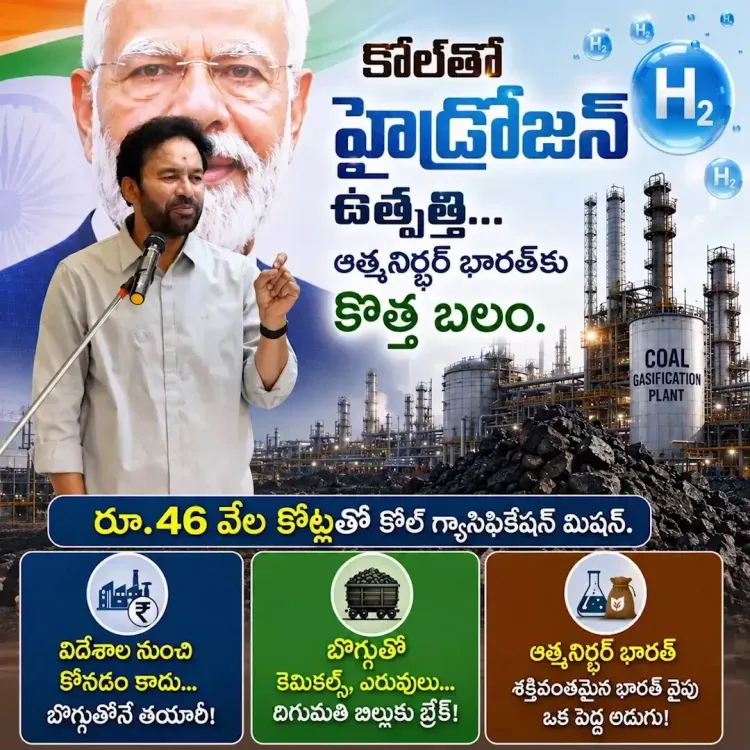
In a post on X, the minister stated — translated from Telugu — that 'with the foresight of honourable Prime Minister Shri Narendra Modi, a Coal Gasification Mission worth Rs 46,000 crore has been brought in to fulfil the country's energy needs.' He further noted that మిథనాల్, హైడ్రోజన్, ఫెర్టిలైజర్, పెట్రో కెమికల్స్ [methanol, hydrogen, fertilisers, and petrochemicals] would all be available as by-products of this gasification process.
Context
Coal gasification converts solid coal into synthetic gas — or syngas — which can then be processed into a range of industrial inputs including methanol, hydrogen, fertilisers, and petrochemicals. For India, a country with among the world's largest coal reserves but a significant dependence on imported crude oil and natural gas, the technology offers a potential route to reduce the import bill while utilising existing domestic assets.
The Ministry of Coal, which G. Kishan Reddy heads, has been the nodal body for pushing gasification adoption across public sector undertakings. The minister's framing of the mission as a product of Modi's 'foresight' aligns with the government's broader communication strategy around energy self-reliance.
Policy Backdrop
As early as 2020, the central government announced a national target to gasify 100 million tonnes of coal by 2030 as part of an import substitution drive. The Coal Gasification Mission, as highlighted by the minister, appears to be a formalisation or scaling of that earlier roadmap under a dedicated financial outlay.
The initiative sits squarely within the Atmanirbhar Bharat framework, which seeks to reduce India's dependence on foreign energy and chemical imports. Gasification-derived hydrogen also feeds into the country's nascent National Green Hydrogen Mission objectives, making the policy relevant across multiple ministerial portfolios.
It should be noted that the exact budget figure of Rs 46,000 crore and the formal launch date of the mission, as cited in the minister's post, have not yet been independently corroborated from official government records available prior to this announcement.
Stakeholders and Impact
The primary beneficiaries of the mission span multiple industries. Coal India Limited and Singareni Collieries Company Limited — the two dominant public sector coal miners — are expected to be key implementing agencies for gasification plants. Fertiliser manufacturers stand to gain a domestic source of syngas-derived feedstock, potentially reducing their dependence on imported LNG and urea precursors.
Petrochemical and methanol producers would similarly benefit from a cheaper, domestically sourced input stream. For coal-mining regions, the mission could translate into downstream industrial investment and employment beyond the mine itself, although environmental clearance processes for gasification plants are expected to be closely scrutinised.
What's Next
Formal Cabinet or CCEA approval of the Rs 46,000 crore outlay will be a key milestone to watch, along with the selection of pilot project sites by Coal India or Singareni. Environmental clearance processes for the first gasification plants will determine the pace of actual on-ground implementation.
If the mission proceeds as outlined, India's coal sector could shift from being a primary energy source to a broader industrial feedstock platform — a structural transformation that would reshape the economics of both the mining and chemicals industries for decades ahead.
Point of View
The government is attempting to future-proof the coal sector against the global energy transition narrative while delivering tangible industrial feedstock benefits. For Minister Kishan Reddy, the announcement also carries political weight in Telangana, where Singareni Collieries is a major employer and a symbol of regional industrial identity. The real test will be whether the Rs 46,000 crore outlay translates into operational plants within the decade, given the historically slow pace of large-scale energy infrastructure projects in India.
NationPress
21 Sept 2026
Frequently Asked Questions
What is the Coal Gasification Mission announced by Kishan Reddy?
The Coal Gasification Mission is a central government initiative worth Rs 46,000 crore that aims to convert domestic coal into synthetic gas, which can then be used to produce methanol, hydrogen, fertilisers and petrochemicals as by-products, reducing India's dependence on imported energy and chemicals.
What are the by-products of coal gasification under this mission?
According to Union Minister G. Kishan Reddy's post, the key by-products of coal gasification under this mission include methanol, hydrogen, fertilisers and petrochemicals — all of which have significant industrial and agricultural demand in India.
How much money has been allocated for the Coal Gasification Mission?
Minister G. Kishan Reddy stated that the Coal Gasification Mission has been launched with an outlay of Rs 46,000 crore, though formal Cabinet or CCEA confirmation of this figure is awaited.
How does coal gasification help India's energy security?
Coal gasification converts India's abundant domestic coal into syngas, which substitutes for imported crude oil, LNG and natural gas in producing fuels and chemicals. This reduces the country's import bill and supports the Atmanirbhar Bharat self-reliance agenda.
Which companies will implement coal gasification projects in India?
Coal India Limited and Singareni Collieries Company Limited, the two major public sector coal miners, are expected to be the primary agencies implementing gasification plants under the mission.