Kishan Reddy: CCEA Approves MSP Hike for Rabi Crops 2027-28
Synopsis
The Cabinet Committee on Economic Affairs has approved revised MSPs for all mandated Rabi crops for Marketing Season 2027-28, with safflower getting the highest hike of ₹675 per quintal. A procurement target of 324 lakh metric tonnes will channel ₹90,962 crore to farmers. Union Minister G. Kishan Reddy shared the announcement.
Key Takeaways
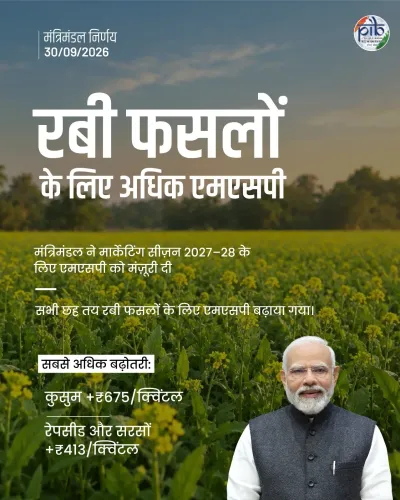
The CCEA , chaired by PM Narendra Modi , approved revised MSPs for all mandated Rabi crops for Marketing Season 2027-28 on 30 September 2026 .
Safflower received the highest MSP hike at ₹675 per quintal , followed by rapeseed and mustard at ₹413 and lentil (masur) at ₹390 .
The government targets procurement of 324 lakh metric tonnes from farmers during this Rabi season.
Total funds to be channelled to farmers via MSP procurement: ₹90,962 crore .
The revision aligns with the 2018 policy mandating MSP at least 1.5 times the cost of production.
The hikes are designed to encourage crop diversification , especially toward oilseeds and drought-tolerant varieties.
A ₹90,962 crore commitment to India's farmers — that is the scale of the Cabinet Committee on Economic Affairs decision approved on Wednesday, 30 September 2026, raising Minimum Support Prices for all mandated Rabi crops for Marketing Season 2027-28. Union Coal and Mines Minister G. Kishan Reddy, also the BJP Telangana state president, shared the announcement, calling it a decisive step toward farmer welfare and crop diversification.
Safflower leads the gains, mustard and masur follow
The sharpest jump in this year's revision belongs to safflower, which sees an increase of ₹675 per quintal — the single highest hike across all mandated Rabi crops. Rapeseed and mustard follow with a rise of ₹413 per quintal, and lentil (masur) comes in third at ₹390 per quintal. These are not marginal adjustments; they are calibrated signals to farmers about which crops the government wants planted this sowing season.
The sequencing matters. Rapeseed and mustard are central to India's edible-oil self-sufficiency push, and a strong MSP nudges farmers away from water-intensive staples toward oilseeds — a strategic pivot the government has pursued consistently. Safflower, a drought-tolerant crop, fits the same logic. The policy, anchored in the 2018 framework that mandates MSP at least 1.5 times the cost of production, now has sharper teeth for the 2027-28 cycle.
₹90,962 crore flowing to farmers via procurement
Beyond the per-quintal numbers, the government has set a procurement target of 324 lakh metric tonnes from farmers during this Rabi season. At the revised MSPs, that translates to ₹90,962 crore channelled directly into farmers' hands — a figure that underscores the scale of state intervention in agricultural markets. Procurement at this volume also functions as a price floor in the open market, giving farmers negotiating leverage even when they sell outside government mandis.
The Cabinet Committee on Economic Affairs, chaired by Prime Minister Narendra Modi, is the apex body that clears these annual revisions. The timing — announced ahead of the Rabi sowing window — is deliberate: farmers need price certainty before seeds go into the ground. Kishan Reddy expressed 'sincere gratitude' to the Prime Minister for his 'continued commitment to the welfare and prosperity of our Annadatas.'
Why the 2027-28 revision carries wider significance
Annual MSP revisions are a routine feature of India's agricultural calendar, but their political and economic weight is anything but routine. For Telangana — a state where Kishan Reddy's BJP is working to expand its footprint — a visible central commitment to farmer income is also an electoral message. Rabi crops including wheat, mustard, and lentils are grown across large swathes of the state and neighbouring Andhra Pradesh.
The broader pattern is one of incremental but consistent enhancement: each successive CCEA revision has attempted to outpace input-cost inflation while tilting the crop basket toward less water-intensive varieties. Whether actual procurement volumes match the 324 lakh metric tonne target — and whether state agencies move swiftly to operationalise procurement centres — will determine how much of the ₹90,962 crore promise reaches the farm gate.
The Rabi sowing season is now open. The numbers are on the table. Farmers will vote with their seeds.
Point of View
962 crore procurement commitment is politically significant, arriving as the BJP works to consolidate its presence in southern states including Telangana. However, the true test of the policy will be in implementation: whether state procurement agencies activate in time, and whether the 324 lakh metric tonne target is actually met at the farm level. Kishan Reddy's amplification of the announcement reflects the party's intent to own the farmer-welfare narrative heading into the next electoral cycle.
NationPress
30 Sept 2026
Frequently Asked Questions
What is the MSP increase for Rabi crops in 2027-28?
The CCEA approved revised MSPs for all mandated Rabi crops for Marketing Season 2027-28. The highest increase is ₹675 per quintal for safflower, followed by ₹413 for rapeseed and mustard, and ₹390 for lentil (masur).
How much money will farmers get from MSP procurement in Rabi 2027-28?
The government plans to procure 324 lakh metric tonnes from farmers during the Rabi season, putting ₹90,962 crore into farmers' hands through MSP-based procurement.
Why did safflower get the highest MSP hike?
Safflower received the steepest hike of ₹675 per quintal as part of the government's push to encourage crop diversification toward drought-tolerant and less water-intensive varieties.
What is the CCEA and who chairs it?
The Cabinet Committee on Economic Affairs is the apex central body that approves major economic decisions, including annual MSP revisions. It is chaired by Prime Minister Narendra Modi.
What is the government's MSP policy since 2018?
Since 2018, the government's policy mandates that MSP for notified crops must be set at least 1.5 times the cost of production, ensuring a guaranteed minimum return for farmers.