Kishan Reddy: Fast-Track Courts for Exam Paper Leaks

Synopsis
Union Minister G. Kishan Reddy announced on 23 July 2026 that the Modi government will set up fast-track courts to try examination paper leak cases swiftly, building on the Public Examinations (Prevention of Unfair Means) Act, 2024, to protect student aspirations and restore trust in India's competitive exam system.
Key Takeaways
Kishan Reddy announced the decision to establish fast-track courts specifically for examination paper leak cases on 23 July 2026 .
The courts aim to ensure quicker conviction of culprits and strengthen accountability in the examination system.
The move complements the Public Examinations (Prevention of Unfair Means) Act, 2024 , which Parliament enacted to deter malpractice in public exams.
The announcement was framed as part of Prime Minister Narendra Modi 's government's commitment to protecting student aspirations.
Operationalisation details — including court numbers, jurisdiction, and case categories — are yet to be formally notified.
The initiative directly impacts crores of students appearing in national and state competitive examinations each year.
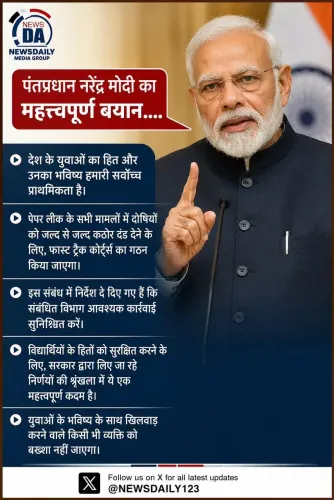
Union Coal and Mines Minister G. Kishan Reddy on Thursday, 23 July 2026, announced that the central government has decided to set up dedicated fast-track courts to expedite trials in examination paper leak cases, reaffirming the government's commitment to protecting the aspirations of students and youth across India.
Context
Posting in Telugu on X, Kishan Reddy stated: 'పరీక్షల పేపర్ లీకేజీ కేసులను వేగంగా విచారించేందుకు ప్రత్యేక ఫాస్ట్ ట్రాక్ కోర్టులను ఏర్పాటు చేయాలని నిర్ణయించాం' — translated: 'We have decided to establish special fast-track courts to swiftly investigate examination paper leak cases.' He added that this decision would ensure quicker punishment for culprits and strengthen trust and accountability in the examination system.
The minister framed the move as a direct commitment by the government led by Prime Minister Narendra Modi toward safeguarding the futures of every honest, hard-working student. He warned that those who 'play with the lives of students' will face strict legal action.
Policy Backdrop
The announcement builds on a legislative foundation already laid by Parliament. In 2024, the Public Examinations (Prevention of Unfair Means) Act was enacted to deter malpractices — including paper leaks — in public competitive examinations. That law established penal provisions but questions around the speed of prosecution and deterrence remained a concern among aspirants.
Fast-track courts, if operationalised, would address the gap between legislation and timely justice. The model has precedent in India across other categories of sensitive offences, where dedicated benches have helped reduce pendency and signal institutional seriousness to potential offenders.
Stakeholders and Impact
The primary beneficiaries of the proposed mechanism are crores of students who appear annually for national and state-level competitive examinations — from recruitment tests for central government posts to entrance exams for professional courses. Paper leak incidents in recent years have forced cancellations and re-examinations, causing significant distress, financial burden, and loss of preparation time for genuine aspirants.
For accused individuals and organised networks involved in leak syndicates, faster trial timelines would mean reduced opportunity to delay proceedings. Accountability for examination-conducting bodies and officials implicated in leaks could also come under sharper judicial scrutiny through such a dedicated mechanism.
What's Next
The immediate watch point is a formal government notification establishing the fast-track court framework — including the number of courts, their jurisdiction, and the category of cases they will handle. Observers will also track whether pending prosecutions under the Public Examinations (Prevention of Unfair Means) Act, 2024 are transferred to these courts once they become operational.
The move signals that examination integrity will remain a high-priority governance issue, with the government seeking to convert legislative intent into visible, time-bound judicial outcomes ahead of upcoming recruitment and entrance examination cycles.
Point of View
The government is attempting to close the credibility gap between law-on-paper and justice-in-practice. For the BJP, which has invested heavily in the 'merit and opportunity' narrative for youth, visible and swift prosecution of leak accused is as much a political imperative as a governance one. The durability of this initiative will depend entirely on how quickly courts are notified and whether early convictions follow.
NationPress
22 Oct 2026
Frequently Asked Questions
What did Kishan Reddy announce about exam paper leaks?
Union Minister G. Kishan Reddy announced on 23 July 2026 that the central government has decided to set up dedicated fast-track courts to try examination paper leak cases swiftly, ensuring quicker punishment for those responsible.
What is the Public Examinations (Prevention of Unfair Means) Act 2024?
It is a law enacted by Parliament in 2024 to deter malpractices — including paper leaks — in public competitive examinations, establishing penal provisions against those involved in unfair means.
How will fast-track courts help students affected by paper leaks?
Fast-track courts will speed up the trial process in paper leak cases, reducing delays in justice and acting as a stronger deterrent against future leaks, thereby protecting the interests of honest exam aspirants.
Are the fast-track courts for exam leaks operational yet?
As of the announcement on 23 July 2026, the decision has been declared but a formal government notification on the courts' jurisdiction, numbers, and operational framework is yet to be issued.
Which exams are affected by paper leak problems in India?
Paper leak incidents have affected several national and state-level competitive examinations in India, including recruitment tests for central government posts and professional course entrance examinations, forcing cancellations and re-tests that harmed genuine aspirants.