Kishan Reddy Flags World Bank Data: 496mn Indians Out of Poverty
Synopsis
The World Bank's India Poverty and Equity Brief (October 2026) shows 496 million Indians exited poverty between 2011 and 2023, with extreme poverty at $3/day crashing from 27.1% to 2.6%. Union Minister G. Kishan Reddy highlighted the data, linking it to PM Modi's Sabka Saath, Sabka Vikas mission and a historic low in inequality.
Key Takeaways
496 million people moved out of poverty in India between 2011 and 2023 , according to the World Bank's India Poverty and Equity Brief (October 2026).
Extreme poverty at the $3.00/day threshold fell from 27.1% to 2.6% over the same period.
Poverty at the $4.20/day threshold declined sharply from 57.7% to 16.1% .
The World Bank brief also noted that inequality in India is at a historic low .
NITI Aayog's multidimensional poverty index has tracked consistent deprivation declines since 2015-16 , corroborating the World Bank findings.
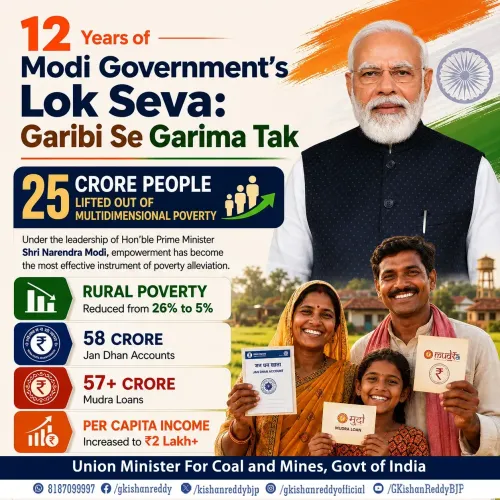
Kishan Reddy attributed the progress to PM Narendra Modi 's Sabka Saath, Sabka Vikas development agenda.
Nearly half a billion people. That is the scale of India's poverty reduction story — and it just got a fresh global citation. Union Coal and Mines Minister G. Kishan Reddy highlighted on 31 October 2026 that the World Bank's India Poverty and Equity Brief (October 2026) has documented a transformation of historic proportions, with 496 million people moving out of poverty between 2011 and 2023.
The numbers that rewrote the poverty map
The headline figures are stark. Extreme poverty — measured at the $3.00 per day international threshold — collapsed from 27.1% to 2.6% over the same twelve-year window. Move up to the $4.20 per day threshold, and the decline is equally dramatic: from 57.7% to 16.1%. The Brief also flags that inequality is now at a historic low, suggesting that growth gains have been distributed, not merely concentrated at the top.
Reddy framed the data as validation of Prime Minister Narendra Modi's governance philosophy. 'The commitment to Sabka Saath, Sabka Vikas [Together with all, development for all] continues to drive inclusive development, improve millions of lives and build a more prosperous Bharat,' he wrote.
From NITI Aayog to World Bank: a decade of converging evidence
The World Bank's findings are not an isolated data point. Since 2015-16, NITI Aayog's multidimensional poverty index has tracked declining deprivations across health, education, and living standards — building a consistent longitudinal picture that the latest World Bank brief now reinforces with consumption-based poverty lines. Welfare programmes targeting food security, housing, sanitation, and direct benefit transfers have been cited across multiple assessments as structural drivers of these declines.
India's sustained economic expansion through the period — interrupted briefly by the pandemic but broadly maintained — provided the macroeconomic floor beneath these interventions. Poverty reduction at this speed and scale, across a population of more than a billion, has few modern parallels.
What the inequality number adds to the story
Poverty headcount figures tell you how many people crossed a threshold. Inequality data tells you whether the crossing was broad-based. The World Bank Brief's conclusion that inequality stands at a historic low is significant precisely because it suggests the 496 million who moved up were not offset by concentrated wealth pulling the average — the gains were, on the data available, genuinely distributed. Economists will scrutinise subsequent national consumption surveys for confirmation, and any revision to these estimates will be closely watched.
For Kishan Reddy, the BJP's Telangana state president, the timing of the post — on the eve of fresh state-level political cycles — is not incidental. Anchoring a global institution's data to the Modi government's development record is a deliberate narrative move, and the numbers are real enough to carry the argument without embellishment.
Five hundred million lives changed in twelve years. The World Bank has now put a number on it — and India's political conversation has already moved to claim it.
Point of View
Framed through the Sabka Saath, Sabka Vikas lens, signals a BJP strategy of anchoring governance performance to internationally verified metrics rather than only government-produced data. The historic-low inequality finding is the politically potent footnote — it deflects the standard critique that India's growth has bypassed the bottom. Economists and opposition voices will likely push back by interrogating the consumption-survey methodology and the base year, making the next national household expenditure survey a high-stakes document for all sides.
NationPress
31 Oct 2026
Frequently Asked Questions
How many people came out of poverty in India between 2011 and 2023?
According to the World Bank's India Poverty and Equity Brief (October 2026), 496 million people moved out of poverty in India between 2011 and 2023.
What is India's extreme poverty rate in 2023 according to the World Bank?
The World Bank's October 2026 brief places India's extreme poverty rate at the $3.00/day threshold at 2.6% in 2023, down from 27.1% in 2011.
What is the World Bank India Poverty and Equity Brief October 2026?
It is a periodic assessment published by the World Bank that benchmarks India's poverty headcount and inequality indicators against international poverty lines, using national consumption survey data.
What does Sabka Saath Sabka Vikas mean and how does it relate to poverty reduction?
Sabka Saath, Sabka Vikas translates as 'Together with all, development for all' — it is PM Narendra Modi 's governing slogan for inclusive growth, under which welfare schemes targeting food security, housing, sanitation, and direct benefit transfers have been credited as key drivers of poverty decline.
Is inequality rising or falling in India in 2026?
The World Bank's India Poverty and Equity Brief (October 2026), cited by Minister G. Kishan Reddy , states that inequality in India is at a historic low , suggesting growth gains have been more broadly distributed.