Kishan Reddy cites 12-year poverty data to mark Modi govt record
Synopsis
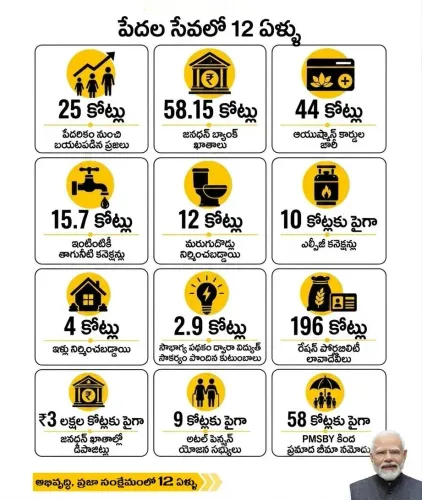
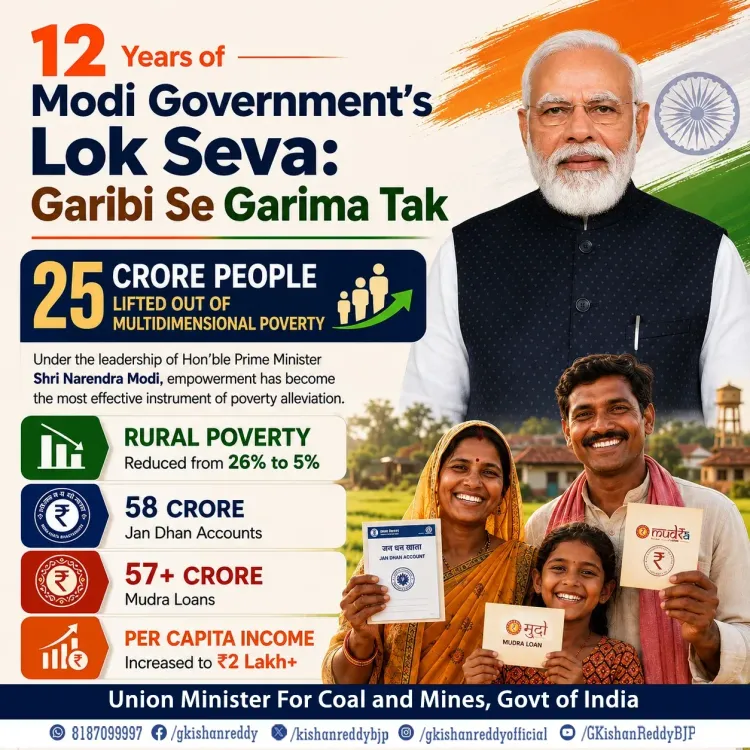
Union Minister G. Kishan Reddy has cited a sharp fall in rural poverty, 58 crore Jan-Dhan accounts, and over 57 crore Mudra loans to argue that the Modi government's Antyodaya-guided governance has produced historic welfare gains over 12 years.
Key Takeaways
Kishan Reddy posted on June 7, 2026 , listing welfare metrics from the Modi government's 12-year tenure.
Rural poverty is claimed to have fallen from 26 per cent in 2014 to 5 per cent in 2026 , with 25 crore Indians exiting multidimensional poverty.
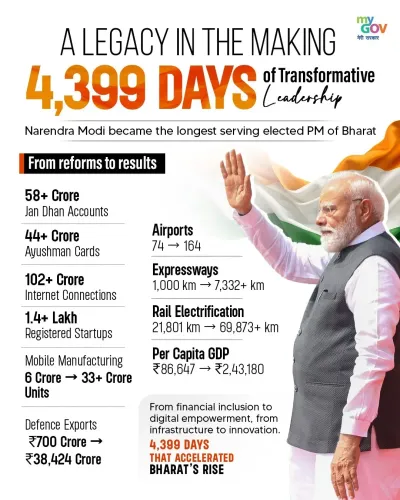
Pradhan Mantri Jan-Dhan Yojana has reportedly brought 58 crore-plus citizens into the formal banking system since August 2014 .
Over 57 crore Mudra loans have been disbursed under the Pradhan Mantri Mudra Yojana since April 2015 .
Per capita income is cited as having risen from ₹86,000 to over ₹2 lakh during this period.
All figures are framed within the Viksit Bharat vision of India becoming a developed nation by 2047 .
Union Coal and Mines Minister and BJP Telangana president G. Kishan Reddy on Sunday, June 7, 2026, invoked the principle of Antyodaya to frame what he described as a historic transformation under the Narendra Modi government over the past 12 years, citing sweeping figures on poverty reduction, financial inclusion, and income growth.
Context
In his post on X, Reddy outlined a series of welfare and economic metrics he attributed to the Modi government's tenure since 2014. He claimed rural poverty has fallen from 26 per cent in 2014 to 5 per cent in 2026, and that 25 crore Indians have risen out of multidimensional poverty. He also cited per capita income rising from ₹86,000 to over ₹2 lakh.
The post anchors these claims in the governing philosophy of 'Sabka Saath, Sabka Vikas' ('Together with all, development for all') and connects them to the long-term national ambition of Viksit Bharat — the vision of India becoming a developed nation by 2047.
Policy Backdrop
Two flagship schemes feature prominently in Reddy's accounting. The Pradhan Mantri Jan-Dhan Yojana, launched in August 2014, was designed to bring unbanked households into the formal financial system; the minister claims it has now covered 58 crore-plus citizens. The Pradhan Mantri Mudra Yojana, introduced in April 2015, extended collateral-free credit to micro-entrepreneurs — Reddy puts the cumulative loan count at over 57 crore.
Both schemes have operated within a broader direct-benefit-transfer architecture that the central government has used to channel welfare spending. NITI Aayog, which replaced the Planning Commission in January 2015, has periodically published multidimensional poverty indices that successive administrations have used to benchmark progress.
Stakeholders and Impact
The primary beneficiaries of the programmes Reddy highlights are rural households, previously unbanked citizens, and small entrepreneurs who accessed credit under Mudra. The scale of Jan-Dhan enrolment, if accurate, would represent one of the largest financial-inclusion drives in the world, reshaping how welfare transfers, subsidies, and savings reach low-income families.
For the BJP, and particularly for state units such as the Telangana chapter that Reddy leads, articulating a quantified welfare record serves a clear political purpose: countering opposition narratives ahead of electoral cycles and building a constituency-level case for continued central-government programmes.
What's Next
Analysts and opposition parties are likely to scrutinise the specific poverty and income figures cited, particularly the 2026 rural poverty estimate of 5 per cent, pending an official NITI Aayog multidimensional poverty index release that would independently validate or revise the claim. Any adjustments to Jan-Dhan or Mudra scheme guidelines in the forthcoming Union Budget will also serve as a practical test of the government's continued commitment to the financial-inclusion architecture Reddy has championed in this post. The framing of all these metrics under Viksit Bharat signals that welfare delivery will remain a central plank of BJP's political messaging as India moves toward the 2047 centenary target.
Point of View
Connecting grassroots welfare delivery to the party's foundational philosophy. The invocation of Viksit Bharat 2047 also extends the political horizon well beyond any single election cycle, framing the BJP as a long-arc governance project rather than a term-by-term administration. The specific poverty and income figures, once subject to independent verification, will either reinforce or complicate this narrative significantly.
NationPress
24 Oct 2026
Frequently Asked Questions
What did G. Kishan Reddy say about poverty reduction under Modi government?
Kishan Reddy claimed that rural poverty declined from 26 per cent in 2014 to 5 per cent in 2026, and that 25 crore Indians have risen out of multidimensional poverty under the Modi government's 12-year tenure.
How many Jan-Dhan accounts have been opened under Pradhan Mantri Jan-Dhan Yojana?
According to Reddy's post, over 58 crore citizens have been brought into the formal banking system through the Pradhan Mantri Jan-Dhan Yojana, which was launched in August 2014.
What is the Pradhan Mantri Mudra Yojana and how many loans have been given?
The Pradhan Mantri Mudra Yojana, launched in April 2015, provides collateral-free micro-credit to small entrepreneurs. Reddy cited over 57 crore Mudra loans disbursed to date.
What is Viksit Bharat and why is it significant?
Viksit Bharat is the Modi government's official vision to make India a developed nation by 2047, the centenary of independence. It serves as the long-term policy and political framework under which current welfare and economic programmes are being presented.
What is the Antyodaya principle that Kishan Reddy referenced?
Antyodaya, meaning 'rise of the last person', is a governance philosophy rooted in the ideology of RSS thinker Deendayal Upadhyaya. The BJP uses it to describe policies that prioritise the poorest and most marginalised citizens.