Kishan Reddy Hails Cabinet Nod for ₹62,500 Cr Mobile Phone Scheme
Synopsis
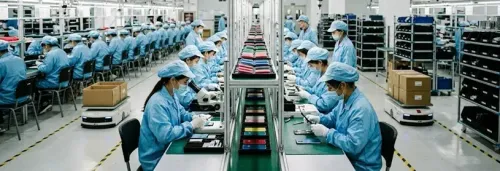
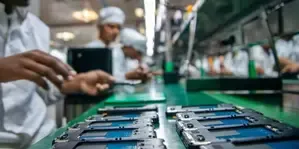
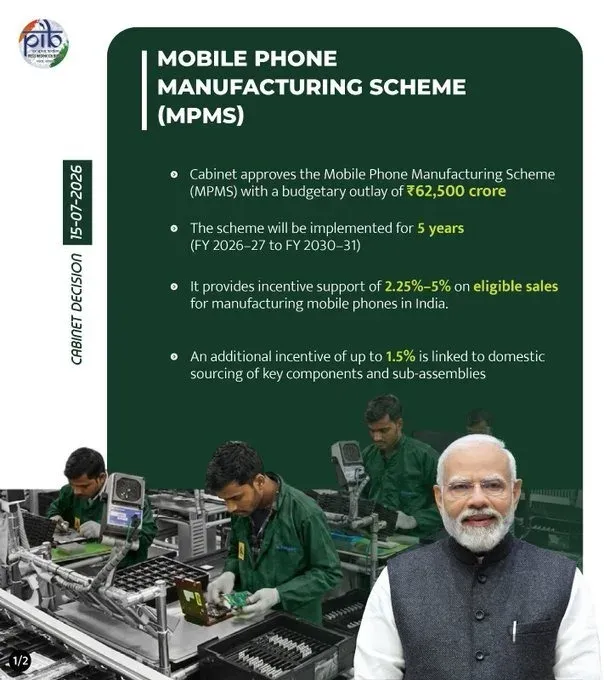
The Union Cabinet has approved the Mobile Phone Manufacturing Scheme (MPMS) with a ₹62,500 crore outlay, projecting ₹39 lakh crore in mobile phone production and 60,000 direct jobs over five years, advancing India's electronics manufacturing ambitions under Make in India and Aatmanirbhar Bharat.
Key Takeaways
The Union Cabinet chaired by PM Narendra Modi approved the Mobile Phone Manufacturing Scheme (MPMS) on 15 July 2026 .
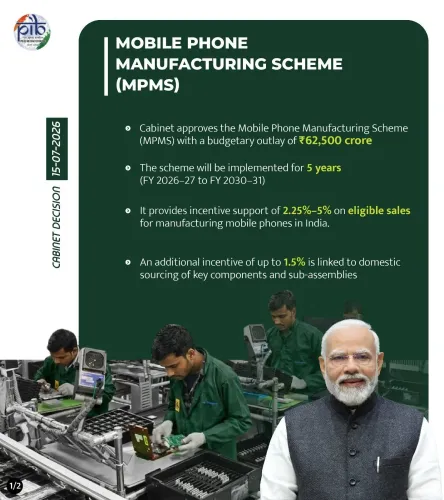
The scheme carries a budgetary outlay of ₹62,500 crore .
Mobile phone production of nearly ₹39 lakh crore is projected over five years.
The scheme is expected to generate around 60,000 direct jobs .
Key objectives include deeper value addition, supply chain strengthening, promotion of Indian brands, and boosting design and R&D.
The MPMS builds on the earlier PLI scheme for large-scale electronics manufacturing approved in 2020 .
Union Coal and Mines Minister G. Kishan Reddy on Wednesday, 15 July 2026, welcomed the Union Cabinet's approval of the Mobile Phone Manufacturing Scheme (MPMS), a landmark initiative carrying a budgetary outlay of ₹62,500 crore. The Cabinet, chaired by Prime Minister Narendra Modi, cleared the scheme with the stated aim of making India a dominant global electronics manufacturing hub.
Context
Announcing the decision on social media, Minister Kishan Reddy said the scheme would 'accelerate domestic manufacturing, deepen value addition, strengthen supply chains, promote Indian brands, and boost design, Research and Development.' He projected mobile phone production of nearly ₹39 lakh crore over five years and the creation of around 60,000 direct jobs. The minister framed the approval as reinforcing the vision of Make in India, Aatmanirbhar Bharat, and Viksit Bharat.
Policy Backdrop
The MPMS follows a decade-long policy trajectory that began with the Make in India initiative launched by Prime Minister Modi in September 2014, which sought to attract investment and expand domestic manufacturing capacity across sectors. In 2020, the government approved the Production Linked Incentive (PLI) scheme for large-scale electronics manufacturing, which provided financial incentives tied to incremental sales and helped establish India as a meaningful node in global smartphone supply chains. The MPMS is positioned as the next step in that progression, shifting the emphasis from assembly toward deeper value addition, component manufacturing, and indigenous research and development.
The broader Aatmanirbhar Bharat framework, announced in May 2020, has underpinned successive interventions in electronics, semiconductors, and allied sectors, with the stated goal of reducing import dependence and integrating domestic industry into global value chains.
Stakeholders and Impact
Electronics manufacturers — both established domestic players and multinational contract manufacturers with operations in India — are the primary beneficiaries under the scheme's expected guidelines. The government's projection of 60,000 direct jobs signals a focus on employment-intensive assembly and component operations, while the design and R&D component targets higher-skilled segments of the workforce. Supply chain ancillaries, including packaging, logistics, and component suppliers, are also expected to benefit from the increased production volumes envisaged over the five-year horizon.
For Telangana and other states with existing electronics clusters, the scheme could attract incremental investment if state-level incentives are aligned with the central scheme's selection criteria.
What's Next
The immediate watch points are the release of detailed scheme guidelines, the criteria for selection of beneficiary firms, and the structure of disbursement linked to production and employment milestones. Quarterly monitoring reports on investment inflows, actual production output, and job creation will be critical to assessing whether the ₹39 lakh crore production target and employment projections are on track. If the MPMS follows the PLI model, an application window for eligible manufacturers is likely to open within months of the formal notification, making the next few weeks consequential for the industry.
Point of View
R&D, and component depth. The ₹62,500 crore outlay is substantial, and the five-year production target of ₹39 lakh crore signals ambition to compete with established manufacturing hubs in the region. For the BJP, the announcement is also politically significant: it reinforces the Viksit Bharat narrative ahead of a period when economic deliverables matter. The real test will be whether scheme guidelines attract credible investment commitments or whether, as with some earlier schemes, headline numbers outpace on-ground execution.
NationPress
15 Jul 2026
Frequently Asked Questions
What is the Mobile Phone Manufacturing Scheme (MPMS)?
The Mobile Phone Manufacturing Scheme (MPMS) is a central government initiative approved by the Union Cabinet in July 2026 with a budgetary outlay of ₹62,500 crore, aimed at accelerating domestic mobile phone manufacturing, deepening value addition, and boosting exports and employment in India.
What is the production target under MPMS?
The scheme projects mobile phone production of nearly ₹39 lakh crore over five years, along with the creation of around 60,000 direct jobs.
How is MPMS different from the PLI scheme for mobile phones?
The PLI scheme approved in 2020 focused primarily on incentivising large-scale assembly and incremental sales. MPMS is positioned to go further by emphasising deeper value addition, supply chain development, promotion of Indian brands, and investment in design and research and development.
Who announced the MPMS cabinet approval?
Union Coal and Mines Minister G. Kishan Reddy announced the Cabinet's approval on social media on 15 July 2026, attributing the decision to the Cabinet chaired by Prime Minister Narendra Modi.
What are the goals of MPMS for India's electronics sector?
MPMS aims to strengthen India's position as a global electronics manufacturing hub by accelerating domestic production, reducing import dependence, promoting indigenous brands, and fostering research and development in the mobile phone sector.