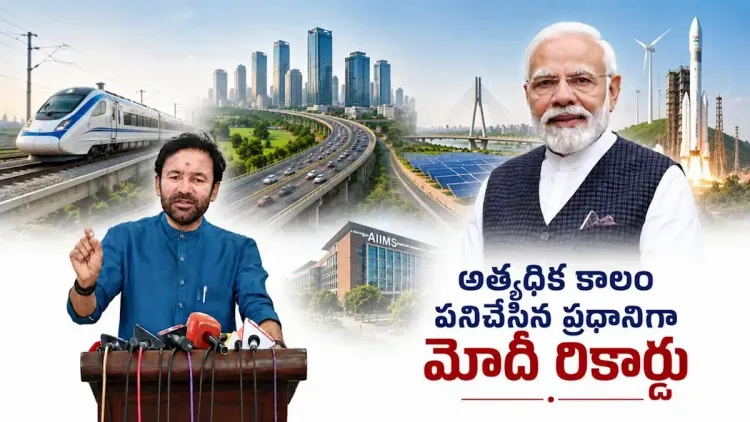
Kishan Reddy Hails Modi's Record PM Tenure Milestone
Synopsis
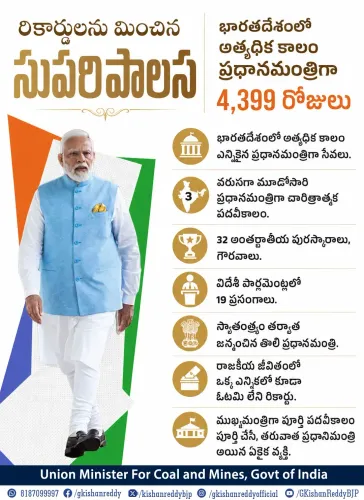
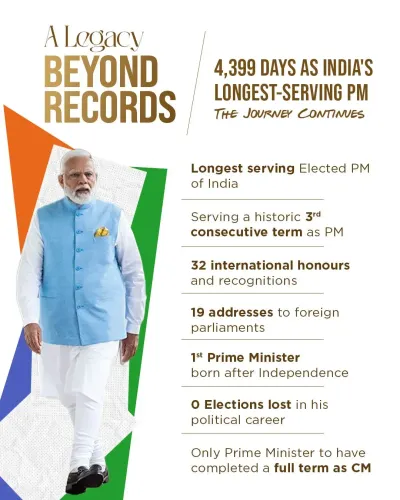
Union Minister G. Kishan Reddy has congratulated PM Narendra Modi on the eve of completing 4,399 days in office, set to surpass Jawaharlal Nehru's record and become India's longest-serving Prime Minister, as Reddy conveyed wishes from Telangana's 4 crore people.
Key Takeaways
Union Coal and Mines Minister G.
Kishan Reddy posted a tribute in Telugu on June 9, 2026 , ahead of PM Modi's record milestone.
PM Narendra Modi is set to complete 4,399 days as Prime Minister on June 10, 2026 , surpassing the previous record.
India's first PM Jawaharlal Nehru held the record at 4,398 days , serving continuously from 1947 to 1964 .
Reddy emphasised that Modi achieved this milestone under competitive multi-party elections, contrasting it with Nehru's era.
Reddy conveyed congratulations on behalf of 4 crore people of Telangana , reflecting the BJP's political outreach in the state.
Modi's tenure spans three consecutive elected terms: 2014, 2019, and 2024 .
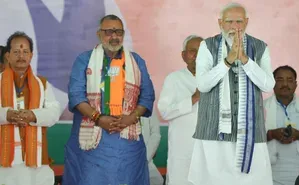
Union Coal and Mines Minister and BJP Telangana president G. Kishan Reddy on Tuesday, June 9, 2026, extended congratulations to Prime Minister Narendra Modi on the eve of what he described as a historic milestone — Modi becoming the longest-serving Prime Minister in Indian history, surpassing a record held since the era of India's first Prime Minister Jawaharlal Nehru.
Writing in Telugu on X, Reddy stated: 'రేపటితో.. మన ప్రియతమ ప్రధానమంత్రి శ్రీ @narendarmodi గారు పరిపాలనలో ప్రధానిగా అత్యధిక సమయం పరిపాలించిన వ్యక్తిగా చరిత్ర తిరగరాయబోతున్నారు.' ('From tomorrow, our beloved Prime Minister Shri Narendra Modi is set to rewrite history as the person who has served the longest as Prime Minister.') Reddy conveyed 'heartfelt congratulations on behalf of the 4 crore people of Telangana.'
Context
Reddy's post draws a pointed comparison between two distinct political eras. He noted that Nehru served for 4,398 days as Prime Minister at a time when, in his words, there was no competitive political party opposition. Modi, he claimed, would complete 4,399 days as an elected Prime Minister on June 10, 2026, doing so in the context of active multi-party electoral competition.
Jawaharlal Nehru served continuously as India's first Prime Minister from 1947 until his death in 1964, during a period of Congress party dominance in Indian politics. Narendra Modi was first sworn in on 26 May 2014 following the BJP's decisive victory in the general elections, and subsequently secured re-election in 2019 and 2024, extending his tenure into a third consecutive term.
Policy Backdrop
Modi's three-term tenure has spanned a wide arc of policy initiatives — from the rollout of goods and services tax and the Pradhan Mantri Jan Dhan Yojana to infrastructure expansion and the reorganisation of states including the creation of Telangana as a separate state in 2014. The BJP has consistently used tenure-length comparisons as part of its political communication, framing longevity in office as a measure of public trust and electoral mandate.
The contrast with Nehru is a recurring motif in BJP political messaging, often used to underline the party's argument that sustained democratic mandates under competitive elections carry greater legitimacy than long tenures from an era of limited political pluralism.
Stakeholders and Impact
G. Kishan Reddy, as BJP's Telangana state president, addressed the message specifically to the state's 4 crore residents, signalling the party's intent to use this milestone to consolidate support in a state where the BJP has sought to expand its footprint after the Congress party returned to power in the 2023 Telangana assembly elections. The post is part of a broader wave of tributes from BJP leaders across the country marking the occasion.
For BJP's base, the milestone reinforces the narrative of Modi as a transformational, long-serving leader whose electoral record stands apart from predecessors. Opposition parties are likely to contest the framing that Nehru's era lacked political competition, pointing to the presence of the Socialist Party, Communist parties, and other formations in Parliament during that period.
What's Next
Official government communications and BJP leadership are expected to mark June 10, 2026 with formal events and statements recognising the tenure milestone. Political observers will watch whether the occasion is used to signal policy priorities or electoral positioning ahead of the 2029 general election cycle. The milestone also sets the stage for further debate among historians and political analysts about how tenure records should be contextualised across different eras of Indian democracy.
Point of View
The message implicitly challenges the Congress party's historical legacy while projecting Modi as a democratically validated leader of a different order. The explicit invocation of Telangana's 4 crore people signals that the BJP intends to leverage national milestones for state-level political mobilisation. As the 2029 election cycle draws closer, such symbolic moments are likely to be deployed with increasing frequency to consolidate the party's base and frame the national political narrative.
NationPress
24 Oct 2026
Frequently Asked Questions
How many days has Narendra Modi served as Prime Minister of India?
According to BJP leader G. Kishan Reddy's post on June 9, 2026, Modi was set to complete 4,399 days as Prime Minister on June 10, 2026, which he described as surpassing the previous record.
Who held the record for longest-serving Prime Minister of India before Modi?
India's first Prime Minister Jawaharlal Nehru held the record, having served for 4,398 days continuously from 1947 until his death in 1964.
When did Narendra Modi first become Prime Minister of India?
Narendra Modi was first sworn in as Prime Minister on 26 May 2014 following the BJP's victory in the 2014 general elections.
What did G. Kishan Reddy say about Modi's PM tenure record?
Kishan Reddy said Modi is set to rewrite history as the longest-serving Prime Minister, noting the achievement is in the context of competitive multi-party elections, and conveyed congratulations from Telangana's 4 crore people.
How many terms has Narendra Modi served as Prime Minister?
Narendra Modi has served three consecutive terms as Prime Minister, winning general elections in 2014, 2019, and 2024.