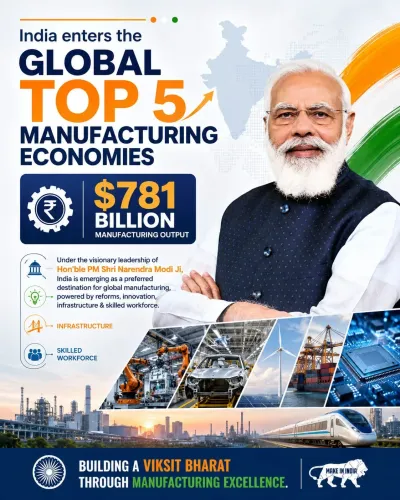
Kishan Reddy: Household manufacturing GVA growing 4x faster than corporate sector

Synopsis
Union Minister G. Kishan Reddy claims India's household manufacturing GVA is growing nearly four times faster than the corporate manufacturing sector, pointing to PM Modi's decade-long policy push through Make in India, Atmanirbhar Bharat and PLI schemes as the driving force behind the shift.
Key Takeaways
Kishan Reddy posted on 29 September 2026 that India's household sector GVA is growing 'nearly 4x faster' than corporate manufacturing.
The claim, if verified by official data, would mark a structural shift in India's manufacturing output toward the informal and micro-enterprise segment.
Make in India (launched September 2014 ), Atmanirbhar Bharat ( May 2020 ) and multiple Production Linked Incentive schemes form the policy backbone cited as enabling this growth.
The household manufacturing segment covers unincorporated, often informal units — weavers, small food processors, local fabricators — outside the organised corporate sector.
The specific 4x GVA growth differential cannot be independently verified from publicly available national accounts data at this stage.
The next official disaggregated GVA release from the Ministry of Statistics will be the key data point to watch.
India's smallest factories — the home-based workshops, the artisan units, the micro-enterprises tucked into urban lanes and rural courtyards — are now outpacing the country's corporate manufacturing engine by a factor of nearly four, according to a claim made by Union Coal and Mines Minister G. Kishan Reddy on Tuesday, 29 September 2026. The minister framed the figure as evidence of a historic industrial resurgence unfolding under Prime Minister Narendra Modi.
The 4x claim and what it points to
Reddy's post states that 'household sector GVA is growing nearly 4x faster than corporate manufacturing' — a striking data point that, if borne out by official national accounts, would mark a structural shift in where India's industrial output is actually being generated. Gross Value Added, or GVA, is the standard measure economists use to track a sector's contribution to the economy, stripping out taxes and subsidies to reveal underlying productive activity.
The household manufacturing segment covers unincorporated, often informal units — think handloom weavers, small food processors, local fabricators — that sit outside the organised corporate sector. A sustained acceleration here would suggest that policy support for MSMEs and micro-enterprises is translating into real output gains, not just headline scheme launches.
The policy architecture behind the push
The claim lands against a decade-long policy backdrop. Make in India, launched in September 2014, set the ambition of raising manufacturing's share of GDP and positioning the country as a global production hub. Six years later, the Atmanirbhar Bharat Abhiyan — announced in May 2020 — added a self-reliance dimension, with dedicated revival packages for local manufacturers including the unorganised sector. Running alongside both has been the Production Linked Incentive scheme, rolled out from 2020 across sectors from electronics to pharmaceuticals to automobiles, providing direct financial incentives for domestic output.
Together, these three pillars represent the most sustained legislative and fiscal push India has directed at manufacturing in the post-liberalisation era. The question Reddy's post implicitly raises: is the household segment — historically the hardest to reach through formal policy — finally feeling the effect?
Millions of citizens as industrial protagonists
Reddy's framing is deliberate. He describes 'millions of citizens actively leading the nation's industrial resurgence' — language that positions the informal producer not as a beneficiary of government welfare but as a driver of national economic momentum. It is a political argument as much as an economic one: that the Modi government's manufacturing story is bottom-up, not just top-down corporate FDI.
The specific 4x faster growth figure cannot be independently verified against publicly available national accounts data at this stage. Official disaggregated GVA releases from the Ministry of Statistics and Programme Implementation will be the definitive test of the claim when the next quarterly or annual data drops.
If the numbers hold, India's manufacturing story will have a new protagonist — and it won't be a listed conglomerate.
Point of View
Framing the Modi government's manufacturing record not through corporate FDI wins but through grassroots, informal-sector growth — a harder metric for the opposition to dismiss as elite-capture. The 4x GVA differential, if validated by official data, would be a genuinely significant structural story, not just a talking point. It also reflects a broader BJP communications strategy of positioning welfare-adjacent economic gains as entrepreneurial success, blurring the line between beneficiary and producer. The claim's credibility will hinge entirely on the next round of disaggregated national accounts data.
NationPress
29 Sept 2026
Frequently Asked Questions
What is household sector GVA in India's manufacturing context?
Household sector GVA refers to the Gross Value Added generated by unincorporated, informal manufacturing units — such as home-based workshops, artisans and micro-enterprises — as distinct from the organised corporate manufacturing sector. It is tracked separately in India's national accounts.
What did G. Kishan Reddy say about India's manufacturing growth?
Union Minister G. Kishan Reddy claimed on 29 September 2026 that India's household sector GVA is growing nearly four times faster than corporate manufacturing, attributing the trend to PM Modi's leadership and policies like Make in India and Atmanirbhar Bharat.
What is the Make in India scheme?
Make in India is an initiative launched in September 2014 to position India as a global manufacturing destination by attracting investment, easing regulations and promoting domestic production across multiple sectors.
What are Production Linked Incentive (PLI) schemes?
PLI schemes, introduced from 2020 onward, provide direct financial incentives to manufacturers in priority sectors — including electronics, pharmaceuticals and automobiles — based on incremental domestic production output.
Has the 4x household GVA growth claim been officially verified?
Not yet. The specific claim that household sector GVA is growing nearly four times faster than corporate manufacturing has not been independently verified against publicly available disaggregated national accounts data. The next official GVA release will be the key test.