Kishan Reddy marks 12 years of Modi govt with welfare milestone post
Synopsis
Union Coal and Mines Minister G. Kishan Reddy marked twelve years of the Modi government on 9 June 2026, posting under #12YearsOfSeva that challenges once shaping millions of lives have become 'stories of the past' through welfare, trust and development.
Key Takeaways
Kishan Reddy posted on 9 June 2026 marking twelve years of the Narendra Modi -led government under the hashtag #12YearsOfSeva .
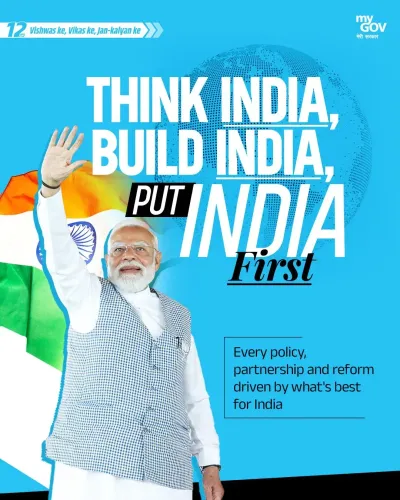
The post described the period as '12 Saal Vishwas Ke, 12 Saal Vikas Ke, 12 Saal Jan-Kalyan Ke' — twelve years of trust, development and public welfare.
Narendra Modi was first sworn in as Prime Minister on 26 May 2014 and has since led three consecutive NDA governments.
Key welfare pillars cited in the broader BJP narrative include Swachh Bharat Mission , PM Ujjwala Yojana and PM Awas Yojana , targeting rural households, women and low-income families.
Reddy, also BJP Telangana state president , is a prominent amplifier of the central government's governance record on social media.
State-level implementation reports and the next Union Budget are expected to define the welfare agenda through 2026-27 .
Union Coal and Mines Minister G. Kishan Reddy on Tuesday, 9 June 2026 marked twelve years of the Narendra Modi-led government with a social media post crediting the administration with transforming the daily lives of millions of Indians across basic necessities, dignity, empowerment and opportunity.
Context
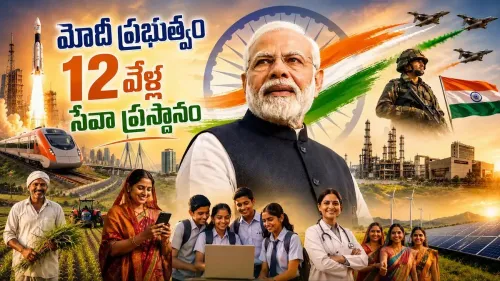
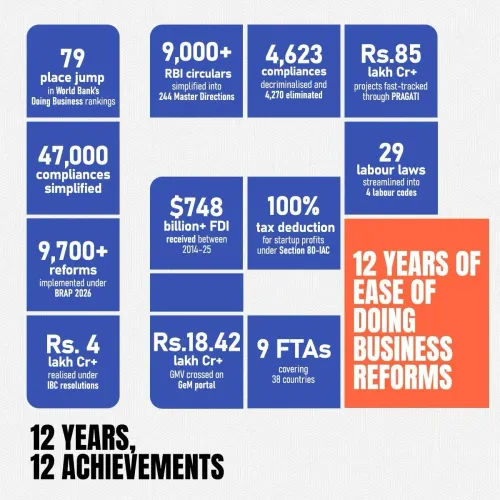
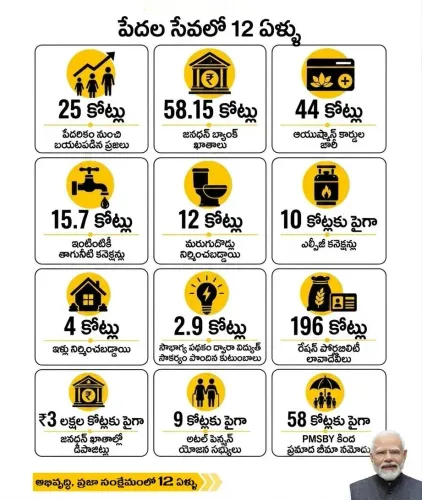
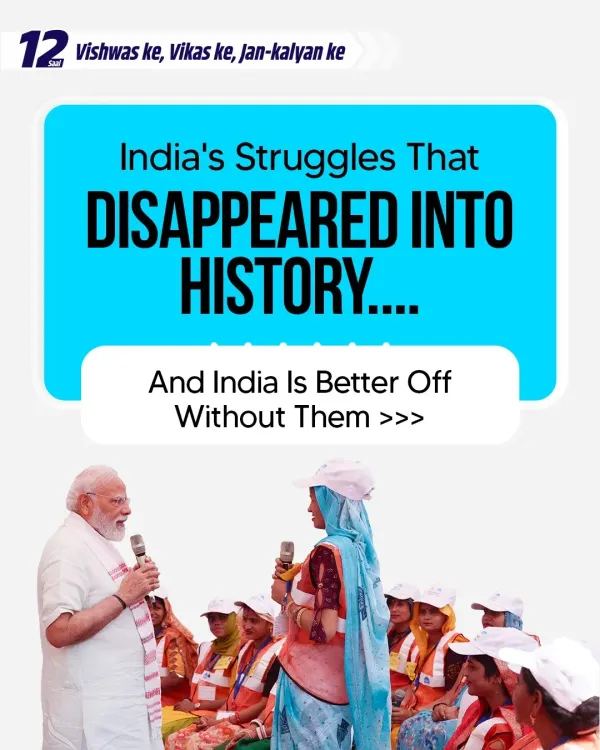
Posting under the hashtag #12YearsOfSeva, Reddy described the period as '12 Saal Vishwas Ke. 12 Saal Vikas Ke. 12 Saal Jan-Kalyan Ke.' — 'Twelve years of trust. Twelve years of development. Twelve years of public welfare.' The post accompanied an image cataloguing challenges that the minister said have 'disappeared into history' under Prime Minister Narendra Modi's leadership since May 2014.
The message frames the anniversary not as a political milestone but as a ledger of social change, pointing to improvements spanning households that once lacked access to basic services. Reddy, who also serves as BJP Telangana state president, is among the party's prominent voices amplifying the government's governance narrative on social media.
Policy Backdrop
Narendra Modi was sworn in as Prime Minister on 26 May 2014 following the BJP-led NDA's majority in the Lok Sabha elections that year, going on to lead three consecutive governments. The administration's welfare architecture has rested on flagship schemes targeting rural sanitation, cooking fuel access, housing, financial inclusion and electrification.
The Swachh Bharat Mission, launched in October 2014, set out to eliminate open defecation and expand sanitation infrastructure across rural and urban India. Successive programmes — including PM Ujjwala Yojana for LPG access among low-income households and PM Awas Yojana for affordable housing — became the pillars of the government's outreach to rural households and women beneficiaries.
BJP anniversary communications have consistently used this cumulative framing, linking continuity of leadership to measurable shifts in access metrics and positioning the current policy cycle as a departure from earlier governance patterns.
Stakeholders and Impact
The constituencies referenced most directly in the government's welfare narrative are rural households, women beneficiaries and low-income families — the primary target groups of schemes on sanitation, fuel, housing and banking access. For these groups, the government's self-assessment is that structural deprivations once treated as permanent features of daily life have been addressed through direct-benefit delivery and infrastructure expansion.
Opposition parties have contested the scale and pace of these outcomes, arguing that gaps in implementation persist across states. Independent assessments of individual scheme outcomes have produced mixed findings, though the broad direction of welfare expansion over the twelve-year period is widely acknowledged across the policy spectrum.
What's Next
Parliamentary deliberations on the next Union Budget and fresh phases of schemes such as PM Awas Yojana and PM Ujjwala Yojana are expected to shape the government's welfare agenda through 2026-27. State-level implementation reports due in the coming fiscal year will provide a clearer picture of on-ground delivery against the targets set during the twelfth year of the administration.
As the BJP continues to build its electoral narrative in states including Telangana — where Reddy leads the state unit — the '12 years of seva' messaging is likely to anchor party communications in the months ahead, tying central welfare outcomes to regional voter outreach.
Point of View
The BJP is reinforcing a long-running argument that structural deprivation is a solvable governance problem, not a permanent condition. For Reddy, who leads the party in Telangana where the BJP is a challenger rather than an incumbent, amplifying the central welfare record serves a dual purpose: national loyalty signalling and local electoral positioning. The messaging also pre-empts budget-cycle scrutiny by anchoring the conversation in outcomes rather than allocations.
NationPress
22 Sept 2026
Frequently Asked Questions
What is #12YearsOfSeva about?
#12YearsOfSeva is a BJP campaign hashtag marking twelve years of the Narendra Modi-led government since May 2014, highlighting welfare delivery, infrastructure and social transformation over the period.
Who is G. Kishan Reddy?
G. Kishan Reddy is the Union Minister of Coal and Mines in the Narendra Modi government and the BJP's state president for Telangana, known for actively promoting central government initiatives on social media.
When did Narendra Modi first become Prime Minister?
Narendra Modi was first sworn in as Prime Minister of India on 26 May 2014 after the BJP-led NDA won a majority in the 2014 Lok Sabha elections.
What welfare schemes are linked to the Modi government's 12-year record?
Key schemes include the Swachh Bharat Mission for sanitation, PM Ujjwala Yojana for LPG access among low-income households, and PM Awas Yojana for affordable housing, all targeting rural families and women beneficiaries.
What comes next after the 12-year anniversary messaging?
Parliamentary discussions on the next Union Budget and fresh phases of PM Awas Yojana and PM Ujjwala Yojana are expected to shape welfare policy through 2026-27, with state-level implementation reports due in the coming fiscal year.