Ladakh to set up Hill Development Councils in all 7 districts
Synopsis
Ladakh is about to get five new elected district bodies — and they will hold the same full powers that Leh and Kargil have exercised for decades. With a proposed UT-level body under a customised Article 371 framework that has no precedent in India, Ladakh's governance overhaul is arguably the most ambitious decentralisation experiment in any Union Territory since 2019.
Key Takeaways
Ladakh will establish an Autonomous Hill Development Council in each of its seven districts , announced on 13 July .
The region expanded from two to seven districts in April 2026 , adding Sham , Nubra , Changthang , Zanskar , and Drass .
New councils will hold full LAHDC Act powers — including land, recruitment, taxation, and development planning — not a diluted version.
A UT-level body under a customised Article 371 framework is proposed above the seven councils, with no existing parallel in India.
Amendments to the LAHDC Act and delimitation of constituencies are still pending before councils can be constituted.
Ladakh will gain elected representation at three tiers : village, district, and Union Territory level.
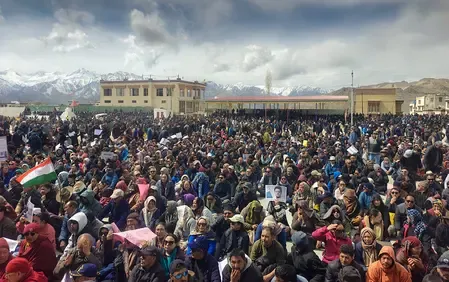
The Union Territory of Ladakh will establish an Autonomous Hill Development Council in each of its seven districts, a move that Ladakh Chief Secretary Ashish Kundra described on Monday, 13 July as a landmark step toward democratic decentralisation and grassroots governance. The announcement marks the most significant restructuring of Ladakh's administrative framework since the region was carved out as a Union Territory.
What the Expansion Covers
Ladakh expanded from two districts to seven in April 2026, when Sham, Nubra, Changthang, Zanskar, and Drass were notified as new districts. Until now, elected representation had been confined to the two existing councils in Leh — functional since 1995 — and Kargil, which received its council in 2003. The five new districts had no elected district-level bodies of their own.
Chief Secretary Kundra clarified that Section 3(1) of the LAHDC Act already provides for a council in every district, to be constituted from a date notified by the government in the Gazette. The remaining steps are amendments to the Act wherever required and the delimitation of constituencies.
Full Powers, Not a Diluted Version
Critically, the new councils will exercise the full powers provided under the LAHDC Act — not a reduced set. The five new districts will hold authority over land ownership and allotment, regulation of recruitment and promotion for district cadre posts, maintenance of dedicated Council Funds, and the power to levy taxes and fees. Each district will also formulate its own development plans, freeing them from dependence on Leh or Kargil for priority-setting.
The councils will additionally oversee health, education, and tourism at the district level, alongside local infrastructure and social welfare schemes.
A Union Territory-Level Body Above the Councils
Chief Secretary Kundra said a Union Territory-level body has been proposed above the seven councils under a customised Article 371 framework, with legislative, executive, financial, and administrative powers. He described the proposed model as having no parallel elsewhere in India, drawing on the best features of existing governance arrangements across the country.
The structure and powers of this UT-level body will be finalised through consultations between Ladakh's representatives and the Government of India. Some rebalancing of powers between the councils and the UT-level body may follow. The seven Hill Councils, however, are confirmed as the first firm element of the proposed structure.
Three-Tier Elected Representation
Panchayati Raj institutions will continue to function alongside the Hill Councils. Once the framework is in place, Ladakh will have elected representation at three levels: village, district, and Union Territory. This is the first time the region will have a full democratic ladder from the grassroots upward, according to the Chief Secretary.
With delimitation and legislative amendments still pending, the timeline for operationalising the new councils has not yet been announced. The next step — consultations between Ladakh's representatives and the Centre — will shape the final contours of a governance model that, if implemented as described, could serve as a template for other Union Territories seeking greater self-governance.
Point of View
Not a diluted arrangement. Past decentralisation efforts in Union Territories have often created elected bodies with nominal authority while real decisions remained with the Lieutenant Governor's office. The customised Article 371 framework — described as without parallel in India — is the more consequential, and more uncertain, piece. Until the UT-level body's powers are defined through Centre-Ladakh consultations, the balance of authority remains open. The councils are confirmed; the architecture above them is not. That gap is where the politics will play out.
NationPress
12 Oct 2026
Frequently Asked Questions
Why is Ladakh setting up Hill Development Councils in all seven districts?
Ladakh expanded from two to seven districts in April 2026, but elected district-level representation existed only in Leh and Kargil. The UT Administration is now constituting Autonomous Hill Development Councils in all seven districts to extend democratic decentralisation and grassroots governance to the five new districts.
What powers will the new Hill Development Councils have?
The new councils will exercise full powers under the LAHDC Act, including authority over land ownership and allotment, recruitment and promotion of district cadre posts, maintenance of Council Funds, levying of taxes and fees, and formulation of district development plans. They will also oversee health, education, tourism, and social welfare at the district level.
What steps remain before the new councils are constituted?
Amendments to the LAHDC Act wherever required and the delimitation of constituencies must be completed before the new councils can be formally constituted. The government will then notify the constitution date in the Gazette, as provided under Section 3(1) of the Act.
What is the proposed UT-level body under Article 371?
Chief Secretary Ashish Kundra has proposed a Union Territory-level body above the seven Hill Councils under a customised Article 371 framework, with legislative, executive, financial, and administrative powers. Its structure and powers will be finalised through consultations between Ladakh's representatives and the Government of India. No similar model currently exists elsewhere in India.
How does this affect Panchayati Raj institutions in Ladakh?
Panchayati Raj institutions will continue to function alongside the new Hill Councils. Once the full framework is in place, Ladakh will have elected representation at three levels: village (panchayat), district (Hill Council), and Union Territory.