Ladakh groups reach in-principle deal with Centre on legislative powers
Synopsis
After years of stalled negotiations and a deadly crackdown in Leh, Ladakh's two major civil society blocs have struck an in-principle deal with the Centre for an elected legislature and a Chief Minister — stopping short of statehood but laying a constitutional roadmap that could reshape governance in one of India's most strategically sensitive regions.
Key Takeaways
The Leh Apex Body (LAB) and Kargil Democratic Alliance (KDA) announced an 'in-principle understanding' with the Government of India on 23 May .
The proposed framework envisages a UT-level legislature and an elected administration headed by a Chief Minister , with bureaucrats — including the Chief Secretary — under elected executive authority.
Constitutional safeguards similar to Articles 371A, 371F, and 371G (applicable to Nagaland, Sikkim, and Mizoram) are part of the understanding.
Full statehood remains deferred; the Centre cited Ladakh's insufficient revenue generation capacity as the key obstacle.
Talks had stalled after four people , including a Kargil war veteran, were killed in police firing in Leh on 24 September 2025 .
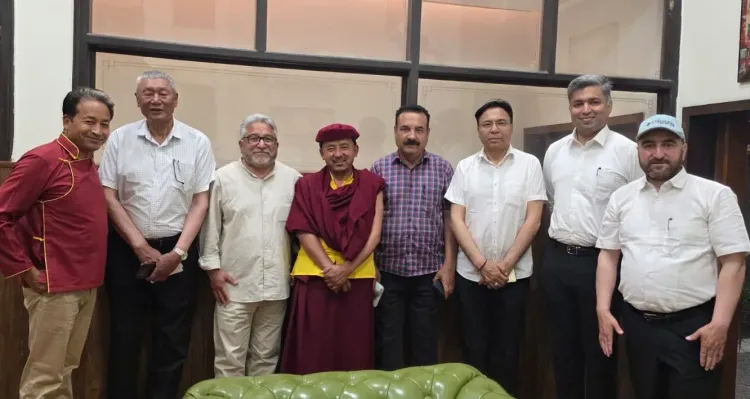
Climate activist Sonam Wangchuk , released from NSA detention on 14 March , attended the meeting.
The Leh Apex Body (LAB) and the Kargil Democratic Alliance (KDA) announced on 23 May that they have reached an 'in-principle understanding' with the Government of India on restoring democratic governance in Ladakh and securing constitutional safeguards comparable to those granted to Nagaland, Sikkim, and Mizoram under Articles 371A, 371F, and 371G of the Constitution. The agreement, disclosed in a joint statement after a meeting with Ministry of Home Affairs officials and Ladakh Chief Secretary Ashish Kundra, marks the most significant forward movement in the region's governance negotiations since they stalled in late 2025.
What the Proposed Framework Entails
Under the proposed arrangement, legislative, executive, and financial powers would vest in elected representatives through a Union Territory-level legislative body. Crucially, all bureaucrats in the UT — including the Chief Secretary — would come under the executive authority of an elected administration headed by a proposed Chief Minister. This would mark a structural departure from the current setup, where Ladakh operates as a UT without a legislature, leaving administrative control largely with the centrally appointed Lieutenant Governor.
The LAB and KDA stated that detailed and constructive deliberations led both sides to converge on several key aspects of governance and administrative powers within the existing UT framework.
Why Full Statehood Remains Deferred
According to the delegation, Ministry of Home Affairs officials explained that the primary obstacle to immediate statehood is Ladakh's limited revenue generation capacity — the region currently cannot independently meet revenue expenditures such as salaries and administrative costs. However, the proposed framework is described as a stepping stone: it is expected to gradually pave the way for eventual statehood once Ladakh meets the required revenue benchmarks. The delegation said it would continue working with the Home Ministry and constitutional experts to finalise the legal and operational details.
Background: A Long Road of Stalled Talks
Ladakh was carved out as a separate Union Territory in 2019 following the abrogation of Article 370 and the bifurcation of the erstwhile state of Jammu and Kashmir. Since 2020, both the KDA and LAB have consistently demanded constitutional safeguards — including Statehood and inclusion under the Sixth Schedule of the Constitution — to protect the region's tribal identity and cultural heritage.
Negotiations had earlier broken down after violence erupted in Leh city on 24 September 2025, during which four persons, including a Kargil war veteran, were killed in police firing. A high-powered committee headed by Minister of State for Home Nityanand Rai had also failed to produce a conclusive outcome in its last sitting.
Wangchuk's Presence and Recent Developments
Climate activist Sonam Wangchuk, who was released from detention under the National Security Act (NSA) on 14 March, attended Friday's meeting — signalling a thaw in relations between civil society and the Centre. The latest round of talks also follows Ladakh Lieutenant Governor Vinai Saxena's 26 April approval of five new districts — Nubra, Sham, Changthang, Zanskar, and Drass — whose creation had originally been announced by Union Home Minister Amit Shah in August 2024.
What Comes Next
The LAB and KDA said they would work closely with the Home Ministry and constitutional experts to finalise the finer operational and legal details of the proposed framework. Whether the in-principle understanding translates into a formal legislative or constitutional amendment will be closely watched, given the region's history of inconclusive negotiations and the sensitivity of its border geography with China and Pakistan.
Point of View
But the devil lies in the constitutional mechanics: converting it into a legislature without full statehood requires a Parliament amendment, and the Centre has shown no urgency on that front. The revenue-capacity argument for deferring statehood is real but also convenient — Ladakh has been a Union Territory for six years with no credible roadmap to fiscal self-sufficiency. Notably, the talks resumed only after Sonam Wangchuk's release and the notification of five new districts, suggesting the Centre moved when political pressure — not administrative readiness — demanded it. Whether this understanding becomes a formal legislative framework or another inconclusive milestone depends entirely on whether the Home Ministry moves from in-principle to in-statute before the next electoral cycle.
NationPress
7 Oct 2026
Frequently Asked Questions
What is the in-principle understanding between Ladakh groups and the Centre?
It is an agreement in principle, announced on 23 May, between the Leh Apex Body (LAB), the Kargil Democratic Alliance (KDA), and the Government of India on restoring democratic governance in Ladakh. The framework proposes a UT-level legislature, an elected Chief Minister, and constitutional safeguards similar to those under Articles 371A, 371F, and 371G.
Why has Ladakh not been granted full statehood?
According to Ministry of Home Affairs officials, Ladakh currently lacks sufficient revenue generation capacity to independently meet expenditures such as salaries and administrative costs. The proposed framework is intended to serve as a stepping stone toward eventual statehood once Ladakh meets the required revenue benchmarks.
What constitutional safeguards are Ladakh groups seeking?
The LAB and KDA have demanded protections comparable to Articles 371A, 371F, and 371G, which apply to Nagaland, Sikkim, and Mizoram respectively. They have also sought inclusion under the Sixth Schedule of the Constitution to safeguard Ladakh's tribal identity and cultural heritage.
Why had talks between Ladakh civil society and the Centre stalled earlier?
Negotiations broke down after violence in Leh city on 24 September 2025, during which four people — including a Kargil war veteran — were killed in police firing. A high-powered committee headed by Minister of State for Home Nityanand Rai had also failed to produce a conclusive outcome in its last meeting.
What role did Sonam Wangchuk play in the latest talks?
Climate activist Sonam Wangchuk, who was released from detention under the National Security Act on 14 March, attended the 23 May meeting as part of the Ladakh delegation. His presence was seen as a signal of renewed engagement between civil society and the Union government.