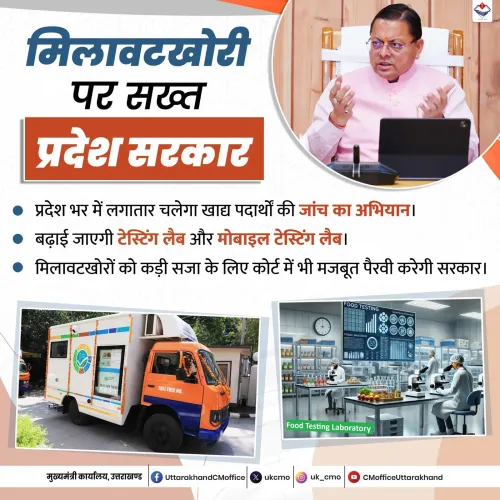
Uttarakhand CM Office: Laksar dairy unit licence suspended
Synopsis
Uttarakhand's Food Safety Department destroyed nearly 10 quintals of adulterated paneer and palmolein oil at a manufacturing unit in Laksar, Haridwar, and suspended the unit's licence — an action announced by the Chief Minister's Office on October 15, 2026.
Key Takeaways
The Food Safety Department conducted a major raid in Laksar, Haridwar district , announced on October 15, 2026 .
Close to 10 quintals (approximately 1,000 kg) of adulterated paneer and palmolein oil were destroyed.
The manufacturing unit's operating licence was suspended as part of the enforcement action.
Action was taken under the Food Safety and Standards Act, 2006 , India's central food regulatory law.
The Chief Minister's Office of Uttarakhand publicly flagged the action, lending it direct political visibility.
Follow-up inspections across Haridwar and other Uttarakhand districts are expected standard procedure.
Nearly 10 quintals of adulterated paneer and palmolein oil were destroyed in Laksar, Haridwar district, after Uttarakhand's Food Safety Department carried out a crackdown on a manufacturing unit — and then suspended its operating licence entirely. The Chief Minister's Office of Uttarakhand announced the action on Thursday, October 15, 2026, signalling the state's intent to pursue zero tolerance on food adulteration.
The post by the Chief Minister's Office stated: 'जनपद हरिद्वार के लक्सर में मिलावट के खिलाफ खाद्य सुरक्षा विभाग की बड़ी कार्रवाई' ('A major action by the Food Safety Department against adulteration in Laksar, Haridwar district') — with the seized products destroyed and the unit's licence suspended.
What the Food Safety Department found in Laksar
Laksar is a town and active small-scale food processing hub within Haridwar district, where dairy and edible-oil units operate alongside larger industrial concerns. The Food Safety Department's raid targeted a manufacturing unit found to be dealing in adulterated paneer and palmolein oil — two commodities that reach consumers directly, often through local markets and eateries near pilgrimage routes.
The destruction of close to 10 quintals (roughly 1,000 kg) of substandard product removes it from the supply chain before it can cause further harm. The licence suspension goes further: it strips the unit of its legal right to operate until authorities determine the outcome of any proceedings.
The law behind the licence suspension
Uttarakhand's Food Safety Department draws its enforcement powers from the Food Safety and Standards Act, 2006, the central legislation that established India's unified food regulatory framework. Under those rules, inspectors can seize products, order their destruction, and suspend or cancel licences when violations are established. The suspension here follows a well-worn enforcement playbook — but its public announcement through the Chief Minister's Office gives it political weight, signalling that senior leadership is watching.
Haridwar district carries additional scrutiny because of its profile as a major pilgrimage and industrial centre. Millions of devotees pass through annually, making food safety failures here a public-health concern at scale.
A wider pattern of state-level crackdowns
Indian state governments have periodically intensified raids on dairy and edible-oil processors — two sectors consistently flagged in national food safety audits. The combination of seizure, destruction, and licence suspension used in Laksar represents the full range of enforcement tools available under FSSAI guidelines, and its deployment suggests regulators found evidence serious enough to warrant the most disruptive response. Follow-up inspections across Haridwar and other Uttarakhand districts are standard procedure after such actions.
For consumers in the region, the message is stark: the milk solids and cooking oil on shelves are under scrutiny, and at least one supplier has now been shut down to prove it.
Point of View
Not a routine regulatory matter. Haridwar's pilgrimage profile makes it a high-visibility district, and crackdowns here carry outsized reputational weight. The suspension of a licence, rather than merely a fine or seizure, indicates a shift toward harder deterrence in Uttarakhand's food safety enforcement posture. Whether this translates into sustained inspections or remains a one-off headline moment will determine its real policy impact.
NationPress
15 Oct 2026
Frequently Asked Questions
What happened in the Laksar food safety raid in Haridwar?
Uttarakhand's Food Safety Department destroyed nearly 10 quintals of adulterated paneer and palmolein oil at a manufacturing unit in Laksar, Haridwar district, and suspended the unit's operating licence.
Under which law can food manufacturing licences be suspended in India?
The Food Safety and Standards Act, 2006 empowers food safety authorities to inspect units, seize and destroy adulterated products, and suspend or cancel licences of violating businesses.
Why is food safety enforcement important in Haridwar?
Haridwar is both a major pilgrimage centre and an industrial hub in Uttarakhand. Millions of visitors consume food there annually, making adulteration a significant public-health risk.
What is a quintal and how much food was destroyed?
One quintal equals 100 kilograms. Nearly 10 quintals means roughly 1,000 kg of adulterated paneer and palmolein oil were destroyed in this action.
What happens after a food licence is suspended in Uttarakhand?
After a licence suspension, the unit cannot legally operate. Authorities typically conduct follow-up inspections and the business may face further proceedings or appeals before the licence is restored or cancelled.