Uttarakhand CM Office Launches State-Wide Food Adulteration Drive
Synopsis
The Chief Minister's Office of Uttarakhand on 5 June 2026 announced a continuous, state-wide campaign to inspect and act against food adulteration, reinforcing the Dhami government's public safety agenda under the Food Safety and Standards Act framework.
Key Takeaways
The Chief Minister's Office of Uttarakhand announced a continuous, state-wide food adulteration inspection drive on 5 June 2026 .
The campaign targets adulteration in food items sold across Uttarakhand , including in tourist and urban markets.
Enforcement is anchored in the Food Safety and Standards Act, 2006 , with FSSAI -empowered state officers conducting sampling and testing.
The drive is framed as ongoing rather than a one-time raid, distinguishing it from earlier episodic crackdowns.
Both consumers and food business operators are directly affected; compliant businesses face no disruption while violators risk prosecution.
Key indicators to watch include monthly test-result publications and any new state-level penalty amendments for repeat offenders.
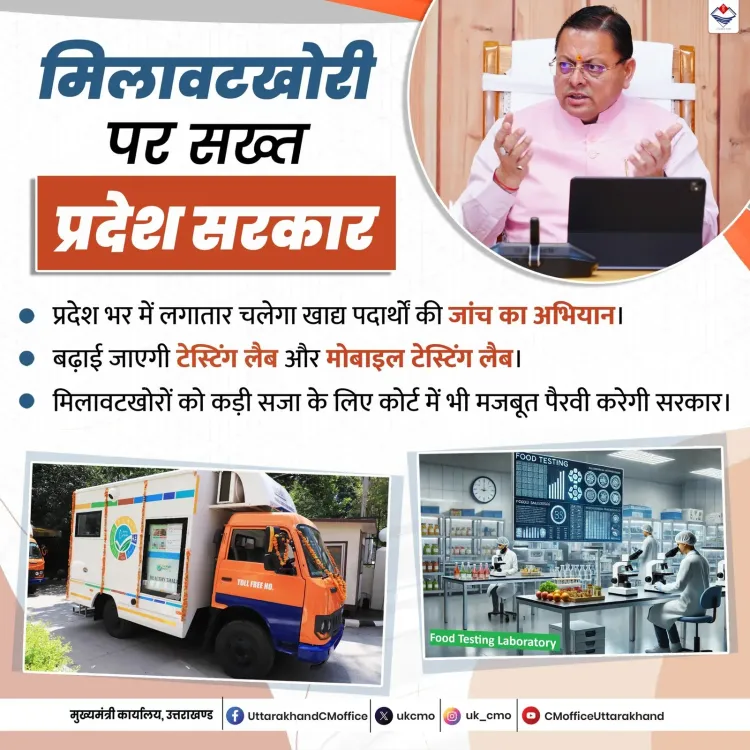
The Chief Minister's Office of Uttarakhand announced on Friday, 5 June 2026 that the state government will conduct a continuous, state-wide inspection campaign targeting food adulteration, signalling a firm crackdown on those mixing or adulterating food products across Uttarakhand.
The post, shared in Hindi, declared: 'मिलावटखोरी पर सख्त प्रदेश सरकार: प्रदेश भर में लगातार चलेगा खाद्य पदार्थों की जांच का अभियान' — translated as 'State government strict on adulteration: a campaign to inspect food items will run continuously across the state.'
Context
Uttarakhand has periodically witnessed adulteration in staples such as milk, ghee, spices, and edible oils, particularly in urban centres and tourist-heavy towns where supply chains are complex and demand is high. The state government under Chief Minister Pushkar Singh Dhami, in office since 2021, has positioned public safety and governance efficiency as central planks of its administration. This latest announcement extends that posture into the food safety domain.
The drive is framed as continuous rather than a one-time raid, suggesting an intent to institutionalise inspections rather than rely on episodic enforcement bursts.
Policy Backdrop
Food safety enforcement in India operates primarily under the Food Safety and Standards Act, 2006, which established the Food Safety and Standards Authority of India (FSSAI) as the apex regulatory body. The Act consolidated earlier fragmented food laws and empowers state-level food safety officers to collect samples, test them in accredited laboratories, and prosecute violators.
State governments work alongside FSSAI to deploy food safety officers, conduct surprise raids, and refer samples to state food laboratories. Penalties under the Act range from fines to imprisonment depending on the severity of adulteration and whether it poses a direct health risk.
Neighbouring states including Uttar Pradesh and Himachal Pradesh have run similar intensified drives in recent years, typically combining enforcement raids with public awareness campaigns and upgrades to laboratory testing capacity. Uttarakhand's announcement follows this well-established regional pattern.
Stakeholders and Impact
The primary beneficiaries are food consumers across Uttarakhand, who face health risks from adulterated products ranging from digestive illness to longer-term harm from chemical adulterants. Tourists visiting the state's pilgrimage and hill-station destinations — a significant consumer segment — also stand to benefit from stricter market oversight.
Food business operators, including retailers, wholesalers, and processors, will face heightened scrutiny. Legitimate operators with compliant supply chains are unlikely to be adversely affected, while those cutting corners on quality face the prospect of prosecution and business disruption.
The campaign also places pressure on the state's food testing laboratory network to handle a sustained increase in sample volume, a logistical challenge that will determine the drive's real-world impact.
What's Next
Observers will watch for the state health department's publication of monthly food sample test results, which would provide a concrete measure of the campaign's reach and the scale of violations detected. Any proposed amendments to state-level penalties targeting repeat offenders would signal a deeper legislative intent beyond the current enforcement push.
The sustainability of a 'continuous' campaign — as opposed to a time-bound drive — will hinge on resource allocation: staffing of food safety officers, laboratory turnaround times, and inter-departmental coordination between the health, food, and civil supplies departments of Uttarakhand.
Point of View
And Uttarakhand's move fits a broader pattern of BJP-governed states using FSSAI-backed drives to reinforce a law-and-order governance identity. The real test will be whether laboratory capacity and officer deployment can sustain the promised continuity. If monthly data is published transparently, the drive could set a useful accountability benchmark; if not, it risks being remembered as another announcement cycle.
NationPress
14 Sept 2026
Frequently Asked Questions
What is the Uttarakhand food adulteration campaign announced in June 2026?
The Chief Minister's Office of Uttarakhand announced on 5 June 2026 that the state government will run a continuous, state-wide inspection campaign to detect and act against adulteration in food items sold across the state.
Who oversees food safety enforcement in Uttarakhand?
Food safety in Uttarakhand is enforced by state-appointed food safety officers working under the framework of the Food Safety and Standards Authority of India (FSSAI), which was established by the Food Safety and Standards Act, 2006.
What foods are typically targeted in adulteration drives in Uttarakhand?
Adulteration drives in Uttarakhand have historically focused on milk, ghee, spices, and edible oils — staples where substitution or dilution is common and poses direct health risks to consumers.
What are the penalties for food adulteration in India?
Under the Food Safety and Standards Act, 2006, penalties for adulteration range from fines to imprisonment, with the severity depending on the nature of the adulterant and the degree of health risk posed to consumers.
How is Uttarakhand's 2026 food safety drive different from earlier campaigns?
The drive is described as continuous and state-wide rather than a time-bound or district-specific operation, indicating an intent to sustain inspections as an ongoing enforcement mechanism rather than a one-off crackdown.