What Were the Immense Contributions of Kharge on Frontier Gandhi’s Death Anniversary?
Click to start listening
Synopsis
On the death anniversary of Khan Abdul Ghaffar Khan, the 'Frontier Gandhi', Congress President Mallikarjun Kharge reflects on the immense contributions made by this legendary leader to India's independence movement and his enduring legacy of peace and nonviolence.
Key Takeaways
- Khan Abdul Ghaffar Khan was a key figure in India’s independence movement.
- He founded the Khudai Khidmatgar Movement for nonviolent resistance.
- His legacy continues to inspire movements for peace and harmony.
- He received the Bharat Ratna in recognition of his contributions.
- Khan’s philosophy emphasizes nonviolence and human dignity.
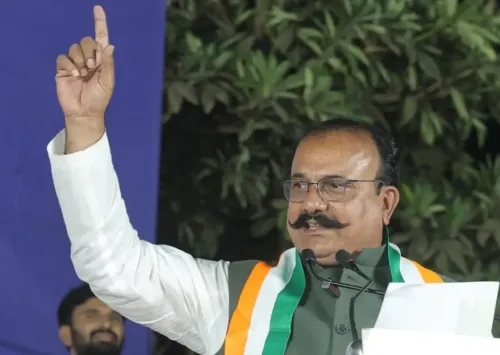
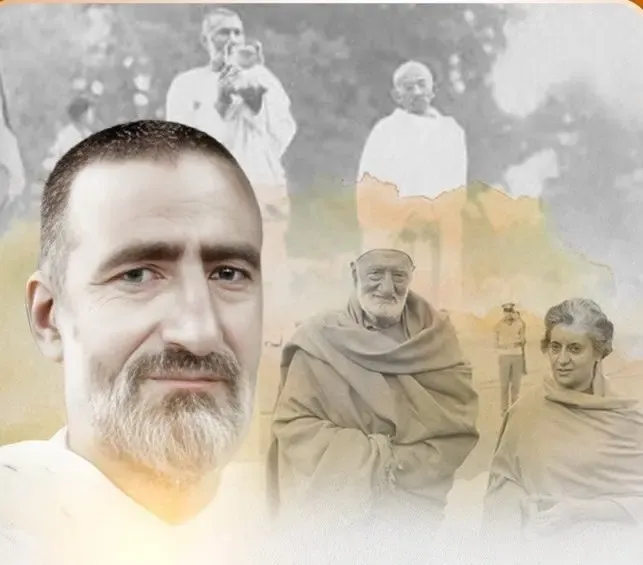
New Delhi, Jan 20 (NationPress) On the occasion of the death anniversary of Khan Abdul Ghaffar Khan, known as the ‘Frontier Gandhi’, Congress President Mallikarjun Kharge remarked on Tuesday that this esteemed freedom fighter made significant contributions to India’s independence struggle, facing numerous imprisonments for his steadfast beliefs.
In a post on the social media platform X, Kharge honored the revered leader, stating, “In heartfelt remembrance of Bacha Khan, the Frontier Gandhi, a recipient of the Bharat Ratna and a symbol of peace, Khan Abdul Ghaffar Khan.”
“A monumental figure in the freedom movement, he made substantial contributions to India’s independence and endured multiple imprisonments for his ideals. He also held a position on the Congress Working Committee and was a member of the Constituent Assembly,” Kharge highlighted.
Emphasizing his philosophy, the Congress leader noted, “His unwavering commitment to nonviolence, harmony, and human dignity continues to motivate millions across India and South Asia, reminding us of the collective principles that unite us.”
Khan Abdul Ghaffar Khan was born in 1890 in Utmanzai, present-day Pakistan. From an early age, he was actively engaged in promoting education and literacy among his fellow Indians. At the age of twenty, he established the first of several schools aimed at social reform and empowerment.
A prominent leader from the Pashtun community, Khan became deeply involved in the Indian independence movement during protests against the Rowlatt Act, where he first encountered Mahatma Gandhi. His relentless activism led to his imprisonment and harsh treatment on multiple occasions between 1920 and 1947.
He later became a part of the Khilafat Movement and, in 1921, was elected president of a district Khilafat Committee in the North-West Frontier Province. In 1929, he initiated the nonviolent Khudai Khidmatgar Movement, also known as the Red Shirt Movement, which closely aligned with the Congress party and played an essential role until the Partition of India in 1947.
While Mahatma Gandhi was spearheading the freedom struggle in mainland India, the North-West Frontier Province witnessed the emergence of another Mahatma—Khan Abdul Ghaffar Khan. Deeply inspired by Gandhi’s nonviolence philosophy, Badshah Khan, as he was affectionately referred to, organized the world’s first large-scale nonviolent army in the region.
He successfully urged nearly 100,000 individuals to renounce violence and commit to combating the British through peaceful means. This group was named the Khudai Khidmatgar, translating to “Servants of God.”
Khan was elected to the Constituent Assembly from the North-West Frontier Province as a Congress member. Although not heavily engaged in debates, he contributed to the Advisory Committee. He strongly opposed the Partition of India but opted to remain in Pakistan, where he continued to champion nonviolence and sought greater autonomy for the Pashtun community.
His advocacy in Pakistan resulted in repeated imprisonments lasting nearly seventeen years. Later, he lived in exile in Afghanistan until 1972.
In 1987, Khan Abdul Ghaffar Khan became the first non-Indian to be awarded India’s highest civilian honor, the Bharat Ratna. He passed away on January 20, 1988, in Peshawar and was interred in Jalalabad, Afghanistan.
Point of View
I believe it is crucial to honor figures like Khan Abdul Ghaffar Khan, who embody the spirit of resilience and nonviolence. His contributions to India's independence movement and his commitment to harmony serve as a reminder of the values that unify us, particularly in today's divided world.
NationPress
21/01/2026
Frequently Asked Questions
Who was Khan Abdul Ghaffar Khan?
Khan Abdul Ghaffar Khan, also known as the 'Frontier Gandhi,' was a prominent freedom fighter who played a vital role in India's independence movement through his philosophy of nonviolence.
What was the Khilafat Movement?
The Khilafat Movement was a campaign launched by Indian Muslims in the early 20th century to protect the Ottoman Empire and its caliphate, which was threatened by British colonial rule.
What is the significance of the Khudai Khidmatgar Movement?
The Khudai Khidmatgar Movement, also known as the Red Shirt Movement, was a nonviolent army organized by Khan Abdul Ghaffar Khan to fight against British colonial rule in India.
Why is Khan Abdul Ghaffar Khan referred to as the 'Frontier Gandhi'?
Khan Abdul Ghaffar Khan earned the nickname 'Frontier Gandhi' due to his close association with Mahatma Gandhi and his commitment to the principles of nonviolence and social reform.
When did Khan Abdul Ghaffar Khan receive the Bharat Ratna?
Khan Abdul Ghaffar Khan was awarded the Bharat Ratna, India's highest civilian honor, in 1987, making him the first non-Indian recipient of this prestigious award.