Maharashtra CMO: Posts cleared for Parshuram, Maharana Pratap corporations
Synopsis
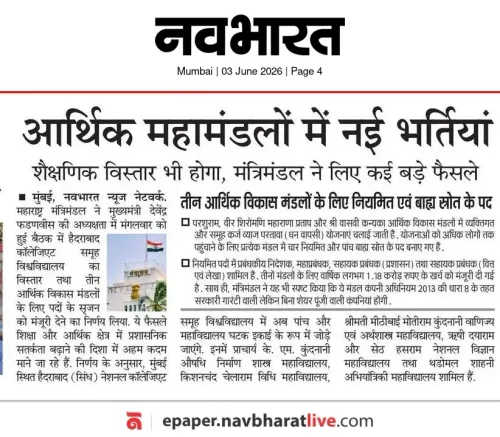
The Chief Minister's Office of Maharashtra said the state cabinet, led by Devendra Fadnavis, has cleared the creation of posts for the Parshuram and Maharana Pratap Economic Development Corporations, operationalising two community-linked bodies that channel welfare and enterprise support to targeted social groups.
Key Takeaways
Maharashtra cabinet has approved creation of posts for the Parshuram and Maharana Pratap Economic Development Corporations.
The decision was announced by the CMO on 3 June 2026 and attributed to the Fadnavis-led cabinet.
Post-creation operationalises the two corporations by giving them a formal staffing structure.
The bodies are part of Maharashtra's pattern of community-named economic development corporations.
Next steps include government resolutions on post grades, parent department and budget allocations.
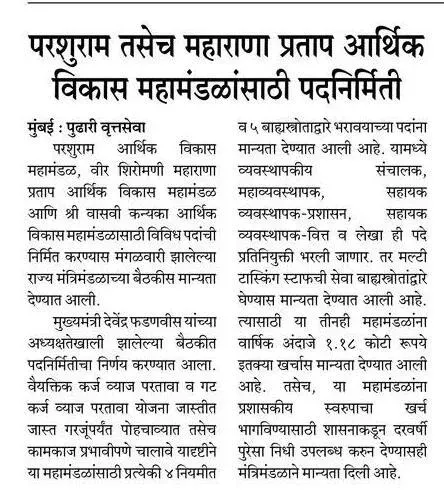
The Chief Minister's Office of Maharashtra announced on 3 June 2026 that the state cabinet has approved the creation of sanctioned posts (padnirmiti) for the Parshuram Economic Development Corporation and the Maharana Pratap Economic Development Corporation. The decision, attributed to the cabinet led by Chief Minister Devendra Fadnavis, operationalises two community-linked state corporations by giving them a formal staffing structure.
In its post on X, the CMO stated: 'Creation of posts for Parshuram as well as Maharana Pratap Economic Development Corporations', tagging Chief Minister Fadnavis and flagging the announcement with #CabinetDecision. The accompanying visual presented the decision as part of a broader set of cabinet approvals cleared in the meeting.
Context
State economic development corporations in Maharashtra typically function as autonomous bodies under the administrative ambit of departments such as social justice, OBC welfare or minorities. They run loan, subsidy and skill-linked schemes for the communities they are mandated to serve.
Without a sanctioned cadre of officers and staff, such corporations remain largely on paper. The cabinet's clearance of posts is therefore the step that converts an announced corporation into a working institution capable of disbursing funds and processing applications.
Policy backdrop
Maharashtra has, over successive governments, used named economic development corporations as a vehicle to channel welfare and enterprise support to specific social groups. The Fadnavis-led government during its 2014-2019 term created several such community-focused corporations, and the current administration has continued that administrative template.
The Parshuram corporation is named after the mythological figure venerated by sections of the Brahmin community, while the Maharana Pratap corporation invokes the 16th-century Rajput ruler associated with the Rajput community. Naming corporations after community icons has been a recurring feature of Maharashtra's targeted welfare architecture.
Stakeholders and impact
The most immediate beneficiaries of the post-creation order are the corporations themselves, which can now begin recruitment of managing directors, finance officers and field staff. Once staffed, they are expected to roll out schemes covering self-employment loans, education support and entrepreneurship assistance for their target groups.
For state administration, the move adds two more bodies to a growing list of community-specific corporations, with implications for budgetary outlays and inter-departmental coordination. Community organisations that had lobbied for institutional recognition are likely to view the staffing clearance as a concrete delivery on prior commitments.
What's next
Attention will turn to the official government resolutions detailing the number and grade of posts sanctioned for each corporation, the parent department under which they will function, and the initial budgetary allocation. Recruitment notifications and the appointment of board chairpersons typically follow such cabinet clearances.
Subsequent assembly sessions are likely to see questions on operational guidelines, scheme design and any convergence with existing state or central welfare programmes. The pace at which the two corporations move from sanctioned posts to active scheme disbursal will indicate how seriously the state intends to use them as delivery vehicles rather than symbolic institutions.
Point of View
The Fadnavis government signals it intends to make these institutions functional ahead of fuller political and electoral cycles. The choice of Parshuram and Maharana Pratap as namesakes also reflects calibrated outreach to community constituencies that have lobbied for dedicated institutional recognition. The real test will lie in budget allocations and scheme delivery, not in the announcement itself.
NationPress
17 Oct 2026
Frequently Asked Questions
What did the Maharashtra cabinet decide about the Parshuram and Maharana Pratap corporations?
The cabinet approved the creation of sanctioned posts for the Parshuram Economic Development Corporation and the Maharana Pratap Economic Development Corporation, as announced by the CMO on 3 June 2026.
What is the Parshuram Economic Development Corporation?
It is a Maharashtra state corporation set up to undertake targeted economic development activities, named after the mythological figure Parshuram.
What is the Maharana Pratap Economic Development Corporation?
It is a Maharashtra state corporation for economic development activities, named after the 16th-century Rajput ruler Maharana Pratap.
Why does creation of posts matter for these corporations?
Without sanctioned posts, such corporations cannot recruit staff or process schemes. The cabinet's approval gives them a formal staffing structure needed to begin operations.
Who is leading the Maharashtra government that took this decision?
The decision was taken by the Maharashtra cabinet led by Chief Minister Devendra Fadnavis.