Maharashtra cuts teacher-student ratio to 3:20 for remote secondary schools
Synopsis
Maharashtra has halved the student threshold for a three-teacher secondary school in rural areas — from 40 to just 20 — a quiet but consequential policy shift that could keep thousands of students, especially girls, from dropping out. The same session also surfaced unresolved contractual teacher disputes in Gadchiroli's tribal belt and a statewide sanitation deficit in schools, revealing how deep the state's rural education infrastructure gap runs.
Key Takeaways
Maharashtra now permits three teachers in remote secondary schools with a combined Classes 9-10 enrolment of 20 or more , down from the earlier threshold of 40 students .
The revised norm was formalised via an official letter dated 11 May 2026 , replacing the 15 March 2024 Government Resolution.
The Bombay High Court on 14 November 2025 upheld the earlier GR as compliant with the RTE Act, 2009 .
A high-level meeting is planned to resolve the service regularisation of contractual teachers in PESA regions of Gadchiroli .
The state has committed to completing school sanitation infrastructure — including separate girl-student toilets and sanitary vending machines — within four to six months .
Funding for infrastructure will draw on DPC funds , CSR contributions, and state social welfare allocations.
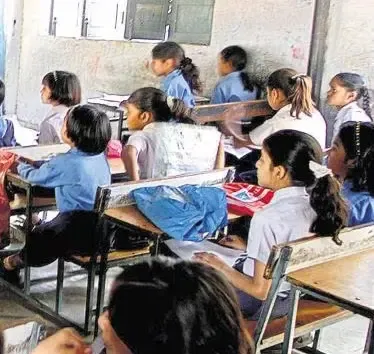
The Maharashtra government has relaxed teacher-staffing norms for secondary schools in rural and remote areas, permitting three teachers for a combined enrolment of 20 or more students in Classes 9 and 10 for the 2025-26 academic year. The move, announced on 25 June 2026, is aimed at preventing dropout rates from rising among students — particularly girls — in regions where educational alternatives are scarce.
What Changed and Why
Minister of State for School Education Pankaj Bhoyar disclosed the policy shift in the Legislative Council during Question Hour on Thursday. Under the previous Government Resolution (GR) dated 15 March 2024, three teachers were sanctioned only when combined student strength reached at least 40, and only for schools within a 3 to 5 km radius of a zero-post school.
Following representations from elected representatives and a ground-level assessment, the state revised its directives through an official communication dated 11 May 2026. The revised threshold of 20 students effectively halves the earlier requirement, making it significantly easier for remote schools to retain a functional teaching staff.
The Rural Education Gap
Bhoyar underscored the stark disparity between urban and rural educational access. Students in cities can choose from multiple schools within walking distance; rural students — especially girls — are often compelled to travel to neighbouring villages. The government, he said, deliberately framed independent criteria for rural areas to curb dropout rates.
This comes amid persistent concerns about female enrolment in Maharashtra's hilly and tribal belts, where distance and safety remain primary barriers to schooling. Notably, the Bombay High Court on 14 November 2025 dismissed a petition challenging the earlier directives, affirming that the 15 March 2024 GR is in compliance with the Right to Education (RTE) Act, 2009.
PESA Region Teachers and Contractual Staff
Bhoyar also addressed a Calling Attention motion moved by MLC Sudhakar Adbale, with participation from leader Bachchu Kadu, regarding contractual teachers in PESA (Provisions of the Panchayats Extension to Scheduled Areas) regions of Gadchiroli.
The minister confirmed that recruitment in PESA areas is conducted through the Teacher Eligibility Test (TET), the Teacher Aptitude and Intelligence Test (TAIT), and the centralised Pavitra Portal. While a reservation-related dispute remains pending before the Supreme Court, the state had proactively hired contractual teachers locally to prevent academic disruption for tribal students.
Teachers selected through TET and TAIT have already been regularised. The regularisation process for other eligible local teachers is being updated in line with the General Administration Department (GAD) resolution dated 11 February 2026. The minister promised to convene a high-level meeting in the concerned minister's chamber to find a comprehensive solution for the service integration of these contractual teachers.
Girl Students' Sanitation Infrastructure
Responding to a question from MLC Chitra Wagh, Bhoyar acknowledged critical sanitation deficits across state schools. Data from the central U-DISE portal — uploaded by school principals and teachers — points to widespread infrastructure gaps.
The government has pledged to conduct a fresh statewide baseline survey and complete all required civil construction within the next four to six months. The audit will prioritise separate, secure toilets for girls and boys, assured drinking water and electricity, sanitary pad vending machines for adolescent girls, and dedicated library rooms. Funding will be drawn from District Planning Committee (DPC) allocations, Corporate Social Responsibility (CSR) contributions, and other state social welfare budgets.
Bhoyar also committed to holding a special meeting with Teacher MLAs immediately after the current assembly session to address remaining staffing anomalies. All eyes will now be on the state's execution timelines across these interconnected commitments.
Point of View
But it also exposes how far Maharashtra's rural school system lags behind policy intent. The RTE Act mandates subject-specific teachers at the secondary level; permitting three generalists for 20 students is a workaround, not a solution. The unresolved contractual teacher crisis in Gadchiroli's PESA belt and the U-DISE data showing widespread sanitation deficits suggest the state is managing symptoms rather than fixing the structural underfunding of rural education. The convergence of DPC, CSR, and welfare funds for toilets sounds resourceful on paper, but multi-source funding has historically meant diluted accountability and delayed execution.
NationPress
24 Sept 2026
Frequently Asked Questions
What is Maharashtra's new teacher-staffing rule for remote secondary schools?
From the 2025-26 academic year, Maharashtra allows three teachers in rural and remote secondary schools if the combined enrolment for Classes 9 and 10 is 20 or more. This replaces the earlier requirement of at least 40 students, making it easier for small remote schools to retain adequate teaching staff.
Why did Maharashtra relax the teacher-student ratio for rural schools?
The state revised the norm after representations from elected representatives highlighted that rural students — particularly girls — often have no nearby alternative school and face long travel distances. The government introduced separate, lower criteria for rural areas specifically to reduce dropout rates.
What is the status of contractual teachers in Gadchiroli's PESA regions?
Contractual teachers in PESA areas of Gadchiroli were hired locally to prevent academic disruption while a reservation dispute remains pending before the Supreme Court. Teachers selected through TET and TAIT have been regularised; regularisation of other eligible local teachers is being processed under the GAD resolution dated 11 February 2026.
What action is Maharashtra taking on school sanitation for girl students?
The state has committed to a fresh statewide baseline survey and completion of all civil construction within four to six months. The audit targets separate secure toilets, drinking water, electricity, sanitary pad vending machines, and library rooms, funded through DPC, CSR, and state welfare budgets.
Has any court weighed in on Maharashtra's school staffing policy?
Yes. The Bombay High Court dismissed a petition challenging the government's earlier directives on 14 November 2025, affirming that the 15 March 2024 Government Resolution is in compliance with the Right to Education Act, 2009.